The Netherlands may not always be the first country that springs to mind in the context of European swordmaking, but its history is far from peripheral. From the Frisians resisting Roman expansion to the naval clashes of the Golden Age and into the colonial campaigns of the Dutch East Indies, the sword was ever-present in Dutch martial culture. What sets Dutch swords apart is their adaptation, blending local craftsmanship with foreign influence, from the Rhine basin to the Indonesian archipelago. This article traces the evolution of Dutch sword types across key historical eras, offering insight into their form, function, and technological progress.
Early Medieval Period (500–1000 AD)
The early medieval period in the Low Countries was shaped by the waning power of the Roman Empire and the rise of Frankish and Frisian tribes. Swords from this time were typically broad-bladed, pattern-welded, and wielded by elite warriors. These weapons bore strong resemblance to other Germanic swords but often featured regional variations in hilt design and blade fuller length.
Swords
- Frisian Spatha
- Early Frankish Sword
- Merovingian Broad-blade
- Frankish Petersen Type D
- Migration-Era Seax
- Early Pattern-Welded Spatha
- Carolingian Longsword
- Frisian Langseax
- Saxon Heavy Seax
- North Sea Trade Sword (Rhine variant)
High Medieval Period (1000–1300 AD)
This era saw increasing feudalism and the rise of towns in the Low Countries. Swords became more refined, with sharper points for thrusting and crossguards lengthening in response to improved armour. Dutch swords began to reflect the pan-European styles associated with crusading knights and growing urban militias.
Swords
- Knightly Arming Sword
- Oakeshott Type X (Dutch variant)
- Type XI Sword (Maas River find)
- Type XII Crusader Sword
- Double Fuller Sword
- Sword of St. Servatius (replica)
- Urban Guild Sword
- Flemish Short Sword
- Chivalric Tournament Sword
- High Medieval Bastard Sword
Late Medieval Period (1300–1500 AD)
With the growing power of cities like Utrecht and Bruges, swordmaking became more standardised and commercialised. Blades became longer and thinner, designed for thrusting through mail and transitional plate. This was also the age of the fencing guilds, and training swords became common.
Swords
- Oakeshott Type XV
- Bruges Bastard Sword
- Utrecht Longsword
- Dutch Hand-and-a-Half Sword
- Type XVIa Thrusting Sword
- Langes Messer (Low Countries variant)
- Dutch Guild Training Sword
- Flemish Flamberge
- Merchant’s Travel Sword
- Fechtbuch Practice Sword (blunt)
Renaissance and Dutch Revolt (1500–1648)
This period coincided with the Dutch fight for independence from Spain. Swords reflected the needs of mercenaries and officers in a conflict that was as much urban as it was rural. Rapier culture also took hold in the cities. The influx of Italian and Spanish styles influenced the Dutch swordsmithing craft profoundly.
Swords
- Dutch Side Sword
- Officer’s Rapier
- Rapiers with Shell Guards
- Stiletto Dagger
- War Rapier (thicker blade)
- Landsknecht Katzbalger
- Naval Cut-and-Thrust Sword
- Rondel Dagger (Dutch grip)
- Civilian Dress Sword
- Pappenheimer Rapier (Dutch variant)
Dutch Golden Age and Early Colonial Period (1648–1700)
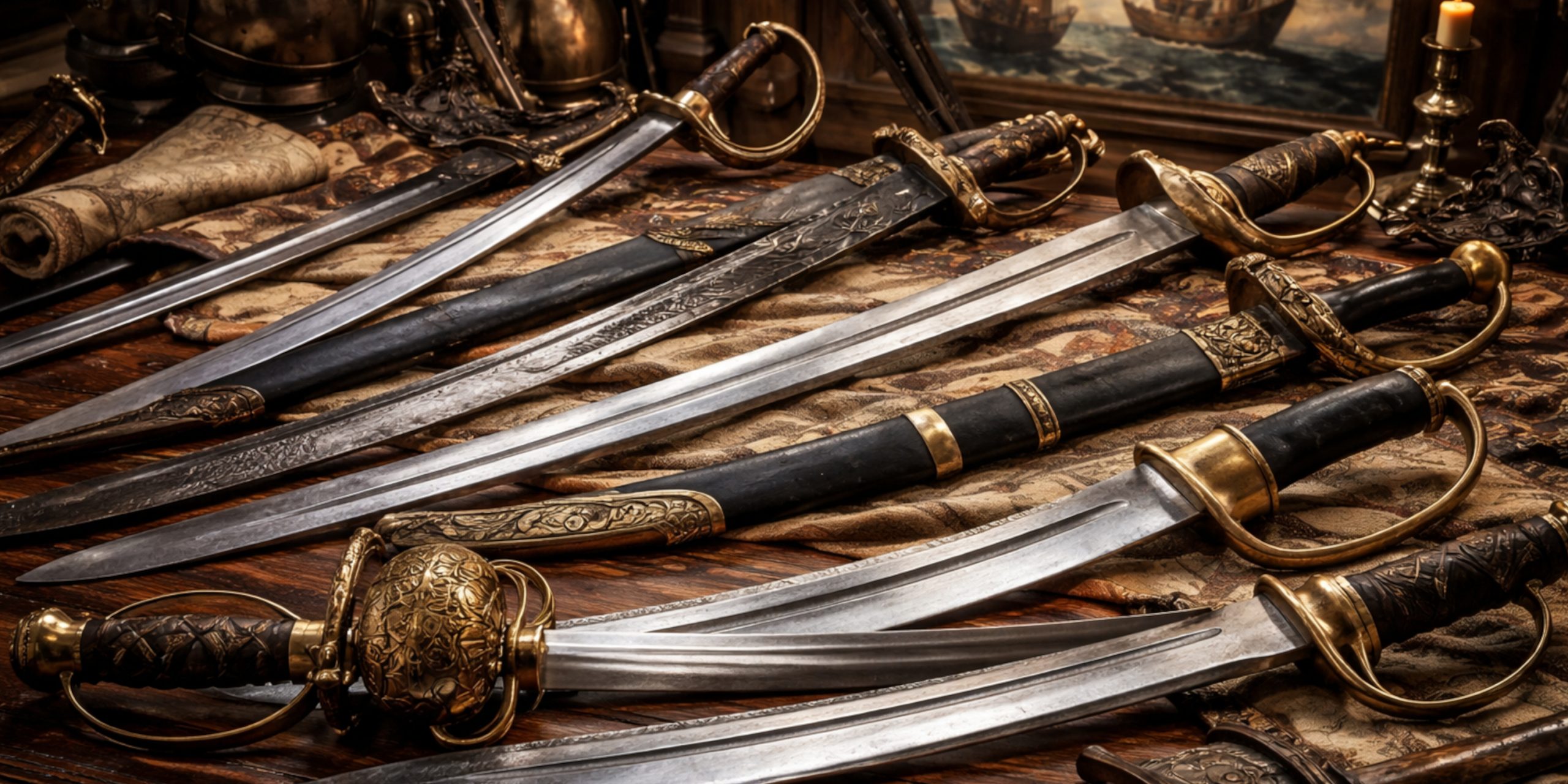
The Dutch Republic emerged as a global maritime power. Naval swords became a dominant type, and colonial campaigns shaped a hybrid weapon culture. Swords were no longer just weapons of war but also of status and ceremony.
Swords
- Dutch Naval Cutlass
- VOC Officer’s Sword
- Tulip-Hilt Rapier
- Dirk with Dutch Motifs
- Merchant Captain’s Sword
- Dutch Flamberge Dress Sword
- Early Colonial Infantry Sabre
- Amsterdam Guild Sword
- Curved Slashing Sword (Indies type)
- VOC Boarding Sword
18th Century (1700–1795)
Dutch sword design followed broader European trends, influenced by French, British and Prussian styles. The Dutch military began to standardise its weapons. Officers’ swords retained elaborate decorations, but functional sabres became the norm in cavalry units.
Swords
- Dutch Small Sword
- Infantry Officer’s Sabre
- Curved Cavalry Sabre
- Dutch Hilted Spadroon
- Court Sword (Civiel degen)
- Colonial Officer Sword
- Hounietre’s Sabre
- Dutch Marine Officer Sword
- Cut-and-Thrust Infantry Sword
- Drill Sabre (academy use)
Napoleonic and Batavian Era (1795–1815)
As the Netherlands fell under French control, Napoleonic reforms transformed military equipment. French styles dominated, with standardised sabres issued to both Dutch and Franco-Dutch troops. Light cavalry and artillery swords followed patterns seen across the Empire.
Swords
- Light Cavalry Sabre (AN XI model)
- Dutch Dragoon Sabre
- Foot Artillery Sword
- Grenadier Briquet
- Officer’s Sabre with Empire Hilt
- Light Infantry Short Sword
- Naval Boarding Cutlass
- Dutch-German Degen
- Ceremonial Republican Sword
- Staff Officer Sabre
19th Century to Industrial Age (1815–1900)
Post-Waterloo, the newly established Kingdom of the Netherlands standardised military arms again. Technological advances led to machine-produced blades, and the influence of German models was marked. Colonial campaigns in Indonesia also brought new types of field swords into service.
Swords
- M1815 Dutch Infantry Sabre
- KNIL Colonial Infantry Sword
- Marechaussee Sabre
- Navy Model 1831 Cutlass
- Dutch Cavalry Officer Sabre
- Engineer’s Short Sword
- M1870 Artillery Sabre
- Sword Bayonet Hybrid
- Model 1895 Colonial Sword
- Guard de Corps Parade Sword
20th Century to Modern Period (1900–Present)
By the 20th century, the sword was largely obsolete as a combat weapon but remained a potent ceremonial and symbolic object. The Dutch maintained a tradition of military sabres, dress swords, and cadet weapons, especially in naval and royal contexts.
Swords
- Dutch Naval Dress Sword
- Air Force Officer’s Sword
- Royal Guard’s Sabre
- Cavalry Training Sabre
- Dutch Officer’s Parade Sword
- WWI Era KNIL Sword
- WWII Resistance Dagger
- Commando Presentation Knife
- Netherlands Military Academy Sword
- Peacekeeping Mission Sword (symbolic)
Traditional and Regional Blades
Alongside mainstream military designs, Dutch culture has produced a range of regional and traditional blades used in ceremonies, fraternal orders, and cultural institutions. Many of these are now kept in museums or private collections.
Swords
- Fraternal Guild Sword (Leeuwarden)
- Frisian Ceremonial Sword
- Delft University Sabre (Corps)
- Carnival Sword (Maastricht style)
- Folkloric Executioner’s Sword
- Dutch East Indies Ceremonial Kris
- Masonic Sword (Dutch lodge)
- Academic Degen
- Sword of St. Willibrord (replica)
- Orange-Nassau Order Sword
Dutch swords may not form a single recognisable tradition like Japanese or Spanish blades, but they are remarkable for their adaptability and multicultural influences. From Frisian seaxes to VOC sabres and ceremonial rapiers, the evolution of Dutch swords reflects the country’s changing identity, ambitions, and practical needs across centuries.