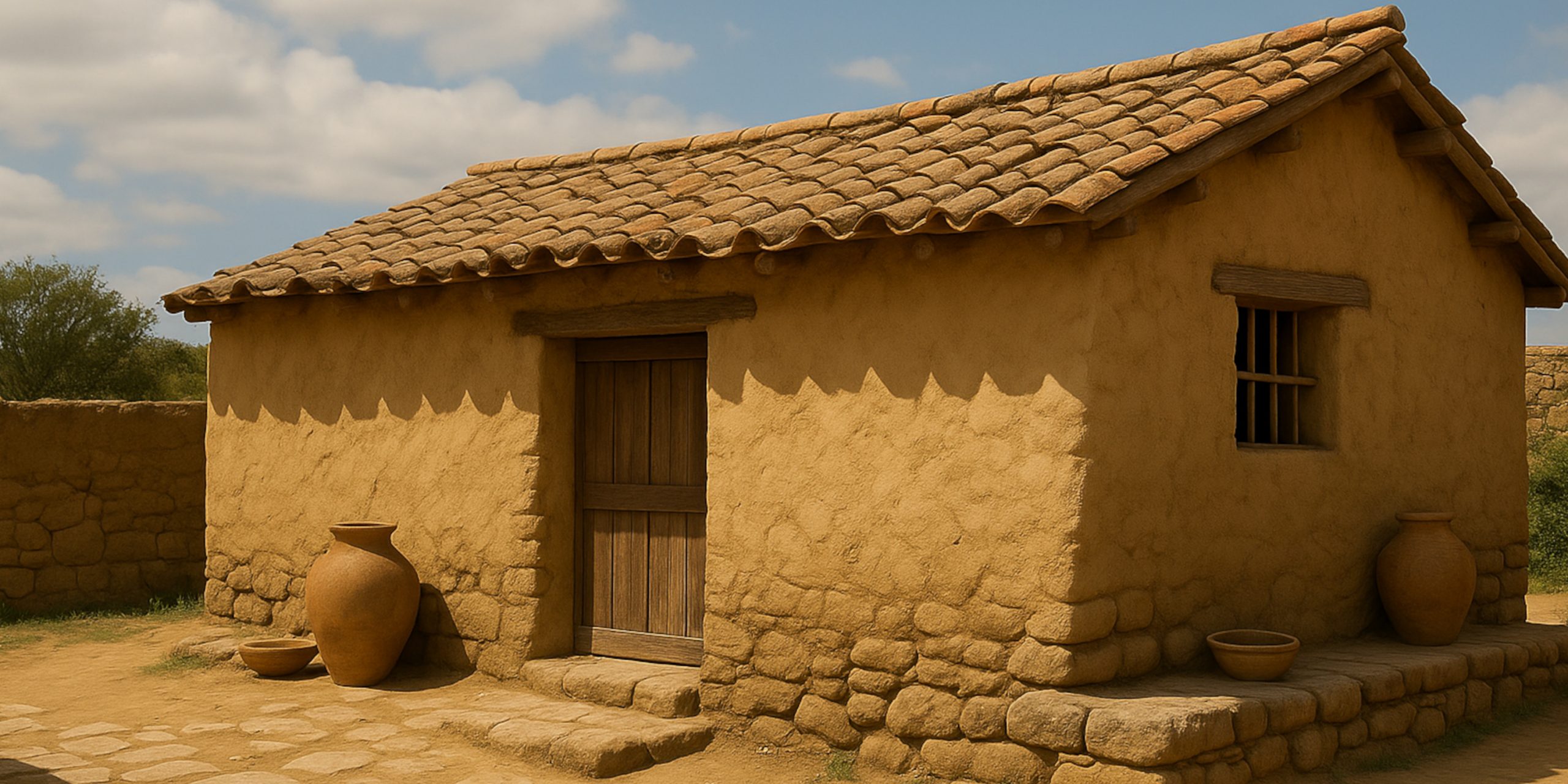
There’s something strangely comforting about knowing that the great thinkers of Greece, the same people who gave us democracy, drama, and the beginnings of science, lived in homes made mostly of mud and straw. Forget marble palaces filled with philosophers lounging on chaise longues. The reality of ancient Greek domestic life was far humbler, even earthy.
When we peel back the centuries and step inside those ancient walls, we find structures that reflected both the limitations of local materials and the brilliance of Greek design. These homes were practical, private, and, in many cases, surprisingly advanced for their time.
Historical Context
Greek domestic architecture evolved from the early Bronze Age through to the Hellenistic period, a span of over a thousand years. During this time, building materials and layouts changed as cities grew, trade expanded, and wealth began to concentrate among urban elites.
- Early Bronze Age (c. 3000–1100 BCE): Simple rectangular huts made from wattle and daub, with thatched roofs.
- Archaic Period (c. 800–500 BCE): The rise of stone foundations and tiled roofs in wealthier regions.
- Classical Period (c. 500–323 BCE): Houses became more complex, often centred around an open-air courtyard.
- Hellenistic Period (c. 323–31 BCE): Urban planning introduced grid systems, and houses in places like Delos showed a taste for mosaics, columns, and luxury.
Despite this progression, most Greek homes remained modest. As Xenophon wryly observed, “The good house is not the one that glitters, but the one that serves.”
Materials and Construction
Ancient Greek houses were, quite literally, made from the ground beneath their feet.
- Walls: Typically constructed of sun-dried mudbrick on a stone base. Mudbrick was cheap, plentiful, and easy to replace, but hardly immortal. Archaeologists often find only the stone foundations of these homes, the upper walls long since eroded.
- Roofs: Supported by timber beams and covered in either thatch or terracotta tiles, depending on the period and location. The Greeks mastered the pitched roof early, allowing rain to run off in heavy Mediterranean downpours.
- Floors: Packed earth was the norm, though finer houses used pebble mosaics or stone slabs.
- Doors and Windows: Wooden frames and shutters, small by modern standards, helped control light and heat. Windows were rarely glazed, because glass was both expensive and unreliable.
It was architecture born of necessity, not grandeur, but in that simplicity lay elegance.
Layout and Design
Greek houses revolved around privacy and practicality. The typical layout featured:
- A central courtyard (aulē): The heart of the home, open to the sky and often containing a small altar or well.
- Andron: The men’s quarters, where guests were entertained during symposiums.
- Gynaikonitis: The women’s area, typically located deeper within the house, where weaving and family life took place.
- Storage Rooms: For food, oil, and wine, reflecting the agrarian rhythm of daily life.
Homes were usually oriented inward, turning blank walls to the street and life to the courtyard. The ancient Greek house was not a display of wealth to the public, but a retreat from it.
As the philosopher Socrates supposedly remarked, “The walls do not make a home, but the people within them.” A nice thought, though it helps if those walls aren’t collapsing in the rain.
Archaeological Evidence
Sites like Olynthus, Delos, and Athens’ Agora have revealed much of what we know about Greek domestic life. The house plans unearthed there show standardised proportions and clever use of space.
- Olynthus (4th century BCE): Grid-like urban planning, with multi-roomed houses and tiled roofs.
- Delos (2nd century BCE): Wealthier homes with intricate mosaics and small columned peristyles.
- Athens: Simpler mudbrick dwellings, often sharing walls with neighbours in dense urban blocks.
Artifacts found within these homes, ceramic cooking pots, loom weights, oil lamps, paint a vivid picture of daily existence. The Greek house was both a workshop and a sanctuary, a place of labour and rest.
Life Inside the Walls
Life in an ancient Greek home was defined by function more than decoration.
- Cooking: Done in small hearths, sometimes portable, usually in the courtyard for ventilation.
- Heating: Charcoal braziers, though they filled rooms with smoke.
- Furniture: Sparse but practical, wooden stools, low tables, storage chests, and couches for reclining.
- Decoration: Minimal. Frescoes and mosaics appeared only in the houses of the wealthy.
It’s a far cry from the ornate villas of Rome that came later, but the Greeks were not obsessed with luxury in the domestic sense. Their attention was fixed on the agora, the temple, and the theatre, not the sitting room.
Regional Variations
Materials and designs varied by geography:
- Mainland Greece: Mudbrick and stone dominated due to limited timber.
- Aegean Islands: More stone, particularly limestone and volcanic rock, with whitewashed exteriors.
- Crete: Influenced by earlier Minoan traditions, sometimes including light wells and upper floors.
These regional quirks reflected local resources, climate, and cultural traditions. Yet the underlying philosophy of modesty and inward focus remained consistent.
Legacy
The Greek domestic model left its fingerprints on Mediterranean architecture for centuries. The Roman domus borrowed heavily from Greek courtyard layouts, while modern Greek village houses retain the same stone bases and whitewashed walls that have endured for millennia.
In the end, the genius of Greek architecture wasn’t just in the Parthenon or the temples of Paestum, but in these quiet, functional homes that sheltered the minds who shaped Western thought.
Closing Thoughts
As a historian, I’ve always admired the contradiction of ancient Greece: a civilisation that built marble temples to gods, yet lived in houses of mudbrick. It’s humbling, really. The Greeks put their beauty where everyone could see it, in their art, their philosophy, their public life, and left the private sphere to simplicity.
Their homes remind us that permanence isn’t always the measure of greatness. Sometimes, what lasts longest is the idea, not the architecture.