Ubba Ragnarsson, sometimes rendered as Ubbe, belongs to that small group of Viking leaders whose names survive because English writers thought them worth remembering. He appears at moments of shock and crisis, attached to conquest, martyrdom, and sudden defeat. Beyond that, the record thins quickly. This is not unusual for the ninth century. What survives is enough to sketch a formidable war leader, operating at scale, whose reputation endured because his actions intersected with events the English never forgot.
As a historian, I find Ubba compelling precisely because he resists tidy biography. He is not a saga hero with a neat arc, nor a shadowy footnote. He is something more realistic, a senior commander whose career can be traced in flashes, and whose death was memorable enough to be written down.
The Sources and Their Limits
Most of what we know about Ubba comes from English sources written by people who had every reason to dislike him. He appears in the Anglo-Saxon Chronicle, in Asser’s Life of King Alfred, and in later religious traditions connected to the death of King Edmund of East Anglia. These sources do not aim to preserve Viking reputations. They aim to explain catastrophe, celebrate resistance, and, in Edmund’s case, create a martyr.
That matters. Ubba is usually named when a villain is required, or when a victory needs a face. Silence elsewhere does not mean inactivity. It means the chroniclers had moved on.
Later Scandinavian tradition folds Ubba into the famous “sons of Ragnar” grouping. This association is attractive but historically fragile. It tells us more about later storytelling than about ninth century reality. For a sober reconstruction, Ubba is best treated as a high status Viking commander whose name endured because it became attached to specific, dramatic events.
Origins and Identity
Some later traditions describe Ubba as a leader of Frisians, or as having strong connections across the southern North Sea world. This is entirely plausible. The Viking Great Army was not a single ethnic bloc. It was a coalition, drawing manpower, ships, and resources from across Scandinavia and its trading networks.
What this suggests is mobility rather than lineage. Ubba’s authority likely rested on reputation, followers, and success, not on dynastic paperwork. In the ninth century, command was earned and could be lost abruptly, sometimes before breakfast.
Ubba and the Viking Great Army
Ubba is firmly associated with the Viking Great Army that campaigned across England from the 860s onwards. This force was different from earlier raiding groups. It overwintered, seized horses, negotiated truces, collected tribute, and occupied territory. It behaved less like a raid and more like a roaming military enterprise.
Ubba appears in connection with the Great Army’s operations in East Anglia and later in the south west. He was not the sole leader, but one of several prominent commanders whose names surface as the army fractured into operating groups. That fragmentation was a strength as much as a weakness. It allowed the Vikings to strike in multiple regions while stretching local defences thin.
Battles and Military Career
East Anglia and the death of King Edmund
Ubba’s name is closely tied to the conquest of East Anglia and the killing of King Edmund in 869. Later religious tradition presents Edmund as a saintly martyr and Ubba, alongside Ivar, as a principal villain. While the details are shaped by hagiography, the core event is solid. East Anglia fell, its king was killed, and the Vikings consolidated control.
For Ubba, this episode signals seniority. Only leaders of consequence were remembered by name in such narratives.
The campaign in the south west and Cynwit
Ubba’s most famous appearance comes in 878 during a Viking expedition into Devon. According to the sources, a Viking force besieged a West Saxon stronghold at a place called Cynwit. The defenders, led by Odda, launched a sudden breakout rather than waiting to starve.
The result was catastrophic for the Vikings. Ubba was killed, and the Raven banner was captured. In early medieval warfare, losing a battle was bad. Losing a revered standard was worse. It suggested divine favour had shifted, a point the English writers were very keen to underline.
Ubba’s death here feels abrupt, and that is probably accurate. Viking commanders died violently and often without warning. Reputation did not buy immunity.
Arms and Armour
No weapon can be securely identified as belonging to Ubba himself, but archaeology from Viking Great Army contexts allows us to reconstruct the military world he inhabited.
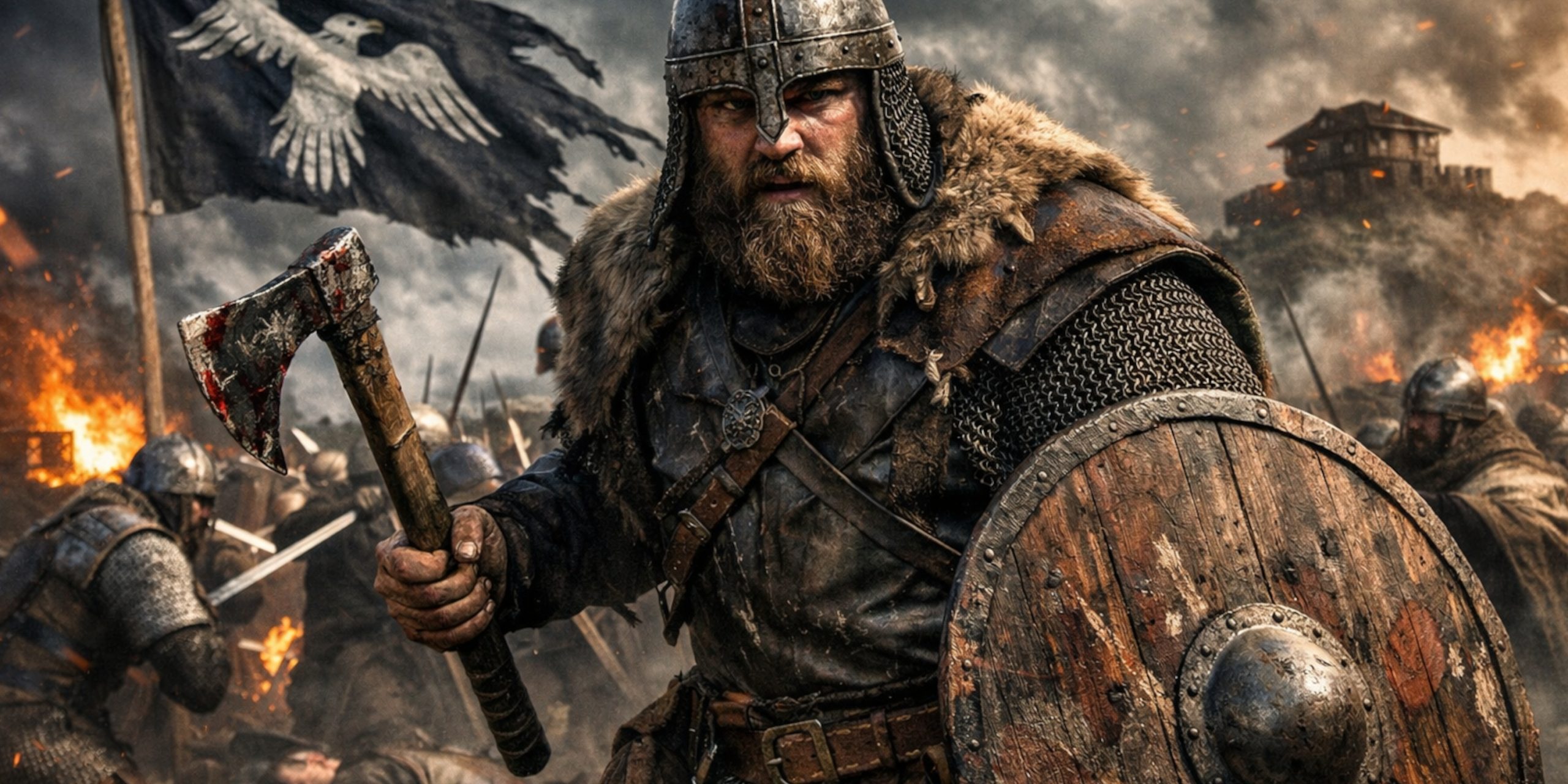
The spear was the backbone of Viking fighting, cheap, versatile, and effective in close formation. Axes were common, ranging from utilitarian hand axes to larger fighting axes. Swords were prestige weapons, not universal, but present among higher status warriors and leaders. Seaxes and long knives filled the gap between tool and weapon.
Defensive equipment centred on the round shield with an iron boss. Helmets and mail existed but were rare and likely confined to elites. The image of half naked berserkers owes more to modern drama than to evidence. Surviving armour fragments and high status finds make it clear that protection mattered.
The Raven banner deserves mention here. Standards were command tools and morale symbols. Capturing one was a tangible military and psychological victory.
Military Acumen
Ubba’s career points to a commander comfortable with complex operations. He was part of an army that could sustain itself, build camps, manage logistics, and negotiate from a position of strength. That required organisation as much as ferocity.
He also understood intimidation. The killing of kings and the naming of leaders in English accounts served a purpose on both sides. Fear travelled faster than ships.
Yet Cynwit shows the limits of Viking power. A besieging force can become complacent. A determined enemy can exploit that. Ubba’s death does not suggest incompetence so much as the constant risk of ninth century warfare. Even experienced commanders misjudge situations, and the consequences are final.
Death and Reputation
Ubba’s reported death in 878 closes his story neatly, which is always suspicious but not impossible. The capture of the Raven banner ensured his name endured. English writers had every incentive to preserve this victory, and they did.
After his death, Ubba’s reputation expanded rather than faded. Later traditions folded him into legendary genealogies, smoothing away the awkward fact that he lost. That is how memory works. History keeps the event. Legend keeps the name.
Where to See Artefacts From Ubba’s World
There are no personal objects that can be securely tied to Ubba himself. What can be seen is the material culture of the Viking Great Army and the landscapes it occupied.
Major museums in York and London hold hoards, weapons, jewellery, and everyday objects from Viking Age England. These finds come from contexts directly associated with Great Army activity and illustrate the wealth, connectivity, and logistical depth of the forces Ubba commanded.
Regional museums in the Midlands and eastern England display material from winter camps and occupied settlements. These collections are invaluable for understanding how Viking armies lived when they were not fighting.
Archaeology and New Perspectives
Recent archaeological work has transformed our understanding of the Viking Great Army. Sites such as Repton, Torksey, and Aldwark show that these were not fleeting encampments but complex, lived-in communities. Radiocarbon dating and isotope analysis have clarified chronologies and corrected earlier assumptions.
This research matters for figures like Ubba. It grounds them in a real, functioning military society rather than in the exaggerated violence of later storytelling. Ubba was not a lone marauder. He was part of an organised force capable of reshaping kingdoms.
A Historian’s Closing Thoughts
Ubba Ragnarsson is remembered because his life intersected with moments the English could not forget: the fall of a kingdom, the killing of a king, and a rare, morale-boosting victory snatched from the Vikings at Cynwit.
He was not invincible, and he did not always win. That, oddly enough, makes him more credible. Ubba stands as a reminder that Viking power was formidable but fragile, dependent on momentum, leadership, and luck.
History preserves him in fragments. Archaeology fills in the texture. Between the two, Ubba emerges not as legend, but as something far more interesting: a capable, dangerous, and ultimately mortal commander in a brutal age.
Watch the documentary: