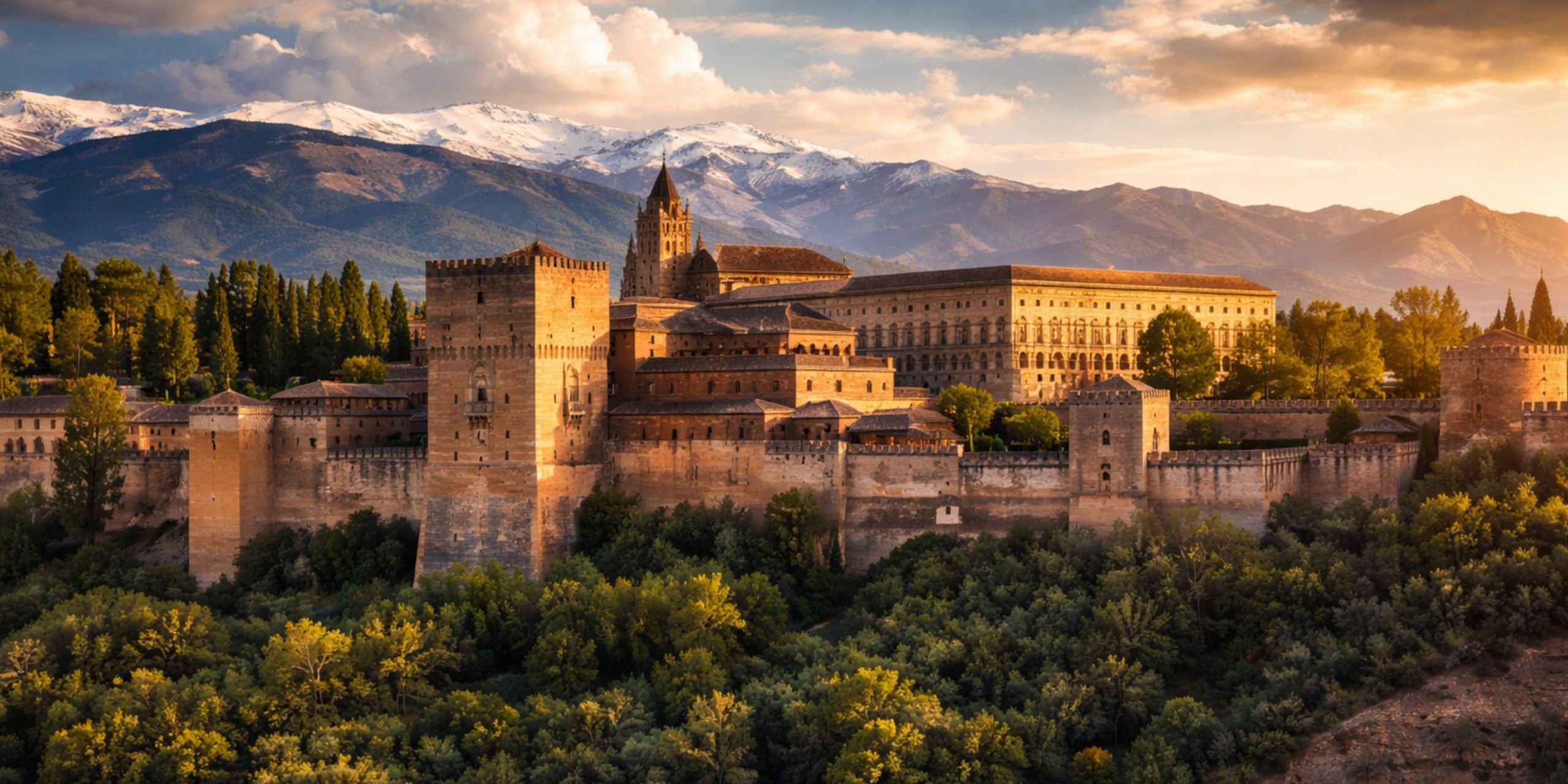
Perched above the Spanish city of Granada sits one of the most extraordinary palace complexes in Europe. The Alhambra is many things at once. It is a fortress, a royal residence, a masterpiece of Islamic architecture, and a quiet witness to the long struggle between Christian and Muslim powers in medieval Iberia.
The name comes from the Arabic al-Qal‘a al-Hamra, meaning “the Red Fortress”, a reference to the reddish hue of the clay walls that glow warmly in the Andalusian sun. To walk through the Alhambra today is to wander through centuries of ambition, politics, poetry, and occasionally betrayal.
Historians often describe it as the final great monument of Islamic Spain. That is broadly true, although the building did not end its life in 1492. The Catholic monarchs moved in, Renaissance palaces were added, soldiers were stationed there, and travellers from across Europe arrived to marvel at its elegance.
Even after seven centuries, the Alhambra retains the rare ability to make visitors stop mid-sentence and simply stare.
Origins and Early Development
The hill on which the Alhambra stands had been occupied since Roman times, yet the fortress itself truly began to take shape in the mid thirteenth century.
Its builder was Muhammad I Ibn al-Ahmar, founder of the Nasrid dynasty and ruler of the Emirate of Granada. After the collapse of earlier Muslim states in Iberia, Granada remained the last major Islamic stronghold. Ibn al-Ahmar understood the political situation perfectly. The kingdom needed a fortress that was defensible, impressive, and capable of housing a royal court.
Construction began around 1238.
What emerged over the following century was not simply a castle. It was an entire royal city enclosed within defensive walls. Palaces, gardens, mosques, baths, and administrative buildings were arranged along the ridge above Granada. Water from the nearby Sierra Nevada mountains was diverted into sophisticated channels that fed fountains and pools throughout the complex.
Later Nasrid rulers expanded the site considerably. The most celebrated additions were made by Yusuf I and Muhammad V during the fourteenth century. Many of the most famous spaces date from this period.
These include:
- The Court of the Lions
- The Hall of the Ambassadors
- The Palace of Comares
- Intricately decorated audience chambers and courtyards
The design reflected a particular philosophy of architecture. The exterior walls remain austere and fortress-like. Inside, however, rooms blossom into delicate geometric patterns, carved stucco, calligraphy, and tranquil reflecting pools.
It is a contrast that seems entirely deliberate. Power on the outside. Poetry within.
Architecture and Design
The Alhambra represents the finest surviving example of Nasrid architecture. Rather than overwhelming scale, its power lies in proportion, geometry, and ornament.
Several architectural features define the complex.
Calligraphy
Verses from the Qur’an and court poetry appear throughout the walls. The Nasrid motto is repeated again and again:
“There is no victor but God.”
Muqarnas Decoration
Honeycomb shaped vaulting appears in ceilings and domes, creating intricate patterns that catch and diffuse light.
Water and Reflection
Pools, fountains, and channels run throughout the palaces. Water cools the air and creates mirror like reflections that visually expand the space.
Gardens
The nearby Generalife palace served as a royal retreat. Terraced gardens, orchards, and shaded walkways provided relief from the heat of Granada.
The overall effect is calm rather than intimidating. Medieval Islamic architecture often aimed to evoke paradise through light, symmetry, and flowing water.
Sieges and Military History
Although the Alhambra is celebrated for its beauty, it was also a formidable fortress.
The surrounding walls stretch roughly two kilometres and are reinforced with towers positioned along the ridge. The Alcazaba, the military citadel at the western end of the complex, served as the primary defensive stronghold.
Several significant military moments shaped its history.
Early Nasrid Conflicts
During the fourteenth century Granada was repeatedly threatened by neighbouring Christian kingdoms. The Alhambra functioned as the political and defensive centre of the Nasrid state.
Internal revolts were just as dangerous as outside enemies. Rival factions within Granada occasionally seized parts of the fortress during palace intrigues.
The Castilian Pressure
From the late fourteenth century onward, the Kingdom of Castile increased pressure on Granada. Border raids, sieges of nearby towns, and political manoeuvring gradually weakened the Nasrid position.
The Alhambra itself remained secure during most of this period.
The Fall of Granada, 1492
The final crisis came during the Granada War between the Catholic Monarchs Ferdinand II of Aragon and Isabella I of Castile and the Nasrid ruler Muhammad XII, known to the Spanish as Boabdil.
Granada was surrounded and blockaded.
In January 1492, Boabdil surrendered the city. The Alhambra passed peacefully into Christian hands. The surrender agreement allowed the Muslim population to retain religious rights, though these guarantees would later erode.
A chronicler described the moment when the Christian banners replaced the Nasrid standard:
“The cross and the royal banners were raised upon the towers of the Alhambra while the city looked on in silence.”
Occupants Timeline
The Alhambra’s history can be understood through the rulers and communities who occupied it.
Roman Period
Early fortifications likely existed on the hill.
9th Century
A small fortress known as Hisn al-Hamra appears in historical records.
1238 – Nasrid Dynasty
Muhammad I establishes the Alhambra as the royal seat of the Emirate of Granada.
13th to 15th Century
Successive Nasrid rulers expand the palaces and defensive works.
1492 – Catholic Monarchs
Ferdinand and Isabella take possession after the surrender of Granada.
16th Century – Habsburg Spain
Emperor Charles V builds a Renaissance palace within the complex. It is architecturally striking though somewhat controversial among purists.
18th Century
The complex declines in importance and falls partly into neglect.
19th Century Romantic Era
European writers and artists rediscover the Alhambra. Restoration efforts begin.
20th Century to Present
Major conservation programmes stabilise and preserve the site as one of Spain’s most important monuments.
Archaeology and Restoration
The Alhambra has been the subject of extensive archaeological study since the nineteenth century.
Early excavations revealed the layout of residential districts, workshops, and service areas that supported the royal court. Many parts of the medieval complex extended beyond the palaces that visitors see today.
Key discoveries include:
- Foundations of earlier defensive structures beneath Nasrid walls
- Water engineering systems feeding fountains and baths
- Ceramic workshops and domestic housing areas within the fortified city
- Decorative fragments that reveal the original colour schemes of palace interiors
Many visitors are surprised to learn that the Alhambra was once vividly coloured. Stucco carvings that appear pale today were originally painted in blues, reds, and gold.
Modern conservation has focused on stabilising delicate plasterwork, controlling visitor numbers, and preserving the intricate wooden ceilings.
The balance between tourism and preservation remains an ongoing challenge. The Alhambra receives millions of visitors each year, which would have astonished its medieval builders.
Contemporary Impressions
The Alhambra fascinated travellers long before modern tourism existed.
One of the most famous observers was the American writer Washington Irving, who lived in the palace during the 1820s. His book Tales of the Alhambra helped bring international attention to the site.
Irving wrote:
“There is a spell about the Alhambra that holds the traveller in delighted bondage.”
Earlier Spanish chroniclers were equally captivated. A fifteenth century poet described the palace as:
“A pearl set in emeralds.”
Even today the complex retains that quality. The city of Granada spreads below while the Sierra Nevada mountains rise behind it, framing the palace in a setting that almost feels theatrical.
Legacy
The Alhambra stands as the most complete surviving palace of medieval Islamic Europe.
It represents the final flowering of the Nasrid dynasty, the cultural richness of Al-Andalus, and the complicated history of Spain itself. Muslim architects built it. Christian monarchs reshaped it. Romantic travellers preserved its reputation.
Few places carry so many layers of history in one location.
For historians, the Alhambra offers something rare. It allows us to step into a medieval court and still sense the rhythms of daily life. Diplomats once debated policy in the Hall of the Ambassadors. Courtiers wandered through shaded gardens. Guards watched the horizon from the towers of the Alcazaba.
And centuries later, visitors still do exactly the same thing, minus the armour and palace intrigue.
The fortress may have lost its political power long ago, yet its cultural influence has only grown stronger.