The name “Sword of Saint Maurice” causes more confusion than almost any famous medieval weapon. That is because it refers to two different swords, each famous for very different reasons.
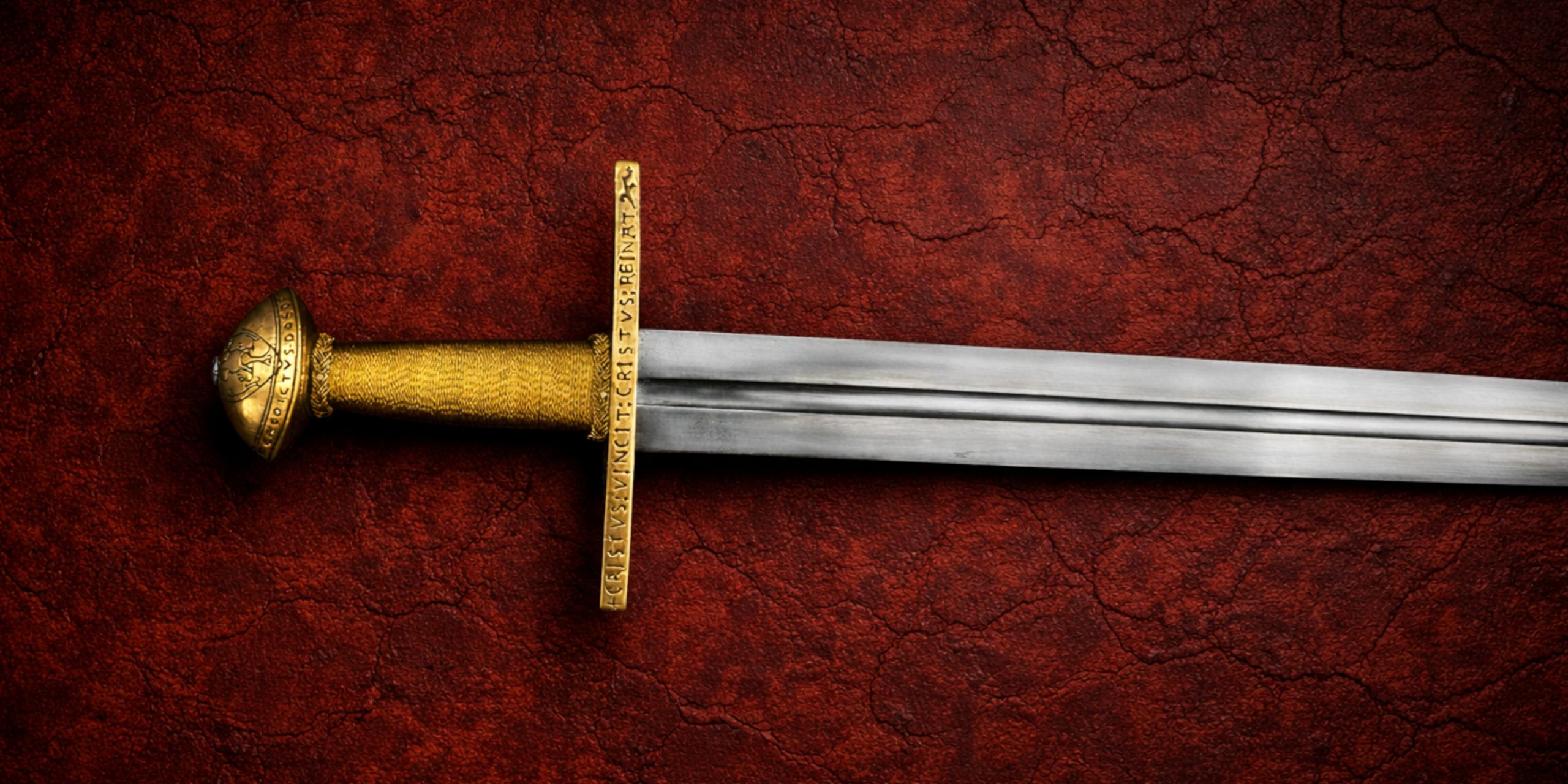
One is the Imperial Sword of the Holy Roman Empire, preserved in Vienna. This sword functioned as a coronation and authority object, heavy with religious and political meaning.
The other is the Sword of Saint Maurice preserved in Turin. This is a genuine medieval fighting sword that survived in exceptional condition because it was venerated as a relic and later adopted as a dynastic symbol by the House of Savoy.
Any serious discussion has to treat both, otherwise the story is incomplete.
Specifications
Identification overview
| Feature | Vienna Imperial Sword | Turin Sword of Saint Maurice |
|---|---|---|
| Function | Imperial regalia and coronation sword | Relic sword preserved as a saintly and dynastic object |
| Date | Sword late 12th to early 13th century, scabbard late 11th century | Sword early 13th century, scabbard traditionally dated to the 15th century |
| Character | Symbolic and ceremonial | Practical medieval weapon |
| Current location | Imperial Treasury, Vienna | Royal Armoury, Turin |
Imperial Sword of the Holy Roman Empire, Vienna
| Specification | Detail |
|---|---|
| Overall length | Approx. 110 cm |
| Weight | Sword approx. 1.3 kg, scabbard approx. 1 kg |
| Blade | Straight, double edged, broad profile |
| Hilt | Gilded fittings, silver wire grip |
| Scabbard | Decorated with gold sheet and symbolic imagery |
| Inscriptions | Latin religious and imperial phrases invoking Christ’s authority |
| Purpose | Coronations and imperial ceremonies |
This sword was never meant to be anonymous. Every element pushes the message that imperial authority was sanctioned by God.
Sword of Saint Maurice, Turin
| Specification | Detail |
|---|---|
| Date | Early 13th century |
| Blade | Straight, double edged, functional fighting profile |
| Materials | Steel blade, organic materials in grip and scabbard |
| Preservation | Exceptional due to relic status |
| Scabbard | Later medieval scabbard traditionally dated to the 15th century |
| Character | Knightly sword treated as a sacred object |
Unlike the Vienna sword, this is a weapon that would not look out of place on a battlefield. Its survival owes more to belief than metallurgy.
History and evolution
Saint Maurice was an ideal figure for medieval rulers. A soldier saint allowed power, faith, and violence to sit comfortably in the same narrative.
The Vienna sword became associated with Saint Maurice through symbolism rather than origin. The object itself is medieval, assembled and refined over time to serve imperial ritual. Its inscriptions make clear that this was about authority, not personal combat.
The Turin sword followed a different path. It became a relic, which meant it was preserved, displayed, and protected rather than worn out through use. Over centuries, it also became a symbol of Savoyard identity, blending devotion with dynastic pride.
Both swords evolved, not physically in the same way, but in meaning. Each generation decided what they were supposed to represent.
Advantages and disadvantages
Vienna Imperial Sword
Advantages
- Clear documentation and institutional history
- Exceptional symbolic programme with surviving inscriptions
- Central object within European imperial regalia
Disadvantages
- Limited value for understanding real combat use
- Composite object shaped by centuries of ceremonial refitting
Turin Sword of Saint Maurice
Advantages
- Rare example of a practical medieval sword preserved in near complete form
- Valuable insight into knightly weapons of the early 13th century
- Physical object rather than pure symbolism
Disadvantages
- Public documentation is less detailed and more fragmented
- Relic tradition complicates the line between legend and history
Comparison with similar weapons
The Vienna sword belongs with other European regalia swords. These objects prioritise message over martial efficiency. Decoration, inscriptions, and precious materials matter more than balance or cutting ability.
The Turin sword compares more naturally with high medieval knightly swords. Straight, double edged blades of this period dominate museum collections and auction catalogues, though few survive in such complete condition.
The key difference is intent. One was built to be seen. The other was built to be used, then spared.
Legacy
Together, the two swords show how medieval power worked.
The Vienna sword transforms authority into ritual. It reassures subjects that rule is divinely ordered, even when politics are anything but.
The Turin sword survives because belief protected it. Faith turned a weapon into an artefact, and that artefact now gives historians a clearer view of medieval craftsmanship than many more famous battlefield finds.
They tell the same story from opposite ends.
Where to see it
Vienna
- Imperial Treasury, part of the Kunsthistorisches Museum. The sword is displayed with the Holy Roman Empire regalia.
Turin
- Royal Armoury within the Musei Reali di Torino. The sword is exhibited as the Sword of Saint Maurice.
Both are displayed in controlled museum settings, and neither travels lightly.
Collector’s guide including auction prices
This is the point where expectations need adjusting.
Neither of these swords is collectible in any realistic sense. They are state and museum property. Anyone offering one is either selling fantasy or legal trouble.
What collectors can buy are comparable medieval swords.
Typical auction ranges for medieval swords
- Heavily worn or excavated examples often appear in the low thousands of pounds.
- Better preserved knightly swords with sound attribution and condition reports can reach five figures.
- Exceptional examples with rarity, strong provenance, and visual appeal push higher, but those are the exception rather than the rule.
What matters most to collectors
- Clear provenance and export history
- Honest condition reports that separate original elements from later work
- Consistency between description, photographs, and metallurgical reality
If documentation feels vague or romantic, walk away.
Replicas and study pieces
High quality reproductions exist inspired by both the Vienna and Turin swords. These are useful for study, display, and handling, provided they are sold honestly as modern work rather than historical originals.
For most people, that is the sensible way to engage with the Sword of Saint Maurice without needing a museum budget or a very good lawyer.