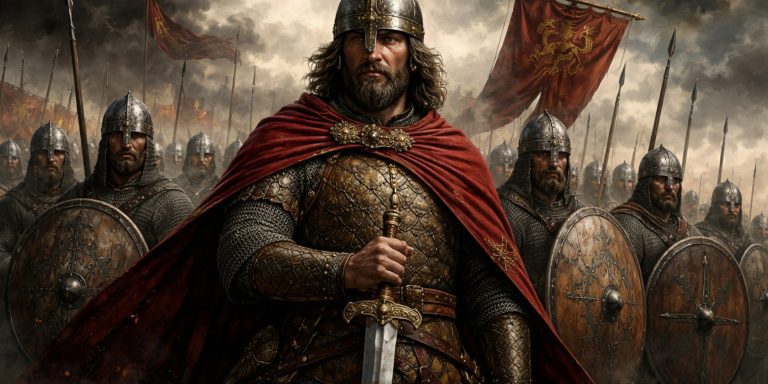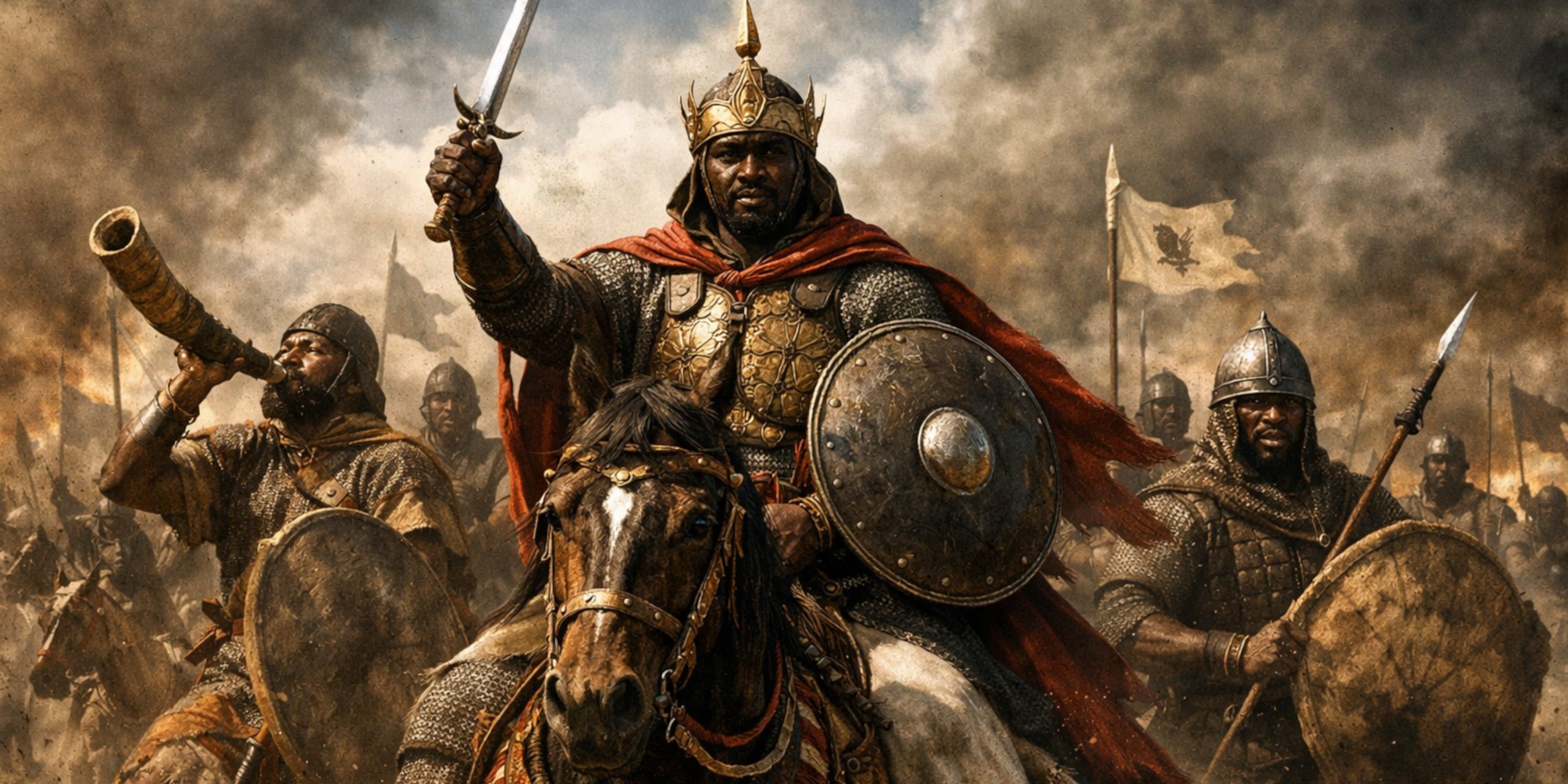
Few figures in medieval history loom as large as Sundiata Keita. He was the founder of the Mali Empire in the early thirteenth century, a ruler whose life sits somewhere between documented history and epic poetry. His story survives most vividly in the Epic of Sundiata, preserved by West African griots who carried his memory across generations.
As a historian, I find him both exhilarating and frustrating. Exhilarating because his career reshaped West Africa. Frustrating because our sources are layered with legend. Yet beneath the lion metaphors and prophecies stands a formidable political and military architect who built one of the most powerful states in medieval Africa.
Historical Background
Sundiata was born into the Keita clan of the Mandinka people, likely in the late twelfth or early thirteenth century. His father, Maghan Kon Fatta, ruled the small kingdom of Niani. After his father’s death, the throne was seized by a rival queen and her son. According to oral tradition, Sundiata was exiled with his mother, Sogolon.
During his exile he gathered allies across the savannah, forging relationships with neighbouring rulers. His main rival would be Soumaoro Kanté, king of the Sosso, who had conquered much of the former Ghana Empire’s territory.
By the 1230s, Sundiata returned to reclaim his homeland. His campaign culminated in the Battle of Kirina, the decisive moment in West African history that established the Mali Empire.
The Battle of Kirina and Other Campaigns
Battle of Kirina, c. 1235
Kirina was fought between Sundiata’s Mandinka coalition and Soumaoro’s Sosso forces. Oral accounts emphasise strategy and alliance building as much as battlefield prowess.
Key factors:
- A broad coalition of Mandinka chiefs united under Sundiata
- Skilled use of cavalry and infantry coordination
- Psychological warfare, with Soumaoro portrayed as a tyrant losing support
- Targeted attack on the Sosso command structure
Soumaoro was defeated and disappeared from the historical record. With that victory, Sundiata became mansa, meaning ruler, of a new imperial state.
Expansion Campaigns
After Kirina, Sundiata consolidated control over:
- The gold fields of Bambuk and Bure
- Trade routes linking the savannah to the Sahara
- Former territories of the Ghana Empire
Rather than endless conquest, he focused on integration. Tribute systems, vassal agreements and shared governance allowed Mali to expand without constant warfare.
Arms and Armour
West African military equipment in Sundiata’s era was shaped by environment and trade networks.
Weapons
- Straight or slightly curved iron swords, often leaf shaped
- Spears and javelins for infantry and cavalry
- Bows with poison tipped arrows in some regions
- Daggers and short blades for close combat
Ironworking was well developed in the region. Mandinka smiths were respected specialists, and weapon production was embedded within social and spiritual traditions.
Armour
- Quilted cotton or leather tunics
- Hide shields, often circular
- Occasional mail or imported items through Saharan trade
Cavalry were especially important. Horses were valuable imports from North Africa, and mounted troops provided speed and shock capability on open savannah terrain.
Sundiata’s forces were not equipped like European knights, nor did they need to be. Their mobility and regional knowledge were decisive advantages.
Military Acumen
Sundiata’s genius was less about personal heroics and more about statecraft in armour.
He demonstrated:
- Coalition building across clan and regional lines
- Strategic patience during exile
- Control of economic resources, especially gold
- A federated political structure that reduced rebellion
After his victory, he is traditionally credited with establishing the Kouroukan Fouga, a charter that set out laws and social principles. Whether written or orally codified, it reflects a sophisticated approach to governance.
His military model combined force with legitimacy. He defeated rivals, then incorporated them. That balance explains why Mali endured long after his death.
Administration and Empire Building
Sundiata organised his empire around tribute paying provinces governed by trusted lieutenants. Local rulers retained authority but acknowledged the supremacy of the mansa.
Control of gold was central. Mali’s wealth would later astonish the Mediterranean world, particularly under Mansa Musa. That prosperity rested on foundations laid by Sundiata.
Trade routes carried not only goods but ideas. Islam expanded through merchant networks, though Sundiata himself appears to have ruled within a largely traditional Mandinka religious framework while accommodating Muslim communities.
Artefacts and Where to See Them
Material remains directly linked to Sundiata are rare. West African history relied heavily on oral preservation, and tropical climates are unforgiving to organic materials.
However, relevant artefacts and contexts can be explored at:
- The National Museum of Mali in Bamako, which houses medieval artefacts from the region
- Archaeological sites around Niani, traditionally identified as Sundiata’s capital
- Regional collections in West African museums focusing on Mandinka culture
Iron weapons, trade goods and settlement remains provide indirect but valuable evidence of the society he ruled.
Latest Archaeology
Archaeological work in Mali and neighbouring regions has refined our understanding of the early Mali Empire.
Key findings include:
- Urban settlement patterns around Niani suggesting administrative complexity
- Evidence of trans Saharan trade networks linking Mali to North Africa
- Metallurgical studies confirming advanced iron production
Excavations have been limited by political instability in recent years, which has slowed international research. Even so, material culture increasingly supports the picture of a centralised and economically powerful thirteenth century state.
Death and Legacy
Sundiata likely died around 1255. Accounts vary, with some suggesting he drowned in the Sankarani River. His death did not unravel his creation.
The Mali Empire endured for centuries. Its political structure influenced later West African states, and its wealth became legendary. His story continues to be performed, sung and adapted across West Africa.
As a historian, I cannot always separate the man from the myth. Yet perhaps that is part of his achievement. Sundiata did not just build an empire. He became a cultural anchor, a shared origin story for a civilisation.
Takeaway
Sundiata Keita stands at the intersection of legend and verifiable history. He united fractious polities, defeated a regional hegemon and established a state that would dominate West Africa. His military success rested on alliances, economic control and strategic vision.
In a medieval world often told through European chronicles, his career reminds us that power, sophistication and statecraft flourished far beyond the familiar map.