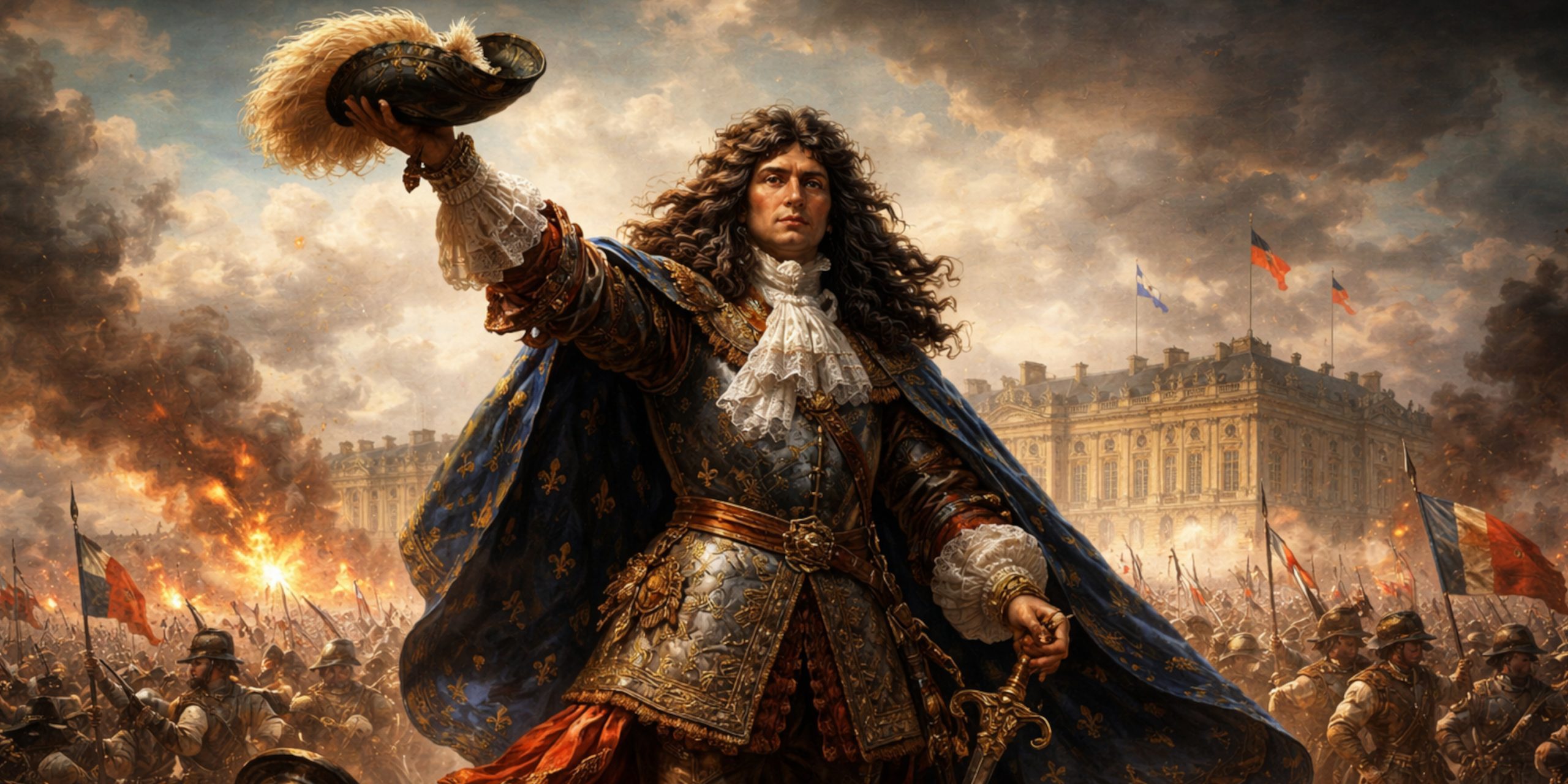
Few rulers shaped European history as completely as Louis XIV of France. Born in 1638 and reigning for seventy two years, he became the longest ruling monarch in European history. His court glittered with theatre, ceremony, and power, yet beneath the gold leaf and silk was a ruler obsessed with control, war, and reputation.
Historians often call him the Sun King, a symbol chosen deliberately. Just as the sun sat at the centre of the heavens, Louis placed himself at the centre of the French state. The result was a transformation of France into the dominant military power of seventeenth century Europe.
From a historian’s perspective, Louis XIV is fascinating precisely because he embodied contradiction. He loved spectacle and ballet, yet he also supervised brutal continental wars. He cultivated culture, but his armies marched almost constantly across Europe. Versailles might be remembered for chandeliers and gardens, though it was financed and protected by one of the most formidable military systems of the early modern period.
Early Life and Rise to Absolute Power
Louis was born at the Château de Saint Germain en Laye to King Louis XIII and Anne of Austria. His birth came after twenty three years of marriage and was widely regarded as miraculous. France finally had an heir.
When Louis XIII died in 1643, the boy was only four years old. Power passed to his mother and her chief minister, Cardinal Mazarin. During this regency the young king witnessed the Fronde, a series of civil rebellions between 1648 and 1653 that nearly toppled royal authority.
Those experiences left a permanent mark. Louis learned a simple lesson early in life: noble independence was dangerous. When Mazarin died in 1661, Louis shocked Europe by announcing he would rule personally without a chief minister.
From that moment, royal authority flowed directly through him.
The Versailles System
Louis XIV turned the palace of Versailles into the political theatre of Europe.
Originally a hunting lodge, Versailles became a vast palace where noble families were required to live and compete for royal favour. The daily rituals of the court were choreographed with astonishing precision.
The king rising in the morning became a political event.
Behind the glitter sat careful calculation. By keeping nobles close to Versailles, Louis prevented them from raising independent power bases in the provinces. Authority remained concentrated in the crown.
Versailles also projected French prestige across Europe. Diplomats, visitors, and ambassadors saw a kingdom that appeared wealthy, disciplined, and powerful.
Arms and Armour of the Sun King’s Armies
By the time Louis XIV ruled independently, warfare in Europe was undergoing transformation. Gunpowder weapons dominated battlefields, though traditional blades still played an important role.
French forces during his reign were among the most organised and best equipped in Europe.
Infantry Weapons
French infantry were primarily armed with:
• Flintlock muskets, gradually replacing earlier matchlock firearms
• Socket bayonets, which allowed muskets to double as polearms
• Short infantry swords for close combat
The bayonet revolutionised infantry tactics. Soldiers no longer needed separate pikemen for protection against cavalry.
Cavalry Arms
French cavalry retained more traditional weapons.
Typical equipment included:
• Straight cavalry swords designed for thrusting
• Curved sabres influenced by eastern designs
• Pistols carried in saddle holsters
• Carbines for mounted skirmishing
The French cavalry sword of the period often featured a long straight blade suitable for both cutting and thrusting. Officers frequently carried more elaborate weapons with engraved blades and ornate hilts.
Armour and Protection
By the mid seventeenth century heavy armour had largely vanished from infantry.
Cavalry still wore some protection, especially cuirasses.
Typical armour included:
• Steel breastplates worn by heavy cavalry
• Buff coats made from thick leather
• Metal helmets such as the lobster tail pot helmet
Elite units like the Musketeers of the Guard combined firearms with light armour and ceremonial splendour.
Louis XIV and Military Reform
Louis XIV did not simply inherit an army. He transformed it.
Under the guidance of ministers like Michel le Tellier and François Michel le Tellier, Marquis de Louvois, the French army became the largest standing force in Europe.
Key reforms included:
• Standardised uniforms and equipment
• Permanent regiments instead of temporary feudal levies
• Centralised supply systems
• Military academies for officer training
France could field armies of more than 300,000 soldiers by the late seventeenth century. That scale shocked rival powers.
Battles and Military Acumen
Louis XIV was not a battlefield commander in the mould of Napoleon or Alexander. He rarely led troops directly into combat.
However, he was deeply involved in strategic planning and political decision making. His reign saw nearly constant warfare.
War of Devolution (1667 to 1668)
This conflict targeted the Spanish Netherlands. French forces captured several fortified cities before diplomatic pressure forced peace.
The war demonstrated the growing power of the French army.
Franco Dutch War (1672 to 1678)
Louis attempted to break the Dutch Republic. French armies initially swept through the Netherlands with remarkable speed.
However, Dutch flooding tactics and a European coalition halted the advance. The conflict became a long continental war.
War of the League of Augsburg (1688 to 1697)
Also known as the Nine Years War, this struggle pitted France against a large alliance including England, the Dutch Republic, and the Holy Roman Empire.
Battles such as Fleurus and Neerwinden showed the strength of French command, though the war drained resources.
War of the Spanish Succession (1701 to 1714)
This final great conflict defined the end of Louis XIV’s reign.
France supported the claim of Louis’s grandson Philip to the Spanish throne. Europe feared a united Franco Spanish empire.
Key battles included:
• Blenheim in 1704
• Ramillies in 1706
• Malplaquet in 1709
The war devastated France economically, though the Bourbon dynasty ultimately secured the Spanish throne.
From a historian’s perspective, Louis XIV’s strategic ambition often exceeded France’s financial endurance. His armies were powerful, though maintaining them strained the kingdom.
Military Engineering and the Age of Vauban
No discussion of Louis XIV’s military power is complete without Sébastien Le Prestre de Vauban.
Vauban was the greatest military engineer of the seventeenth century. His fortress designs reshaped European warfare.
He constructed or improved over one hundred fortified cities across France.
Key features of Vauban fortifications included:
• Star shaped bastions that deflected artillery
• Complex outer defences and ravelins
• Carefully designed artillery positions
Many of these fortresses still survive today.
They represent some of the finest preserved military architecture in Europe.
Artefacts from the Reign of Louis XIV
Remarkable objects from the Sun King’s era remain preserved in museums across Europe.
Palace of Versailles
Versailles itself is the greatest surviving artefact of the reign.
Visitors can see:
• The Hall of Mirrors where royal ceremonies took place
• The King’s Grand Apartments
• Court weapons, uniforms, and ceremonial arms
Musée de l’Armée, Paris
Located within Les Invalides, this museum holds an exceptional collection of seventeenth century military artefacts.
Notable pieces include:
• Muskets used by royal infantry
• Cavalry swords from French regiments
• Armour worn by elite cavalry units
Louvre Museum
The Louvre contains court artefacts from the Bourbon monarchy including ceremonial arms and royal regalia.
Château de Vincennes
The fortress at Vincennes houses military archives and artefacts relating to the early modern French army.
For historians and enthusiasts of arms and armour, these collections provide direct insight into the military culture of Louis XIV’s France.
Archaeology of the Sun King’s Wars
Archaeology continues to shed light on battles and fortifications from Louis XIV’s reign.
Recent excavations across former battlefields in Belgium, the Netherlands, and Germany have revealed:
• Musket balls and artillery fragments
• Remains of siege trenches
• Military equipment such as belt buckles and weapon fittings
One particularly interesting area of research focuses on Vauban’s fortresses.
Archaeologists have studied buried sections of bastions and defensive works, revealing the scale of seventeenth century engineering projects.
Battlefields such as Blenheim and Malplaquet continue to produce artefacts that help historians reconstruct troop movements and battlefield conditions.
Even small discoveries can be revealing. A cluster of musket balls might indicate where a regiment held its ground under fire.
Personality and Court Culture
Louis XIV cultivated an image of grandeur and control.
He performed in court ballets as a young man and famously appeared dressed as Apollo, the sun god. The symbolism was deliberate.
Yet behind the theatrical confidence was a ruler who worked relentlessly. Louis read reports, reviewed documents, and involved himself in administrative detail.
He believed deeply in the divine right of kings.
His famous declaration captured that belief:
“L’état, c’est moi.”
Whether he actually spoke those exact words remains debated by historians. The sentiment, however, reflected his style of rule.
Death and Historical Legacy
Louis XIV died in 1715 after seventy two years on the throne.
By the time of his death France remained powerful but financially exhausted. Decades of war had drained the treasury.
His great grandson Louis XV inherited a complicated legacy.
Historians still debate Louis XIV’s reign.
On one hand he elevated France to unmatched cultural and military prestige. Versailles became the model for royal courts across Europe.
On the other hand his wars and policies planted seeds of financial instability that would haunt France for generations.
As a historian, I cannot help feeling a certain reluctant admiration for the man. Louis XIV understood power in a way few rulers ever have. He shaped institutions, culture, and warfare with relentless determination.
Yet the Sun King also reminds us that absolute power rarely comes cheaply.
France paid the bill long after the candles of Versailles had burned out.