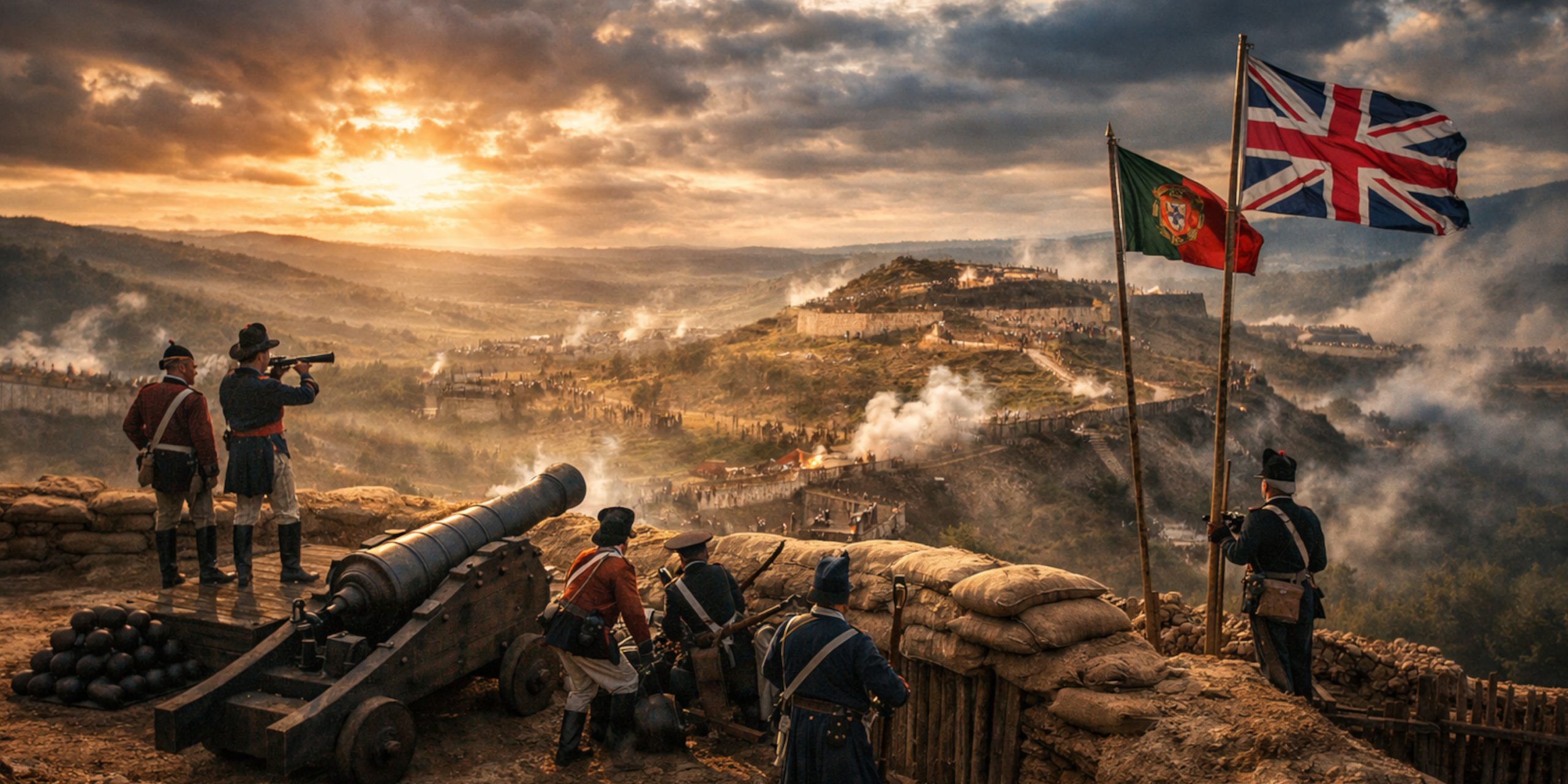
The Lines of Torres Vedras remain one of the most effective defensive systems ever built in Europe. They were not dramatic in the way a single climactic battle is dramatic. There was no great cavalry charge or theatrical collapse. Instead, there was patience, calculation, and an iron understanding of logistics. As a historian, I find them fascinating precisely because they worked so well that very little happened. War, at its most intelligent, often looks like that.
Constructed in secret between 1809 and 1810 under the direction of Arthur Wellesley, later the Duke of Wellington, the Lines shielded Lisbon and ultimately broke the momentum of André Masséna during the French invasion of Portugal in the Peninsular War. They forced Napoleon’s finest marshals to confront a reality they disliked deeply. You cannot eat fortifications.
Strategic Background
Portugal in 1809 was fragile, exhausted, and essential. If Lisbon fell, Britain would lose its foothold in Iberia. Wellington knew that he could not defeat a larger French army in open battle on unfavourable terms. So he chose denial instead of confrontation.
The idea was brutally simple. Construct three defensive lines north of Lisbon, anchor them to the Atlantic, control every valley and road, strip the countryside of supplies, and let the French advance into emptiness. It was not glorious. It was devastatingly effective.
The French marched forward expecting battle. They found walls, guns, hunger, and silence.
Forces
Anglo Portuguese Army
| Component | Estimated Strength |
|---|---|
| British regulars | 30,000 |
| Portuguese regulars | 30,000 |
| Portuguese militia and ordenanças | 20,000+ |
| Artillery | Over 600 guns |
French Army of Portugal
| Component | Estimated Strength |
|---|---|
| Infantry | 60,000 to 65,000 |
| Cavalry | 5,000 to 6,000 |
| Artillery | Around 200 guns |
Numbers tell only part of the story. The French were far from home, increasingly hungry, and operating without reliable intelligence. Wellington’s army was fed, reinforced, and sitting behind earthworks that had been surveyed with near obsessive care.
Leadership and Command
Anglo Portuguese Command
- Arthur Wellesley, overall command
- Lieutenant General Rowland Hill
- Marshal William Beresford, commander of Portuguese forces
Wellington’s leadership style here was restrained and coldly rational. He resisted pressure to fight. That takes confidence, and a certain willingness to endure criticism.
French Command
- André Masséna, commander in chief
- Marshal Ney, VI Corps
- General Junot, VIII Corps
Masséna was not incompetent. He was simply outmanoeuvred by geography and preparation. Even great captains struggle when the map itself seems hostile.
Arms and Armour
Anglo Portuguese Equipment
- Infantry muskets: Brown Bess flintlock musket
- Bayonets standard issue across British and Portuguese units
- Swords:
- British infantry officers carried the 1796 Infantry Officer’s Spadroon
- British light cavalry officers used the 1796 Light Cavalry Sabre
- Portuguese officers often carried locally made sabres influenced by British patterns
- Artillery:
- 6 pounder and 9 pounder guns
- Howitzers positioned to sweep valleys and roads
British kit was not exotic, but it was reliable. Drill and discipline mattered more than ornament.
French Equipment
- Infantry muskets: Charleville Model 1777
- Swords:
- Infantry officers carried straight smallswords or sabres
- French light cavalry wielded curved sabres such as the AN XI pattern
- Artillery:
- 6 pounder and 8 pounder guns
French weapons were excellent, but excellence does not compensate for starvation.
The Defensive System Explained
The Lines consisted of over 150 forts and redoubts spread across three main defensive belts.
- The First Line blocked direct access to Lisbon
- The Second Line protected evacuation points and the Tagus
- The Third Line covered a final withdrawal to the coast if required
Each position was mutually supporting. Roads were covered by artillery. Valleys were flooded. Hills bristled with guns. It was defensive depth done properly, long before the term became fashionable.
Battle Timeline
October 1810
Masséna advances into Portugal after the Battle of Buçaco, expecting Wellington to retreat further south.
Late October 1810
French forces encounter the First Line of Torres Vedras and halt in disbelief. Reconnaissance reveals no easy route through.
November 1810
French army begins to suffer acute supply shortages. Desertion and illness rise sharply.
December 1810
Masséna orders a prolonged halt. Wellington refuses to engage. The stalemate favours the defenders.
March 1811
French forces withdraw north, effectively defeated without a decisive battle.
Few campaigns end with so little drama and such total strategic success.
Archaeology and Surviving Remains
Many of the forts survive remarkably well.
- Forte de São Vicente remains the most impressive and accessible
- Earthworks, gun platforms, and magazines are still visible across the landscape
- Archaeological surveys have uncovered:
- Musket balls and artillery fragments
- Camp debris such as buttons and uniform fittings
- Foundations of barracks and powder stores
Walking these sites today, you can still sense how carefully the land was shaped for defence. The hills feel watchful.
Contemporary Quotes
Wellington, writing with his usual understatement:
“I have made my dispositions, and I trust that they will answer.”
A French officer, less restrained, wrote bitterly:
“We are opposed not by an army, but by the earth itself.”
Masséna reportedly admitted that the Lines were “the devil’s work”. As assessments go, that is not far off.
Historical Legacy
The Lines of Torres Vedras did not just protect Lisbon. They broke French momentum in Iberia and proved that Napoleon’s armies could be contained through planning rather than spectacle. They also demonstrated Wellington’s greatest strength, which was not aggression, but judgement.
I have always admired this campaign. It lacks romance, but it has intelligence. If battles are arguments conducted with violence, then Torres Vedras was a perfectly reasoned essay that left the other side with nothing useful to say.
Watch the documentary: