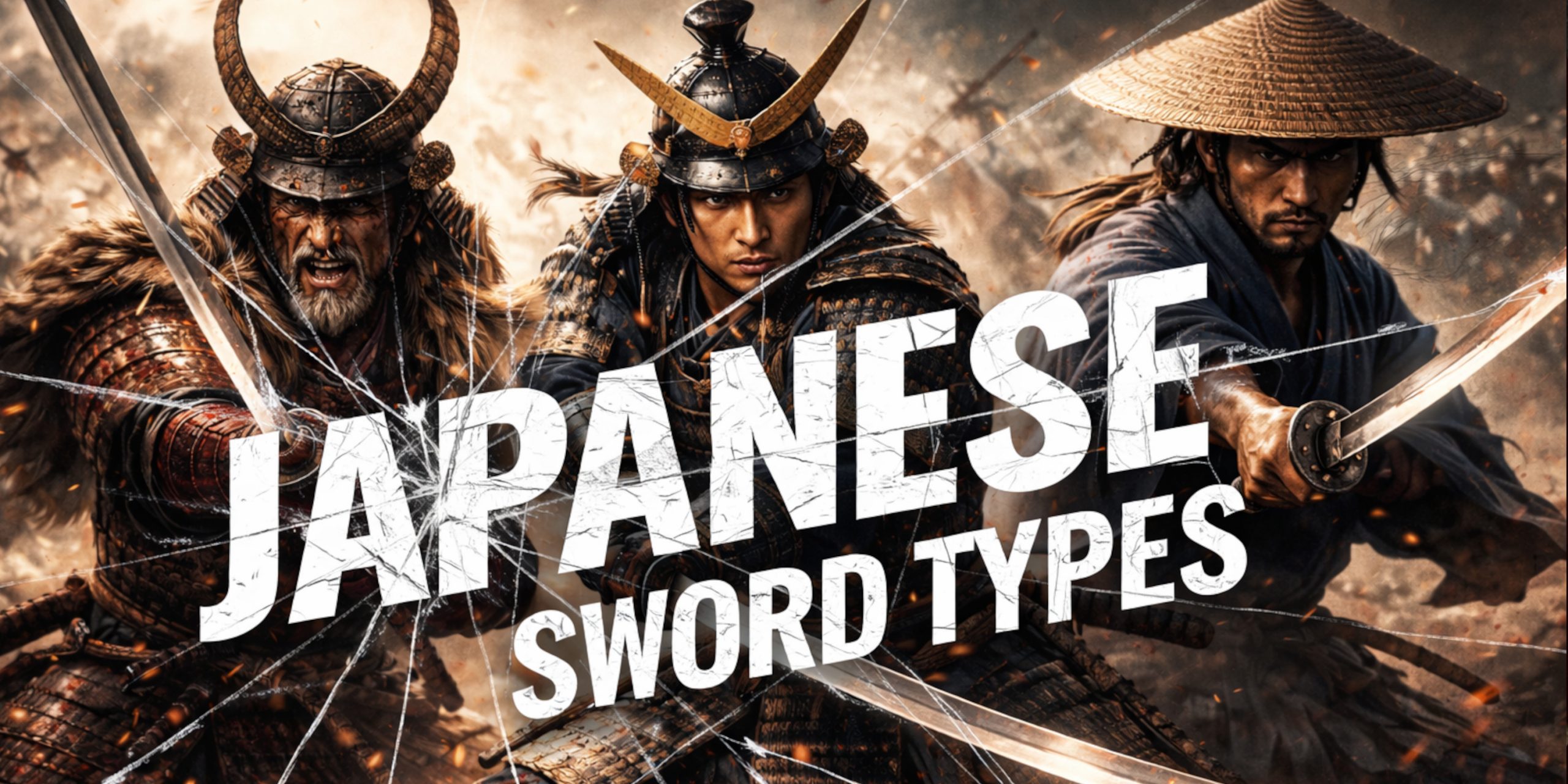
Japanese swords are one of those subjects that look simple from a distance and then get quietly complicated the closer you step in. People often say “katana” and stop there, which is a bit like calling every European sword a longsword and going for a pint. The reality is richer, stranger, and far more tied to politics, warfare, and fashion than most guides admit.
What Defines a Japanese Sword
Before naming types, it helps to understand what makes Japanese swords feel so distinct.
Japanese blades evolved under a few strong constraints. Iron quality was inconsistent, armour changed slowly, and social rules often mattered as much as battlefield need. The result was a family of swords that look related but behave very differently.
Key defining traits include
- Differential hardening using clay, creating the hamon
- A pronounced curvature optimised for cutting
- Long grips for two handed control, even on shorter blades
- A focus on edge alignment rather than brute mass
These shared traits are why Japanese swords feel like a coherent tradition rather than a grab bag of designs.
Early Japanese Swords and Continental Influence
Chokutō
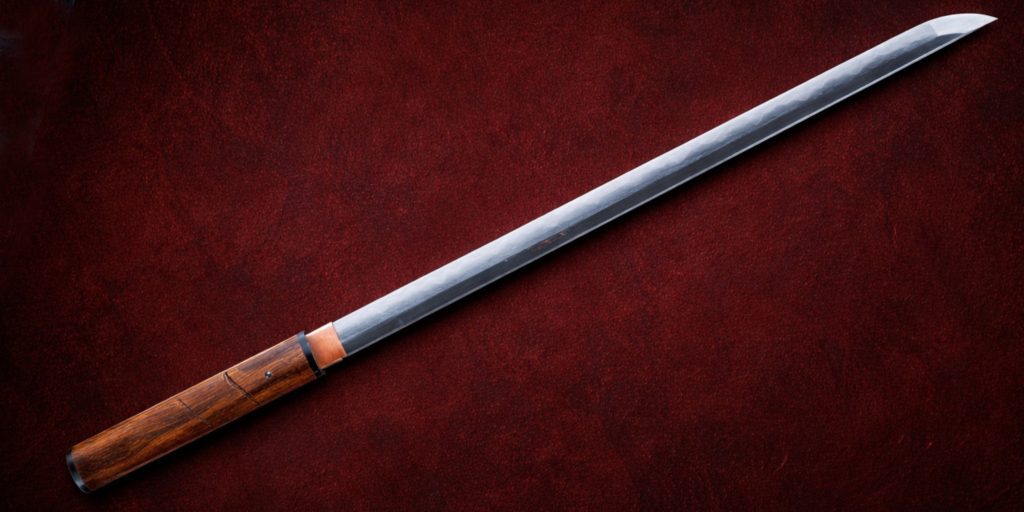
The chokutō is where the story really starts, and it looks nothing like what most people expect.
These early swords were straight, single edged, and heavily influenced by Chinese and Korean designs. They date mainly to the Kofun and early Nara periods and were prestige objects as much as weapons.
Focus points
- Straight blade with little or no curve
- Single edged, occasionally double edged
- Often ceremonial or symbolic by later standards
If you are waiting for sweeping curves and samurai drama, this is the calm before the storm.
The Rise of Curved Battlefield Swords
Tachi
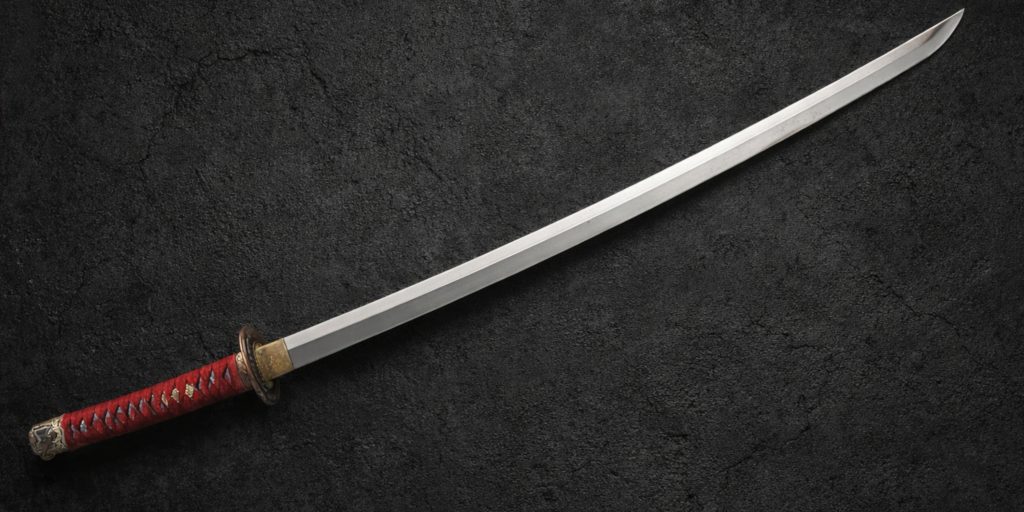
The tachi is the true ancestor of the katana and arguably the most elegant battlefield sword Japan ever produced.
Designed for mounted combat, the tachi features a deeper curve and was worn edge down, suspended from the belt. Many of the most famous blades in Japanese history were originally forged as tachi.
Focus points
- Pronounced curvature optimised for cavalry
- Worn edge down on hangers
- Long, graceful blade with a forward balance
Standing in front of a good Kamakura period tachi feels like looking at a weapon that knows exactly what it was born to do.
Katana
The katana needs no introduction, but it deserves a more careful explanation than it usually gets.
The katana emerged as warfare shifted toward infantry combat and urban violence. Shorter than most tachi and worn edge up through the belt, it was quicker to draw and better suited to close quarters.
Focus points
- Moderate curvature with a strong cutting profile
- Worn edge up through the obi
- Optimised for fast draw and decisive strikes
The katana is not the best sword ever made, but it may be the best sword ever branded by history.
Companion and Secondary Blades
Wakizashi

The wakizashi is often treated as a side note, which is unfair.
This short sword was carried alongside the katana as part of the daishō and was often used indoors where longer blades were impractical. It also had legal and social significance, especially during the Edo period.
Focus points
- Shorter blade suited to indoor combat
- Paired with the katana as a status symbol
- Frequently used for personal defence
If the katana is the headline act, the wakizashi is the reliable understudy that quietly does all the work.
Tantō
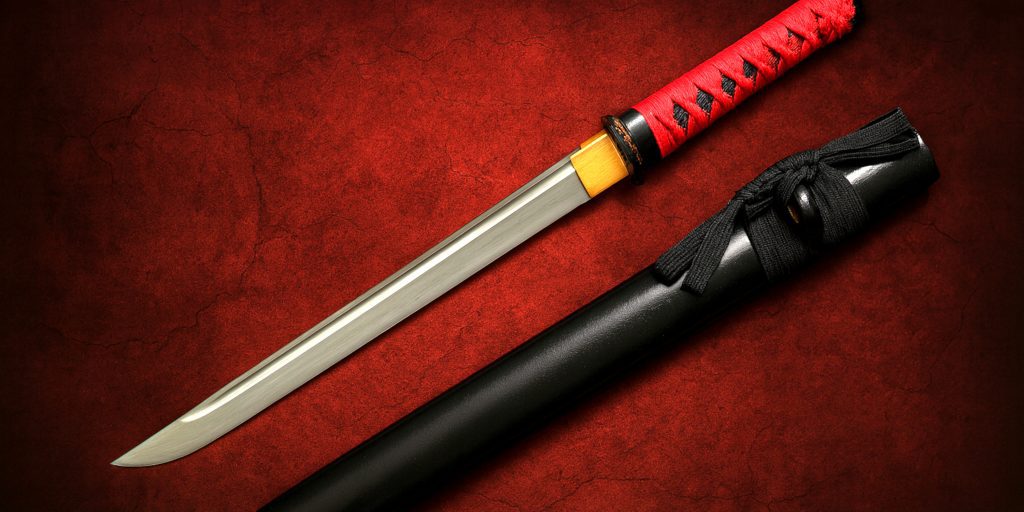
The tantō sits somewhere between dagger and short sword, and it comes in an astonishing variety of forms.
Originally a weapon of war, it later became a highly personal item, often lavishly decorated and carried by both men and women of status.
Focus points
- Blade length typically under 30 cm
- Strong thrusting capability
- Deep personal and ritual associations
Some tantō are brutally utilitarian. Others are basically wearable art with sharp opinions.
Large and Specialist Battlefield Swords
Nodachi and Ōdachi

These oversized swords are where things get dramatic.
The nodachi and ōdachi were massive blades designed for open battlefield use, especially against infantry formations. Carrying one was a commitment, both physically and socially.
Focus points
- Extremely long blades, often over 90 cm
- Used against massed troops
- Difficult to carry and deploy
There is a reason these swords never became everyday weapons. They are magnificent, impractical, and faintly unhinged.
Nagamaki
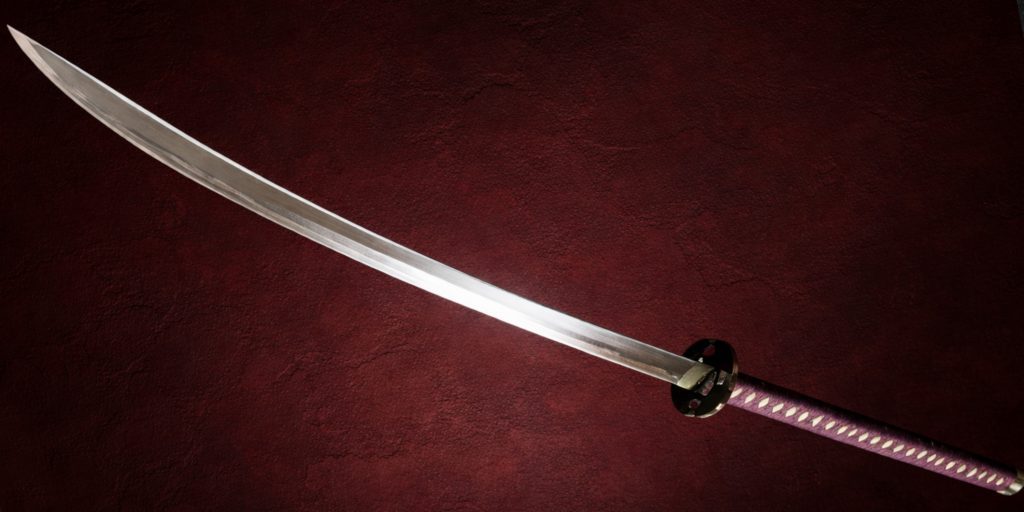
The nagamaki blurs the line between sword and polearm.
With a blade similar in length to a katana but a much longer grip, it offered powerful cuts and extended reach while retaining sword like handling.
Focus points
- Long handle with sword length blade
- Used by elite infantry
- Excellent cutting leverage
It feels like someone asked, “What if we kept going?” and then actually did.
Civilian, Ritual, and Court Swords
Shikomizue
The shikomizue is a hidden sword disguised as a walking stick, most commonly associated with the late Edo period.
Despite its dramatic reputation, it was more about discretion than assassination.
Focus points
- Concealed blade with no visible fittings
- Used for personal defence
- Popular in urban settings
Less ninja fantasy, more practical paranoia.
Ken and Ritual Blades
Some Japanese swords were never meant to see blood.
Straight double edged ken were used primarily in religious contexts and retained symbolic significance long after curved swords took over the battlefield.
Focus points
- Double edged, straight blades
- Strong Buddhist associations
- Primarily ceremonial use
They remind us that swords were as much spiritual objects as tools of violence.
How Japanese Sword Types Compare to European Blades
If you are familiar with European sword typologies, the contrast is revealing.
Japanese sword evolution prioritised cutting efficiency, social regulation, and craftsmanship continuity. European swords diversified aggressively in response to armour, fencing systems, and regional warfare styles.
In simple terms
- Japanese swords changed slowly but deeply
- European swords changed often and visibly
- Both traditions solved different problems with impressive clarity
Neither approach is better. They are answers to different historical questions.
Why These Distinctions Still Matter
Understanding Japanese sword types is not about trivia. It shapes how we read history, assess martial arts, and even judge modern reproductions.
When someone calls a tachi a katana or treats a wakizashi as a dagger, something subtle but important gets lost. These swords were responses to real pressures, real laws, and real bloodshed.
And yes, also to fashion. Samurai were people, after all.
Visual Timeline of Japanese Sword Development
| Period | Approx. Dates | Sword Types in Use | Key Developments | Historical Context |
|---|---|---|---|---|
| Yayoi to Kofun Period | c. 300 BC to 538 AD | Chokutō, Ken | Straight blades influenced by Chinese and Korean swords, early iron working | Swords function as status objects and ritual items as much as weapons |
| Asuka to Nara Period | 538 to 794 | Chokutō, Ken | Improved metallurgy, early experimentation with curvature | Centralised court culture, strong continental influence |
| Heian Period | 794 to 1185 | Early Tachi | Introduction of curved blades optimised for mounted combat | Rise of the warrior class, cavalry warfare dominates |
| Kamakura Period | 1185 to 1333 | Tachi, Tantō | Peak of classical swordsmithing, robust cutting blades | Constant warfare, swords designed for real battlefield use |
| Nanbokuchō Period | 1336 to 1392 | Ōdachi, Nodachi, Large Tachi | Oversized blades developed for mass infantry combat | Large scale battles, experimentation with reach and power |
| Muromachi Period | 1392 to 1573 | Katana, Wakizashi | Shift from tachi to katana, worn edge up, faster draw | Infantry combat increases, urban violence more common |
| Azuchi–Momoyama Period | 1573 to 1603 | Katana, Wakizashi, Tantō | Standardisation of the daishō pairing | Era of unification and intense warfare |
| Edo Period | 1603 to 1868 | Katana, Wakizashi, Shikomizue | Swords become symbols of status, refinement over function | Long peace, strict class laws, civilian carry regulated |
| Meiji Period | 1868 to 1912 | Guntō, Ceremonial Blades | Traditional sword wearing outlawed, Western military models adopted | End of the samurai class, modernisation of Japan |
| Modern Era | 1912 to Present | Gendaitō, Shinsakutō | Swordsmithing preserved as art and cultural heritage | Swords valued as historical artefacts and craft objects |