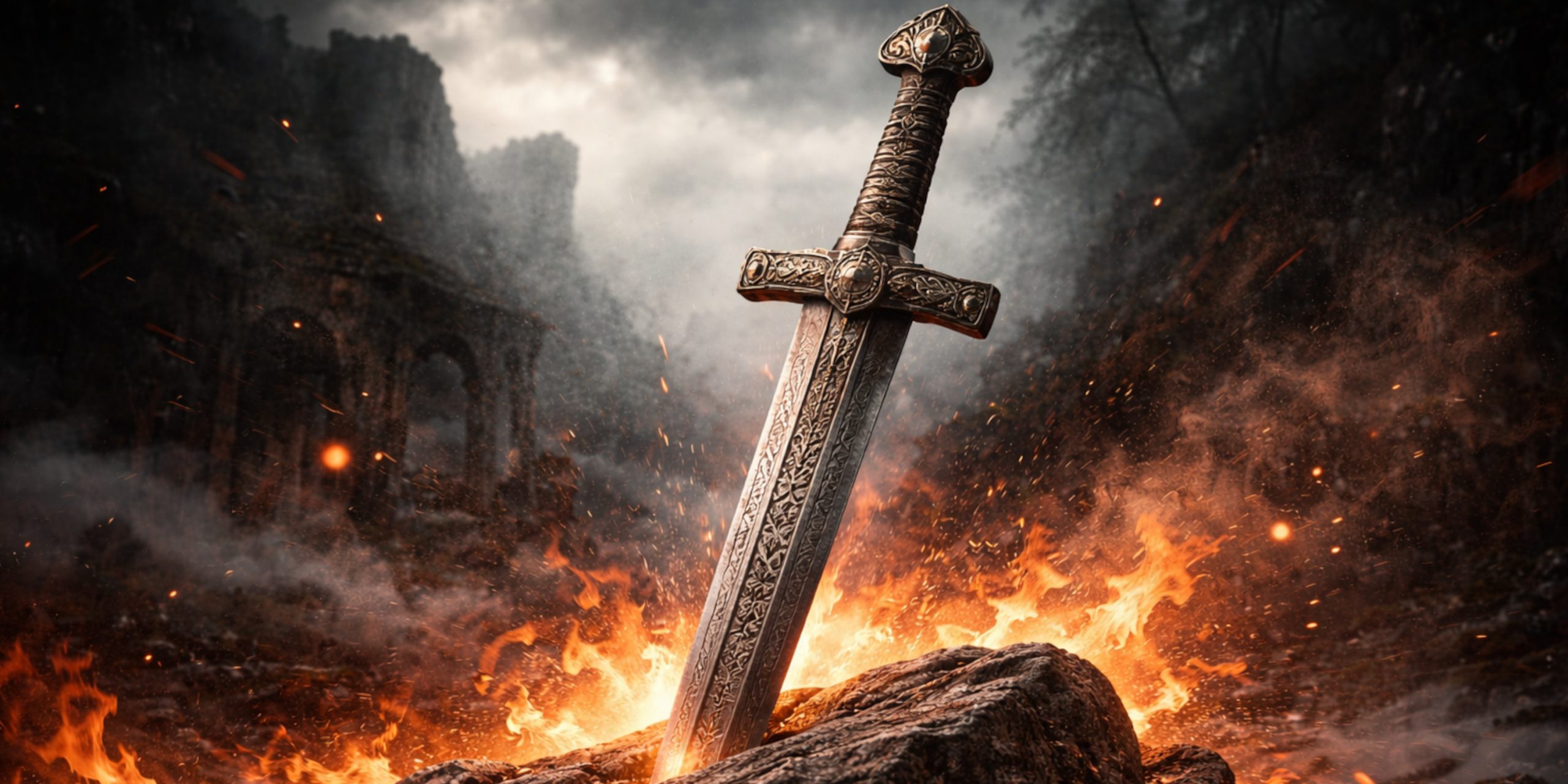
Some legendary swords exist to look impressive on a wall. Gram exists to end bloodlines, rewrite fate, and make dragons nervous. In Norse myth it is not merely carried by a hero, it actively participates in the story, breaking when it must and returning sharper than before. As a historian, I find Gram interesting not because it is magical, but because it behaves like a narrative instrument with a temper.
Origins of Gram
Gram first appears in the lineage of the Völsungs, long before its most famous wielder ever touches it. The sword is driven into the trunk of a great hall tree by Odin himself, who rarely turns up without intent. Only one man can pull it free, Sigmund, father of Sigurd. This is less a test of strength and more a warning label disguised as a miracle.
The sword’s early life is turbulent. Sigmund uses it with success until it shatters in battle, a moment that feels suspiciously deliberate. In Norse storytelling, swords break when destiny needs a pause.
Sigurd and the Reforging of Gram
The broken blade is passed down to Sigurd, raised in the care of the smith Regin, who has ambitions and a flexible moral compass. Gram is reforged, and this time it is not simply sharp. It becomes precise, almost offended by resistance.
When Sigurd wields Gram, it slices through an anvil and cleaves wool floating in water without disturbing the surface. These are not physics demonstrations. They are statements of intent. The sword is ready, and so is the story.
Sigurd, known across legend as Sigurd, takes the reforged blade to face the dragon Fáfnir. Gram does what it was clearly made to do.
Gram in the Slaying of Fáfnir
The killing of Fáfnir is often framed as a triumph of heroism. In practical terms, it is a demonstration of equipment superiority combined with planning. Sigurd digs a pit, waits patiently, and drives Gram upward through the dragon’s belly, which even myth acknowledges as the weak point.
This is where Gram earns its reputation. It does not simply wound. It ends the creature completely, so thoroughly that Fáfnir’s death reshapes the world around Sigurd. Cursed gold, prophetic blood, and an early lesson that victory has consequences all follow.
Symbolism and Meaning
Gram is often described as a symbol of kingship, fate, and divine favour. That is true, but it is also a symbol of inheritance. It passes from father to son in broken form, carrying failure as well as promise. Only when reforged by the next generation does it fulfil its purpose.
From a historian’s perspective, this reflects a very human idea. Power inherited without renewal is fragile. Power reforged through effort and skill is something else entirely.
Archaeology and Historical Echoes
No archaeological find can be confidently labelled Gram, despite the occasional overexcited museum caption. What we do have are Migration Period swords with pattern welded blades, ornate hilts, and evidence of ritual breaking. These practices align neatly with the mythic life cycle of Gram.
The stories preserved in the Völsunga saga likely draw on real cultural attitudes toward weapons as living objects with reputations, histories, and obligations. Gram feels believable because the people who told its story believed swords mattered.
Legacy in Literature and Popular Culture
Gram’s influence stretches well beyond medieval Scandinavia. It appears in later retellings, most famously influencing Wagner’s Ring Cycle, where it becomes Nothung. Modern fantasy owes it a quiet debt, particularly the idea that a sword can be broken, reforged, and reborn alongside its hero.
Every time a fantasy novel introduces an ancient blade that chooses its wielder, Gram is there in the background, nodding politely and sharpening itself.
Takeaway
Gram works as a legend because it is restrained. It does not glow constantly or solve problems on its own. It waits, breaks, and returns when the time is right. In a genre crowded with overachieving swords, Gram remains effective by knowing exactly when to act.
If swords could be said to have personalities, Gram would be the quiet one in the corner. The one you only notice when something very large stops moving.
Watch the documentary: