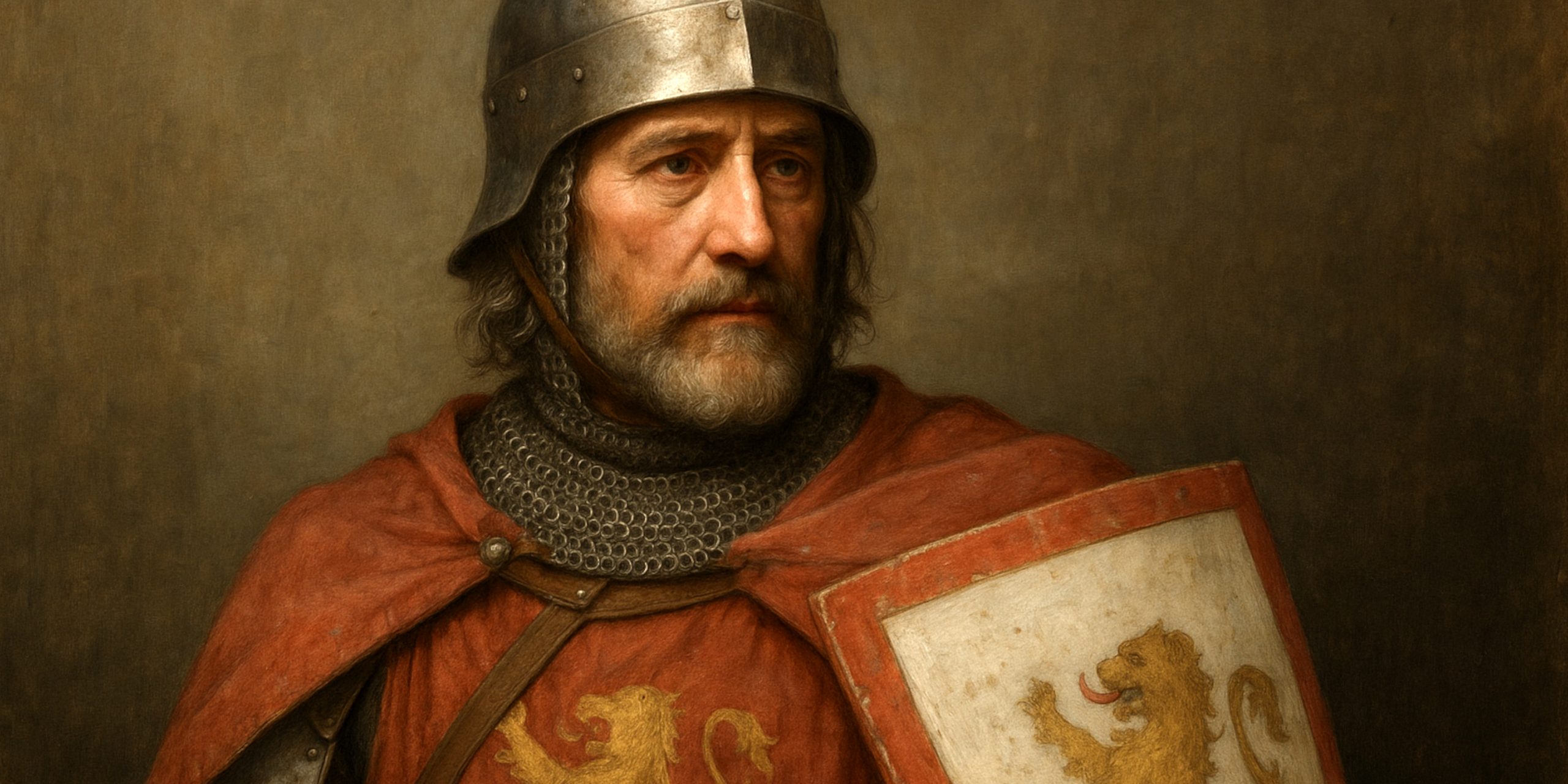
Geoffroi de Charny was a French knight of the fourteenth century, remembered as a soldier, diplomat, author, and standard-bearer of the French royal army. His reputation was built on both martial skill and chivalric ideals. He is also associated with one of the most enigmatic relics of the medieval world, the Shroud of Turin, which he is believed to have first brought to public attention. His life provides a window into the ideals of knighthood and the brutal reality of the Hundred Years’ War.
Early Life and Background
Little is known of Charny’s early years. He came from a noble Burgundian family with ties to the French crown. His upbringing would have emphasised martial training, religious devotion, and the values of honour and loyalty that were central to chivalric life.
Military Career
Charny’s career was closely linked to the conflicts of the Hundred Years’ War between France and England.
- Prisoner of War: He was captured by the English at Calais in the 1340s and ransomed, a common experience for knights of his rank.
- Battlefield Reputation: Known for his courage, he was chosen to carry the royal Oriflamme, the sacred battle standard of France, a role reserved for knights of proven loyalty and bravery.
- Death: He died in 1356 at the Battle of Poitiers, one of the most devastating defeats for France. According to accounts, he fought with great bravery and fell beside King John II.
Writings on Chivalry
Geoffroi de Charny was also a significant writer. His works remain some of the most insightful texts on the ideals of knighthood.
- The Book of Chivalry (Livre de Chevalerie): A treatise offering guidance on the duties, challenges, and moral responsibilities of a knight. It covers subjects such as loyalty, endurance in hardship, and the dangers of pride.
- The Book of the Order of Knighthood: Often attributed to him, though authorship is debated. It outlines the ceremonial and moral framework of knighthood.
- His writings stand out for their practicality. Rather than offering only lofty ideals, he recognised the exhaustion, financial strain, and risks that came with the knightly life.
Surviving Manuscripts
Charny’s writings survive in a number of medieval manuscripts scattered across Europe. These holdings are the basis for modern editions and studies.
- Bern, Burgerbibliothek (Cod. 420): Contains the Livre Charny.
- Brussels, Royal Library (ms 11124–11126): A comprehensive version including Charny’s attributed works.
- Madrid, Biblioteca Nacional (ms 9270): A richly illuminated manuscript, though some miniatures were removed.
- Oxford, Bodleian Library (MS Holkham Misc. 43): Holds both the Livre Charny and the Demandes.
- Paris, Bibliothèque nationale de France (français 25447 and nouvelles acquisitions françaises 4736): Contains the Livre Charny and related works.
- Tours, Bibliothèque municipale (ms 904): Includes the Livre Charny.
- The Hague, Koninklijke Bibliotheek (71 G 74): A later copy of the text.
- Brussels, Royal Library (ms 10549): An incomplete early fifteenth-century manuscript.
The differences between manuscripts have led scholars to conclude that not all works attributed to Charny were written by him. Some may instead belong to his son, Geoffroi II.
The Shroud of Turin
One of the most debated aspects of Charny’s legacy is his connection to the Shroud of Turin.
- The first known exhibition of the Shroud was organised in the 1350s by Charny and his wife, Jeanne de Vergy, in their church at Lirey.
- The origins of the Shroud remain uncertain, but Charny’s role in its early history is well-documented. Whether he believed it to be the burial cloth of Christ or saw it as a devotional object of another kind is unclear.
- This association ensured that his name remained tied to one of the most enduring mysteries of medieval Christianity.
Legacy
Charny’s legacy lies in three areas: his military service, his literary contributions, and his role in the story of the Shroud of Turin.
- As a knight, he represented the highest standards of loyalty and courage, sacrificing his life in defence of his king.
- As a writer, he provided a grounded vision of chivalry that balanced idealism with lived experience.
- As a custodian of the Shroud, he is linked to one of the most enduring religious relics in European history.
The Seven Swords Takeaway
Geoffroi de Charny was a thinker who sought to define the true meaning of chivalry at a time when France was torn by war and political strife. His writings continue to shape how historians understand the medieval knight, while his association with the Shroud of Turin keeps his name alive in both historical and religious debate.
Watch a brief summary: