The straight swords associated with the Fatimid world sit at an interesting crossroads. They belong to a dynasty better known for pageantry, doctrine, and court culture, yet they also reflect a practical military tradition shaped by North Africa, the eastern Mediterranean, and the Islamic east. These weapons are less flamboyant than later curved sabres, but they speak clearly of authority, discipline, and inherited Roman and early Islamic forms.
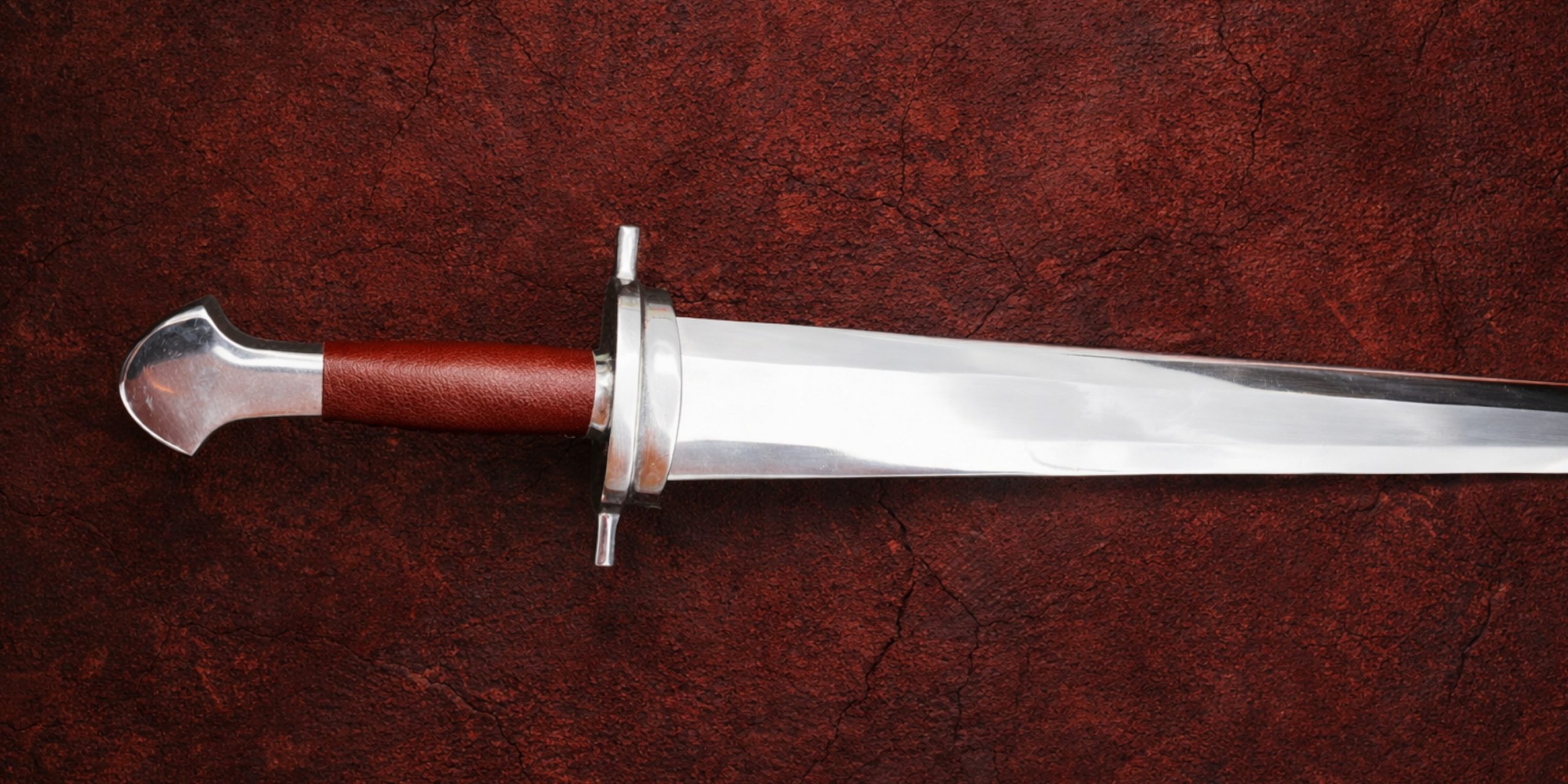
The Fatimid straight sword was not a single standardised pattern. It was a family of weapons used across the Fatimid Caliphate from the tenth to twelfth centuries. Most examples were double edged, straight bladed swords with modest taper, intended for both cut and thrust. They echo earlier Arab and Byzantine blades while hinting at the gradual transition toward curved cavalry sabres that would dominate the later medieval Islamic world.
Specifications
While variation is the rule, surviving examples and manuscript depictions allow for a useful technical outline.
| Feature | Typical Range |
|---|---|
| Overall length | 85 to 100 cm |
| Blade length | 70 to 85 cm |
| Blade form | Straight, double edged |
| Blade cross section | Lenticular or flattened diamond |
| Fuller | Often shallow, sometimes absent |
| Hilt | Short grip, simple crossguard |
| Pommel | Disc or lobed, sometimes faceted |
| Weight | Approx. 1.1 to 1.4 kg |
Materials were high quality for the period. Blades were often of crucible or well refined steel, occasionally with visible patterning. Hilts could be plain iron for soldiers or richly decorated for court and ceremonial use.
History and Evolution
The Fatimid Caliphate ruled from North Africa into the eastern Mediterranean, with Cairo as its centre. Its military inherited weapons from earlier Arab conquests, local Berber traditions, and long contact with Byzantine forces.
Early Fatimid swords closely resemble late Abbasid and Umayyad straight blades. Over time, influences from Turkic cavalry began to appear, especially in elite units, but the straight sword remained common throughout Fatimid rule. It was carried by infantry, guards, and officials, not just battlefield troops.
Unlike later Islamic dynasties, the Fatimids placed strong emphasis on visual symbolism. Swords often appeared in ceremonies, processions, and court art, reinforcing their association with legitimate authority rather than raw aggression.
Advantages and Disadvantages
Advantages
- Balanced cut and thrust capability
- Effective in close formation fighting
- Familiar handling for infantry and guards
- Symbolically associated with justice and authority
Disadvantages
- Less effective from horseback than curved sabres
- Limited cutting efficiency compared to later curved blades
- Short grips restrict leverage for powerful blows
These traits made the sword dependable rather than specialised. It excelled in disciplined contexts but was gradually outpaced by cavalry focused designs.
Comparison with Similar Weapons
| Weapon | Key Difference | Practical Impact |
|---|---|---|
| Abbasid straight sword | Often lighter, simpler fittings | Comparable performance, less ceremonial |
| Byzantine spathion | Broader blade, stronger thrust bias | Better against armour |
| Early Seljuk sabre | Curved blade | Superior cutting from horseback |
| European arming sword | Longer grip, heavier pommel | More versatile hand protection |
The Fatimid straight sword stands closer to Byzantine and early Islamic traditions than to the sabres that followed.
Legacy
The Fatimid straight sword marks the closing chapter of straight bladed dominance in much of the Islamic world. While curved swords would become iconic, the Fatimid period reminds us that straight blades remained relevant long after popular narratives suggest otherwise.
Their visual presence in art and ceremonial contexts influenced later Mamluk and even Ottoman symbolism, where straight swords continued to appear as emblems of justice and state authority rather than frontline weapons.
Where to See Examples Today
Surviving Fatimid swords are rare, but comparable examples and attributed pieces can be found in major collections.
- Museum of Islamic Art
- Topkapi Palace Museum
- British Museum
- Louvre Museum
Attribution is often cautious, with many pieces described as Fatimid or Fatimid period rather than definitively provenanced.
Collector’s Guide and Auction Prices
Authentic Fatimid straight swords are exceptionally scarce on the open market. Most collectors encounter later Islamic straight swords that share stylistic features.
What to Look For
- Straight double edged blade with early Islamic geometry
- Subtle or absent curvature
- Simple crossguard without pronounced quillons
- Evidence of age consistent with tenth to twelfth centuries
- Provenance or old collection history
Typical Auction Prices
| Category | Price Range |
|---|---|
| Attributed Fatimid period blade fragment | £6,000 to £15,000 |
| Complete Islamic straight sword, 11th to 12th century | £18,000 to £45,000 |
| Court or ceremonial sword with decoration | £60,000+ |
Extreme caution is advised. Later Mamluk and Ottoman straight blades are often mislabelled, and modern composites do appear.