Edmund the Martyr remains one of the most elusive kings in early English history. He ruled East Anglia in the mid ninth century and died in 869 during the Viking onslaught that reshaped the Anglo Saxon world. Almost everything we think we know about him comes from later hagiography, coloured by devotion and politics, yet beneath the miracles and moralising there is a historical figure worth taking seriously. Edmund was a young king facing an existential threat, and his death helped create one of medieval England’s most powerful cults.
Historical Background
Edmund became king of East Anglia around 855, probably still in his teens. East Anglia at this point was wealthy, Christian, and dangerously exposed to Scandinavian raiders. The so called Great Heathen Army arrived in England in 865, moving with grim efficiency from kingdom to kingdom. By 869 they turned their attention east.
Later sources portray Edmund as a model Christian ruler who chose martyrdom rather than compromise. The historical reality was likely harsher. East Anglia lacked the manpower and fortifications of Wessex or Mercia. Edmund’s reign coincided with one of the most violent phases of Viking expansion, and survival was always going to be a long shot.
Battles and Military Acumen
There is only one battle firmly associated with Edmund, and even that is hazy. He was defeated and killed by a Viking army traditionally led by Ivar the Boneless and Ubba.
The engagement probably took place near Hoxne in modern Suffolk. Some accounts suggest Edmund fought and lost in open battle. Others imply he was captured after resistance collapsed. What seems clear is that East Anglia’s forces were overwhelmed.
From a military perspective, Edmund was not an incompetent king so much as an unlucky one. East Anglia relied heavily on local fyrd levies, lightly equipped and slow to assemble. The Viking army was professional, mobile, and battle hardened after years of campaigning. Edmund’s decision to resist rather than submit was brave but strategically doomed. It is tempting to admire his resolve while quietly acknowledging that Wessex survived by doing the opposite.
Arms and Armour
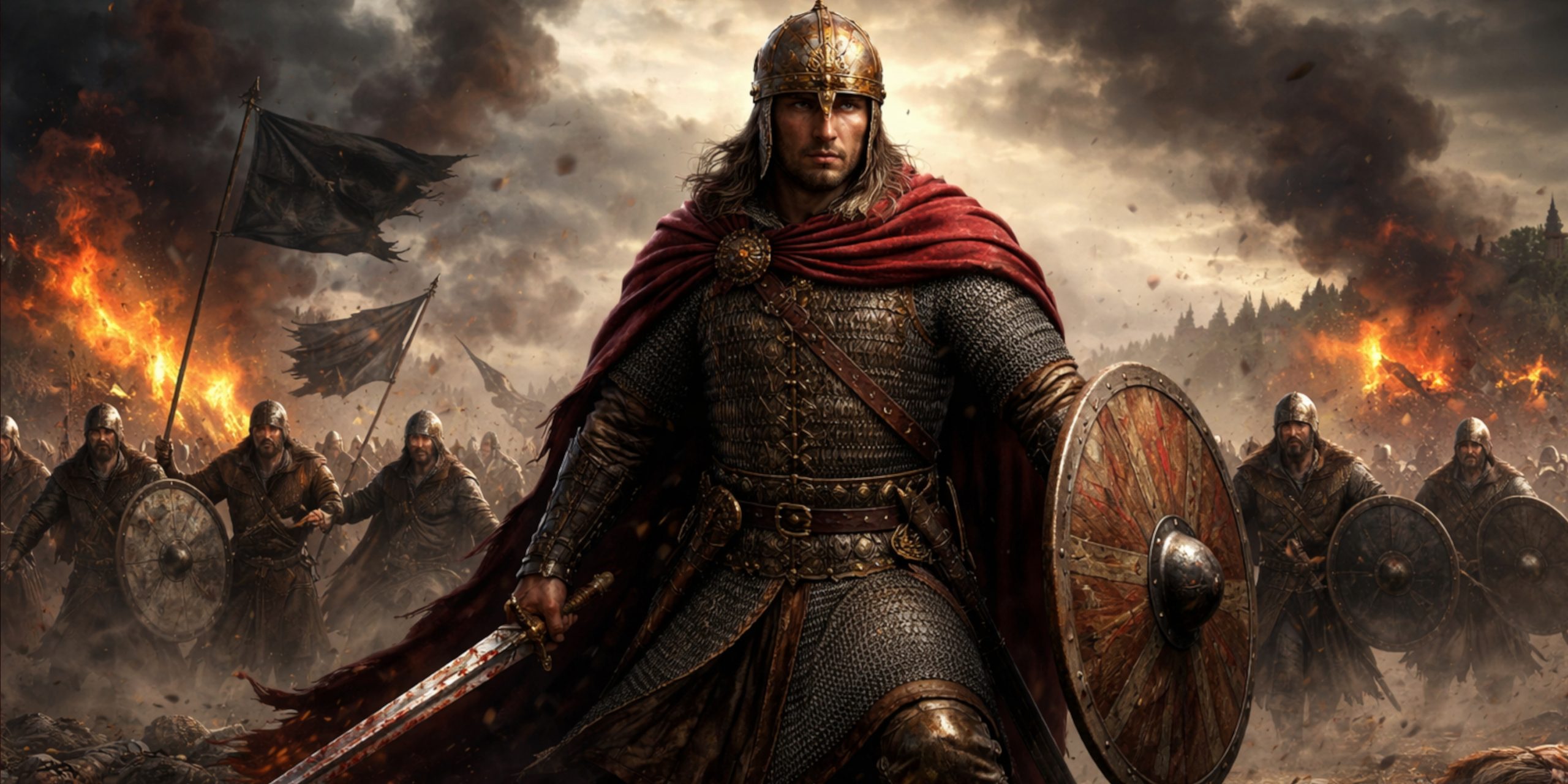
No items can be securely identified as belonging to Edmund himself, but we can reconstruct what an East Anglian king of the ninth century would have worn and carried.
Typical royal and elite equipment in Edmund’s East Anglia included:
- Pattern welded sword with a broad double edged blade, likely of Frankish origin
- Round shield with wooden core and iron boss
- Spear used both for throwing and close combat
- Seax or long knife as a secondary weapon
- Mail shirt for wealthier warriors, though not universal
- Conical helmet with nasal guard, similar in form to finds from Sutton Hoo and Coppergate
Edmund’s later legends describe him being shot with arrows before execution. While symbolic, it does fit the increasing use of bows by Scandinavian forces during this period.
Death and Martyrdom
Edmund was killed in November 869. According to tradition, he refused to renounce his faith or rule as a Viking client king. He was tied to a tree, scourged, shot with arrows, and beheaded. His head was later said to have been guarded by a wolf, which is exactly the sort of detail historians instinctively side eye, though it made for excellent storytelling.
What matters more is how quickly Edmund’s death was framed as martyrdom. Within decades he was venerated as a saint, his kingship recast as a moral stand rather than a failed defence.
Cult and Legacy
Edmund’s shrine at Bury St Edmunds became one of the most important pilgrimage sites in medieval England. Kings visited it. Oaths were sworn there. The abbey grew fabulously rich, which no doubt helped ensure Edmund’s story was preserved and embellished.
To later generations, Edmund represented the ideal of a Christian king who chose death over dishonour. To a modern historian, he also represents how memory can be shaped by need. East Anglia lost its independence, but it gained a saint powerful enough to rival any in England.
Artefacts and Where to See Them
No crown, sword, or armour can be definitively linked to Edmund. His physical relics were translated and re translated over centuries and were probably lost or destroyed during the Reformation.
However, you can still see material closely connected to his cult and context:
- The ruins of Bury St Edmunds Abbey
- Medieval manuscripts recounting his life, held by the British Library
- Anglo Saxon weaponry and regalia from East Anglia in the British Museum, offering a close parallel to what Edmund and his retinue would have used
Standing among these objects, you are reminded how little separates history from educated guesswork at this distance.
Latest Archaeology and Evidence
Recent archaeology has not uncovered anything that can be confidently described as Edmund’s. What it has done is enrich our understanding of ninth century East Anglia.
Excavations across Suffolk and Norfolk continue to reveal:
- Viking winter camps and execution sites
- High status Anglo Saxon burials indicating regional elites
- Evidence of rapid settlement disruption in the late ninth century
These findings support the broader picture of a kingdom under sudden and overwhelming pressure. Edmund’s death fits neatly into that archaeological pattern, even if the finer details remain out of reach.
A Historian’s Reflection
Edmund the Martyr is frustrating in the way only early medieval figures can be. He sits just beyond clear focus, his life filtered through monks, miracle stories, and political agendas. Yet he feels real. A young king facing annihilation, making a stand that failed militarily but succeeded culturally.
I sometimes think Edmund was more useful dead than alive, which sounds unkind but is probably true. His martyrdom gave East Anglia an identity that outlasted its independence. That, in its own strange way, is a form of victory.