History rarely gives young kings an easy ride. Edmund I inherited a kingdom still reforming itself after decades of Viking pressure, yet he managed to shape the early English state with a confidence that belied his age. Writing about him always feels like working through a half lit archive. The outlines are strong, but the details hide in the margins, waiting for a patient historian to coax them out.
Early Life and Accession
Edmund was born in 921, the son of Edward the Elder and half brother of Athelstan. By the time he reached adulthood, the Wessex and Mercian dynasties had moved from survival to consolidation. Athelstan’s death in 939 placed Edmund on the throne at about eighteen. One might expect such youth to draw opportunists, and indeed it did. Norse rulers in Northumbria saw their chance. The king learned early that kingship in tenth century England required decisiveness and a certain cold resolve.
His reign from 939 to 946 is short but pivotal. It carries the energy of a kingdom stiffening its spine after a generation of conflict.
Arms and Armour
Trying to imagine Edmund on campaign means sketching a silhouette rather than admiring a complete portrait. Tenth century royal equipment is sparsely preserved. Even so, contemporary sources and surviving parallels give us enough to build a reasonably confident picture.
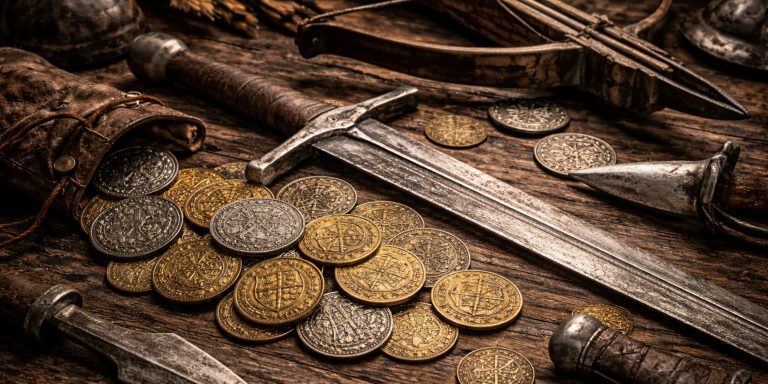
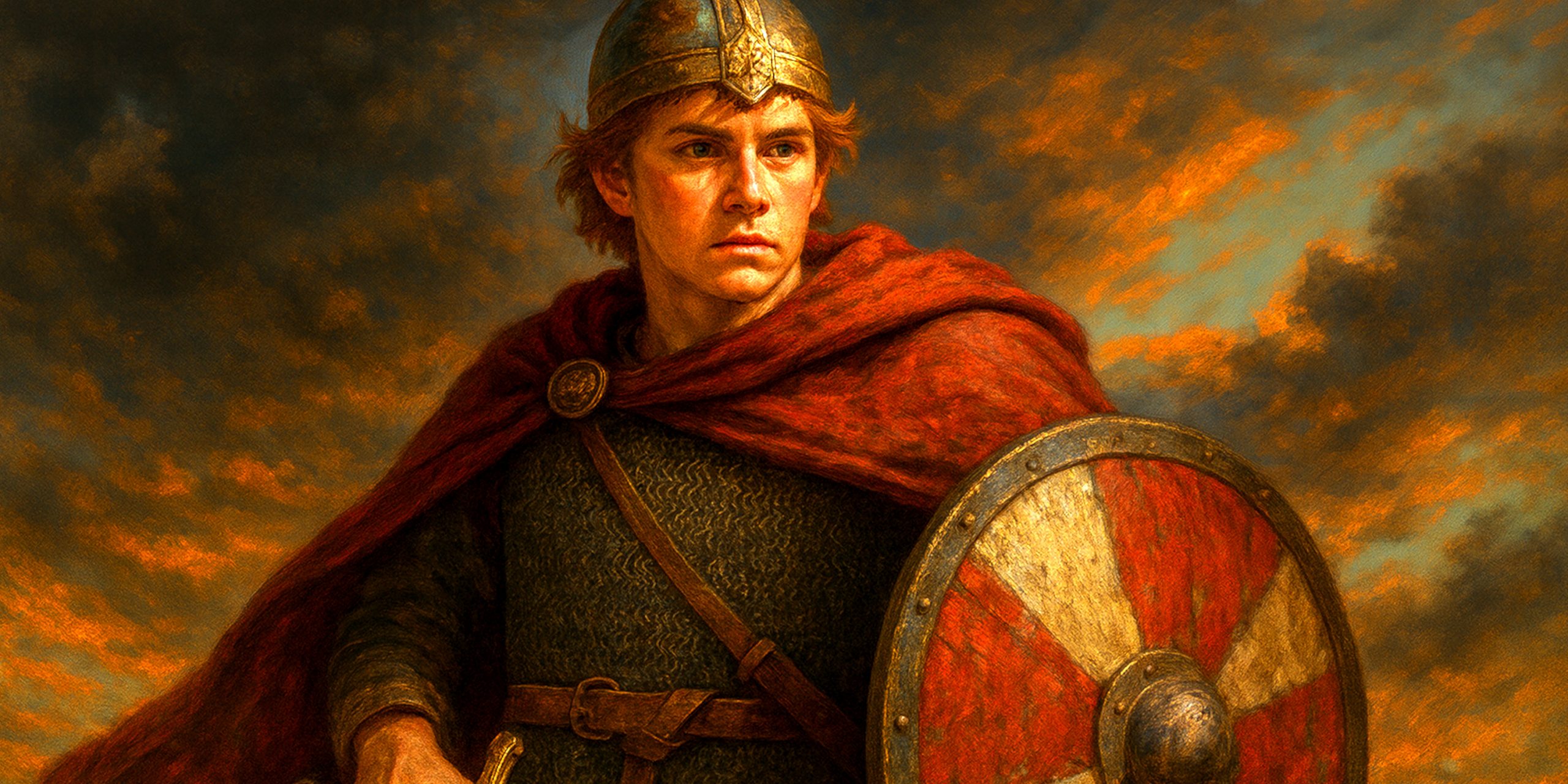
A king of his standing would have carried a pattern welded sword, the signature side arm of high status Anglo Saxon warriors. The blades of this period often came with long, narrow profiles and decorated pommels. His helmet would likely have resembled the late Vendel or early spangenhelm traditions, a practical iron frame rather than the ornate Sutton Hoo style that had already slipped into the past.
Mail shirts remained the core of elite armour, though never as uniform as later medieval hauberks. Shields were round, made from linden or pine, and painted in simple colours. Edmund’s war gear, while functional, symbolised continuity with his father’s generation. He was a young king but armed like a veteran.
Battles and Military Acumen
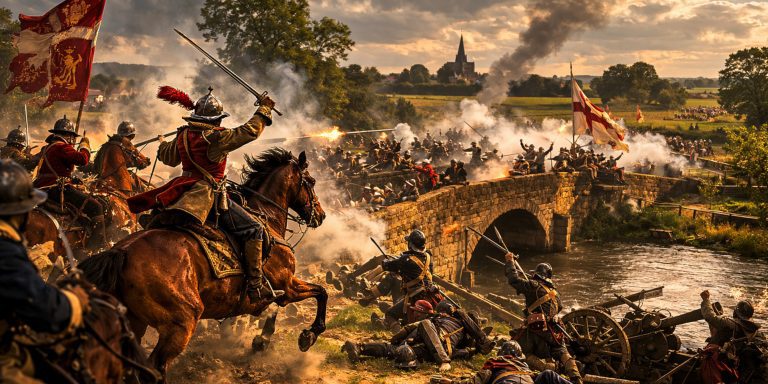
Edmund’s campaigns reveal a ruler who rarely hesitated. His first major trial came immediately when Olaf Guthfrithson seized Northumbria and advanced into the Midlands. Edmund pushed back with a mixture of direct force and careful coordination with local ealdormen. Gains were gradual, but by 941 he had recovered the Five Boroughs, a vital step in restoring the territorial integrity that his brother once commanded.
A second Norwegian claimant, Olaf Sihtricsson, complicated matters. Edmund did not win every engagement outright, yet he managed to tighten English control through attrition, negotiation, and strategic placements of loyal magnates. This hints at a king who understood the political map as well as the battlefield.
One of the more intriguing episodes is the siege of Leicester, which appears to show Edmund applying pressure in a sustained, organised fashion. I have always thought this moment reveals his temperament more clearly than any chronicler’s praise. The king did not simply charge at problems. He squeezed them until the outcomes favoured him.
His most impressive action may be the settlement with the Scots and Strathclyde Britons in 945. Edmund devastated Strathclyde then handed its rule to King Malcolm of Scotland while securing a promise of cooperation. English overlordship reached further north through one deliberate stroke than through Athelstan’s great showpiece battles. It is the work of a ruler thinking several steps ahead.
Reforms and Royal Authority
Although the military episodes take centre stage, Edmund’s reign also marks an administrative tightening. His legal codes stress protection of the church, proper conduct within communities, and a keen interest in royal dues. The laws demonstrate a king attempting to stabilise society after decades of flux. Reading them feels like listening in on a ruler who wants order before glory.
Death and Legacy
Edmund died in 946 during a feast at Pucklechurch after intervening in a brawl. It is an abrupt and faintly tragic end for a king who had finally settled the borders. His younger brother Eadred succeeded him and continued many of his policies. Edmund’s sons, Eadwig and Edgar, later shaped the golden age of the Benedictine reform.
His legacy is subtle but firm. Without his recovery of the Midlands and his political alignment of the northern kingdoms, the later idea of a unified England would have faced a harder road.
Where to See Artefacts from His Reign
Because few objects can be directly attached to Edmund himself, we rely on material culture from his time rather than his person.
You can examine tenth century Anglo Saxon swords and fittings at the British Museum, including pattern welded pieces that reflect the type of weapon the king would have carried.
The Ashmolean Museum in Oxford holds coins minted during Edmund’s reign, which are invaluable for studying royal iconography and economic stability. The Yorkshire Museum keeps finds from the Viking dominated north that help illustrate the environment in which Edmund fought and negotiated.
These collections give a tactile sense of the world he shaped, even if none of the items claims his direct ownership.
Latest Archaeology
Recent excavations at sites linked to the late Anglo Saxon frontier, such as Torksey and the Trent Valley, continue to adjust our understanding of the power dynamics that Edmund inherited. Although these digs do not focus squarely on Edmund, they illuminate the movements of money, weapons, and people during the period. Settlement data suggests more integration between English and Scandinavian communities than older narratives allowed.
Moreover, studies of the Five Boroughs region show shifting military organisation during Edmund’s campaigns. The strengthening of burh systems and rediscovered boundaries hint at a kingdom that was becoming more administratively coherent under pressure.
Archaeology rarely hands us revelations for such a brief reign, but it supplies the texture that written sources lack. In my opinion, that texture is what makes Edmund’s rule feel both fragile and determined.
The Seven Swords Takeaway
Edmund I sometimes reads like a bridge between giants. Athelstan before him and Edgar after him tend to steal the spotlight. Yet the dynasty needed a steady, sharp minded ruler to keep the project of a unified England alive. Edmund did that with a mixture of grit, negotiation, and a surprisingly modern grasp of political leverage.
If history had granted him twenty years rather than seven, the shape of the early English kingdom might have been even more defined. Even so, his short reign still leaves a clear impression, provided you look closely enough.
Watch the documentary: