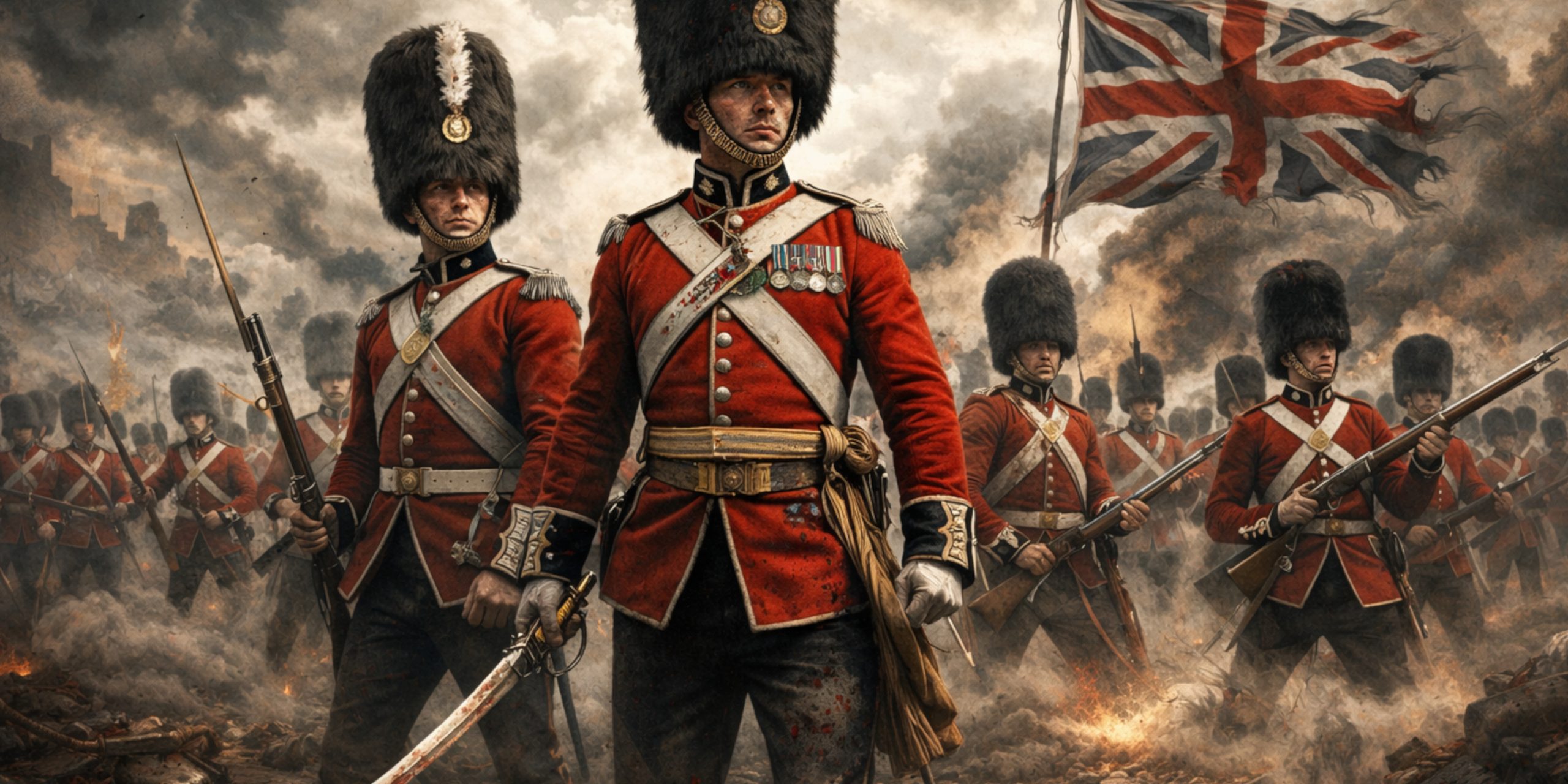
The British Foot Guards sit in an odd and fascinating space between battlefield pragmatism and theatre. They are soldiers first, symbols second, and the order matters more than most people realise. Their scarlet tunics and bearskins have become shorthand for Britain itself, yet their real story is written in mud, powder smoke, and long campaigns far from London.
As a historian, I always find it useful to strip away the ceremony first. Once you do that, what remains is a set of infantry regiments with an unusually long institutional memory, forged in seventeenth century civil war politics and maintained through relentless adaptation.
Origins and Early Development
The Foot Guards trace their origins to the English Civil Wars, when personal loyalty to the monarch was a military necessity rather than a branding exercise. The earliest formations were raised to protect Charles II during exile and return, a reminder that these regiments were created for survival, not pageantry.
By the late seventeenth century, the Guards were formalised as permanent standing units. This was controversial in Britain, where standing armies were viewed with suspicion. The compromise was simple and clever. Keep them close to the monarch, visible, disciplined, and politically loyal.
The core regiments that emerged were:
- Grenadier Guards
- Coldstream Guards
- Scots Guards
- Irish Guards
- Welsh Guards
Their order of precedence still reflects battlefield seniority, a detail that matters enormously within the regiments and not at all to anyone else.
The Dual Role, Warfighters and Symbols
The Foot Guards have always carried two responsibilities that occasionally pull in opposite directions. They are elite line infantry, expected to fight alongside the army in its hardest campaigns. They are also the visible face of royal authority.
This tension explains much about their culture. Discipline is absolute. Drill is unforgiving. Uniform regulations are enforced with a seriousness that borders on the theological. None of this is accidental. When your job includes representing the state in silence, mistakes carry more weight.
Yet when deployed on campaign, the Guards have rarely been sheltered. They fought at Blenheim, Waterloo, the Somme, Normandy, Korea, Iraq, and Afghanistan. The bearskin may be ceremonial, but the casualty lists are not.
Arms and Armour of the Foot Guards
Early Modern Period
In the seventeenth and eighteenth centuries, Guardsmen were equipped in line with contemporary infantry, with slight quality advantages.
- Matchlock and later flintlock muskets
- Socket bayonets by the early eighteenth century
- Defensive equipment limited to buff coats and occasional helmets in the earliest period
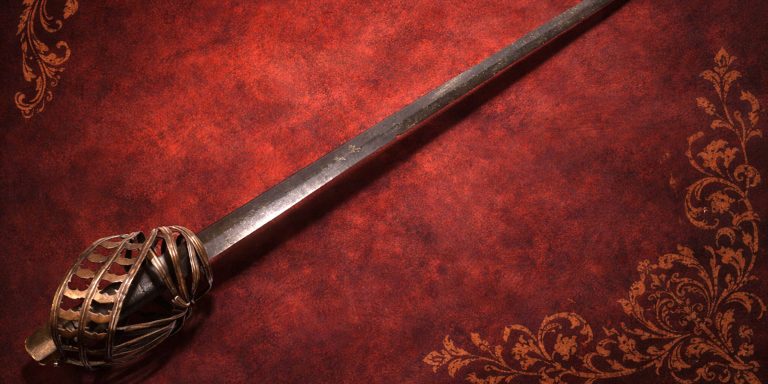
Sword Types Used
Officers of the Foot Guards carried swords that reflected both function and fashion.
- Small swords in the late seventeenth and eighteenth centuries, optimised for status and personal defence
- Infantry spadroons during the late eighteenth century, combining a straight blade with light cutting ability
- The 1822 Infantry Officer’s Sword, which became the defining pattern, featuring a curved blade with royal cypher and regimental etching
The sword was never a battlefield primary weapon by the nineteenth century, but it remained a visible marker of authority. A Guards officer without his sword looked incomplete, like a sentence without punctuation.
Modern Equipment
In the twentieth and twenty first centuries, Guards units have used the same service rifles as the rest of the British Army, from the Lee Enfield through to the SA80 series, with ceremonial arms retained separately.
Campaign History and Battlefield Reputation
The Guards developed a reputation for steadiness rather than flamboyance. Contemporary accounts often describe them as unyielding, even stubborn.
At Waterloo, the Guards famously repelled repeated French assaults, suffering heavily while holding their ground. During the First World War, their battalions endured the same attritional horror as other infantry units, with no exemption for ceremonial status.
There is a quiet irony here. The better known a regiment becomes at home, the more pressure it faces to prove itself abroad. The Guards have lived with that burden for centuries.
Archaeology and Material Evidence
Archaeology related specifically to the Foot Guards is less about grand discoveries and more about accumulation.
- Regimental museums hold uniforms, weapons, and personal effects recovered from battlefields
- Excavations on First World War sites in France and Belgium frequently uncover Guards insignia, buttons, and badge fragments
- Surviving barracks in London, particularly Wellington Barracks, preserve architectural layers that reflect changing military needs
These objects matter because they anchor ceremony to reality. A tarnished button tells a truer story than a polished parade ground ever could.
Contemporary Voices
Guardsmen were not prolific diarists as a group, but those who wrote left clear impressions.
An officer of the Coldstream Guards wrote during the Peninsular War that discipline was maintained not by fear alone, but by pride in the regiment and fear of letting it down.
During the First World War, a Grenadier Guards private described parade drill as harder than trench routine, adding that at least shells did not shout at you.
Such remarks cut through romanticism. They show soldiers who understood both the absurdity and the necessity of what they were asked to do.
The Foot Guards Today
Today, the Foot Guards remain operational infantry within the British Army while continuing their ceremonial duties as part of the Household Division.
This dual identity still shapes recruitment and training. A Guardsman must be able to stand motionless for hours and then deploy overseas with minimal notice. Few units demand that range, and fewer still have maintained it for so long.
Why the Foot Guards Endure
The endurance of the Foot Guards lies in continuity rather than nostalgia. They change just enough to survive, but never enough to forget who they are. As a historian, that is what I find most compelling. Institutions that remember their origins tend to understand their limits.
They are not relics. They are reminders that tradition, when properly maintained, is not the enemy of effectiveness. It is often its scaffolding.
Watch the documentary: