Mount Badon sits in that curious space where history becomes just blurry enough for legend to slip a hand around its shoulder. For a historian, this is both a delight and a menace. You can spend a lifetime combing the sources for certainty and still find yourself muttering at Gildas like an exasperated friend who refuses to give you a date. Yet the battle matters. It marked a turning point in the struggle between the Britons and the advancing Anglo Saxon groups in the late fifth or early sixth century.
Badon symbolised something rare in early medieval Britain. A moment when the scattered Brittonic kingdoms gathered enough strength, leadership and furious resolve to stop the steady Saxon push westward. Whether Arthur commanded there is another question. I will say only that if he did, he earned his ales for the year.
Forces
The armies at Badon remain partly shrouded, but the broad outlines are clear enough. On one side, the Britons drew upon several western and northern polities, loosely coordinated and desperate to protect their shrinking lands. On the other, Saxon warbands, probably from multiple groups, pressed inland with the confidence of decades of victories.
Estimated Forces Involved
| Side | Estimated Strength | Notes |
|---|---|---|
| Britons | 1,500 to 3,000 | Coalition of western Brittonic kingdoms. Numbers suggested by comparative early medieval muster norms. |
| Anglo Saxons | 1,200 to 3,500 | Likely mixed forces of West Saxons, Angles and allied groups. |
These estimates are modest by later medieval standards, but in a landscape of hillforts, ridges and choke points, they were more than enough to decide the fate of regions.
Leaders
Since the early sources insist on being coy, we must reconstruct leadership from hints, patterns and the occasional medieval boast.
Probable Commanders
| Side | Possible Leader | Evidence |
|---|---|---|
| Britons | Ambrosius Aurelianus or Arthur | Gildas credits Ambrosius as a leader of resistance. Later tradition places Arthur at Badon. Both remain debated. |
| Anglo Saxons | Ælle of the South Saxons, or a West Saxon war leader | Bede records Ælle as a prominent Saxon figure. West Saxon activity fits the geography. |
A historian will tell you that uncertainty is part of the work. A weary historian will tell you that Badon is at times an endurance test.
Arms and Armour
Both sides fought with a mixture of Roman influenced kit and early Germanic warfare traditions. The hill or ridge style battlefield often favoured those who held height and discipline.
Brittonic Arms and Armour
- Spears with leaf shaped heads
- Roman style oval shields
- Mail shirts among wealthier retainers
- Leather armour and padded jerkins
- Helmets drawing from late Roman ridge designs
- Sword types
- Spatha with broad cutting blades
- Shorter Roman influenced cavalry spathae
- Locally forged long swords with simple guards
Anglo Saxon Arms and Armour
- Long spears and javelins for the shield wall
- Round shields with iron bosses
- Early pattern mail for elite warriors
- Helmets influenced by continental styles
- Sword types
- Pattern welded long swords
- Seax knives for close finishing work
Arms and Armour Table
| Item | Britons | Anglo Saxons |
|---|---|---|
| Swords | Spatha, Roman cavalry blade | Pattern welded sword, seax |
| Shields | Oval Roman style | Round shield |
| Armour | Mail, leather, padded coat | Mail for elites, leather and woollen layers |
| Helmets | Late Roman ridge helm | Continental inspired helm |
| Spears | Long thrusting spear | Long spear, throwing javelins |
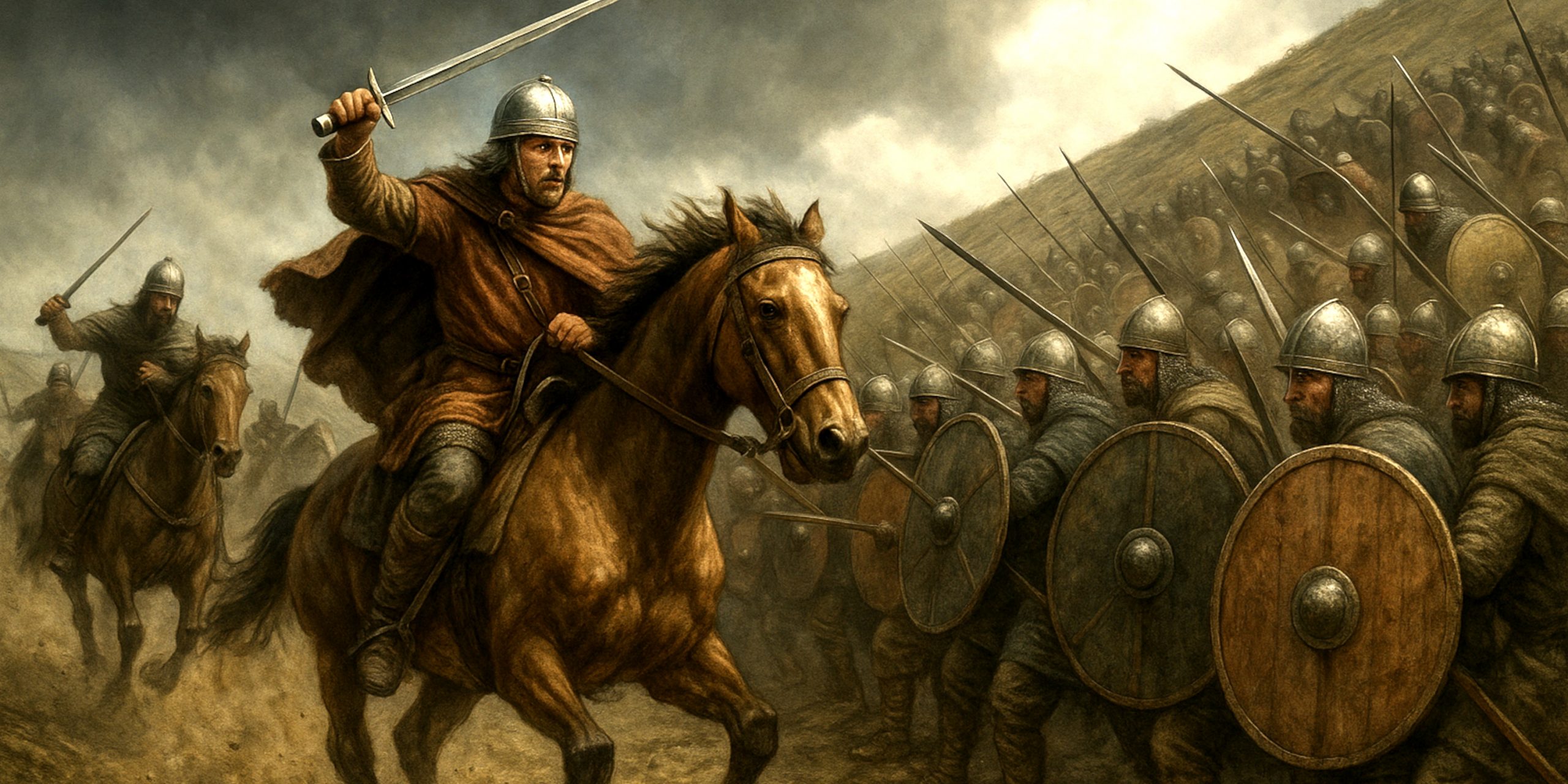
The fighting style likely involved Britons using defensive high ground, pressing downhill, while Saxons relied on the solidity of the shield wall. It must have been desperate, disciplined and loud.
Archaeology
Archaeology has been remarkably uncooperative, which is perhaps the most Badon thing about Badon. Several sites have been proposed, including Bath, Solsbury Hill, Badbury Rings and locations in Wiltshire. Each offers enticing fragments yet none has yielded the smoking spear point.
Key Archaeological Points
- No confirmed battlefield artefacts have been secured.
- Hillforts at Solsbury Hill and Badbury Rings show signs of occupation and fortification in the general period.
- Roman roads and defensive lines around Bath offer a plausible strategic anchor.
- Isotope analysis from burial sites in the region shows mixed populations, suggesting prolonged conflict zones but not a decisive battle layer.
Archaeology may yet surprise us. It usually does when historians have just written a firm conclusion.
Battle Timeline
This timeline reflects the consensus of historians who prefer modest confidence over wild claims.
| Approx. Date | Event |
|---|---|
| Late 440s | Increased Saxon pressure on Brittonic territories after the collapse of central Roman authority. |
| 460s to 480s | Ambrosius Aurelianus leads organised Brittonic resistance. |
| 490 to 510 | Probable window for the Battle of Mount Badon. Most scholars favour c. 500. |
| Day of Battle | Britons take defensive high ground. Saxons attempt uphill assault. Britons counterattack and rout Saxon forces. |
| Aftermath | A generation of relative peace for the Britons. Saxon expansion slows dramatically. |
Contemporary Quotes
Gildas offers the earliest reference, though one must forgive him for sounding like a man who has mislaid his footnotes.
Gildas, De Excidio
“A last but not least slaughter was inflicted on the Saxon horde at the siege of Mount Badon.”
It is not much, but it is what we have. Gildas had the frustrating habit of assuming everyone already knew the context. A mistake students of the period have been tidying up ever since.
Bede later summarises:
Bede, Ecclesiastical History
“They were defeated in that famous battle which was fought at Mount Badon.”
Concise. Painfully so. If only he had shown the same restraint when discussing missionary disputes.
Legacy
Badon became a symbol. It was remembered as the point where Britain refused to vanish into the Saxon tide. Whether the credit belongs to Ambrosius, Arthur or a coalition of local warlords, the result was a breathing space for Brittonic culture, language and identity.
Later chroniclers would use Badon as a narrative hinge, allowing Arthurian literature to flourish and giving medieval Britain a foundation myth rooted in resistance and resilience. Even now, Badon invites argument, imagination and careful academic sighing.
The Seven Swords Takeaway
The Battle of Mount Badon stands at the crossroads of history and story, which is perhaps fitting for early medieval Britain. The sources are thin, the archaeology silent, yet the significance undeniable. It halted the Saxon advance long enough for the Britons to regroup and for culture to survive. If ever a battle deserved both scrutiny and a touch of affection, it is this one. After all, it has kept historians busy for fifteen centuries, which is more than most battles can claim.
Watch the documentary: