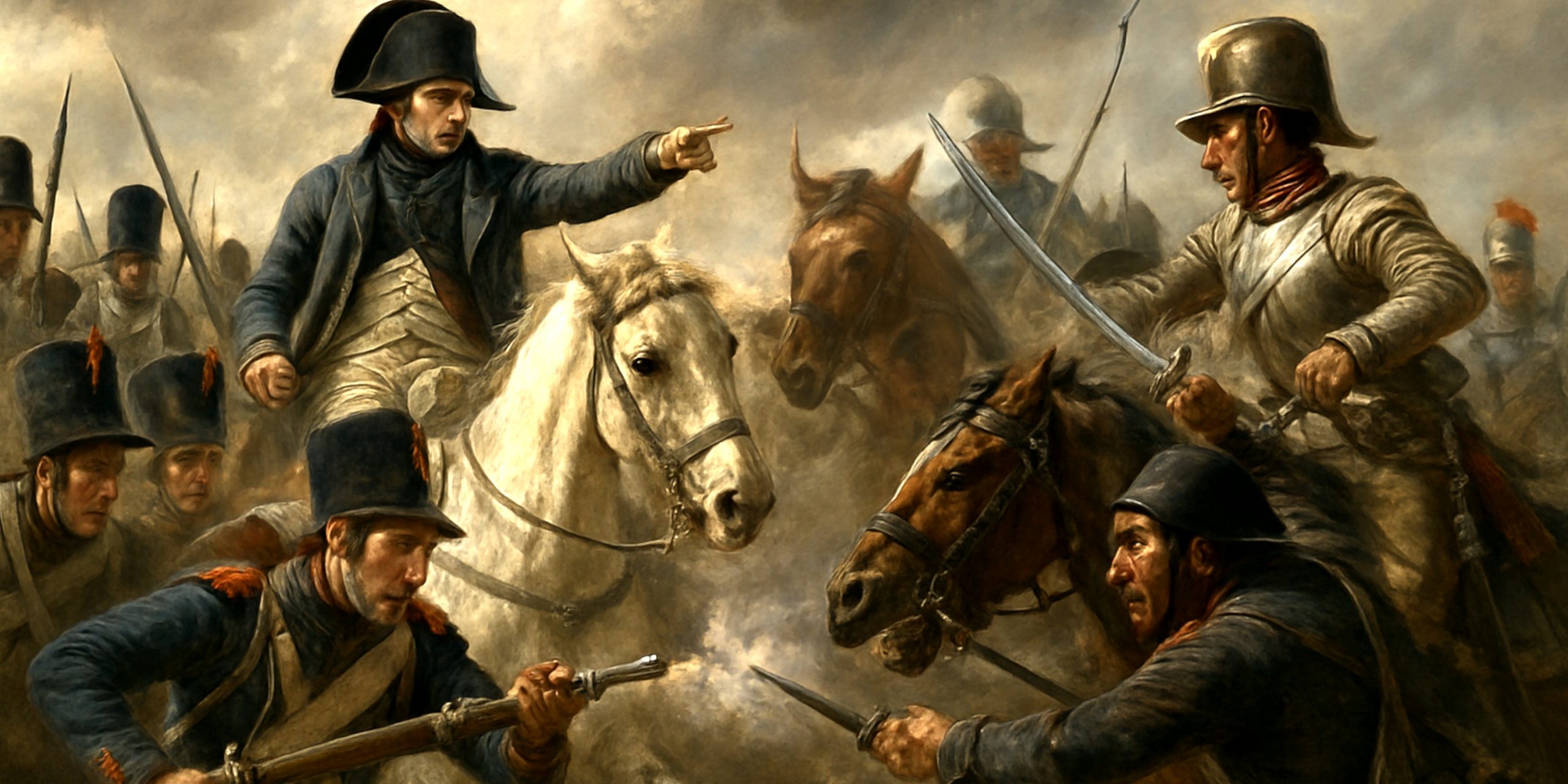
A historian cannot approach Marengo without a faint wince. It is one of those engagements where a single wobble of fate could have redrawn Europe. Napoleon walked away triumphant, although triumph in this instance arrived late, muddy and breathless. The day began with French forces on the brink of collapse and ended with the Austrians stunned at how quickly the ground shifted under their boots. There is a reason Marengo lingered in the minds of veterans. It had the atmosphere of a play rewritten halfway through the final act.
The battlefield lies in the plains east of Alessandria in northern Italy, a landscape of farms, irrigation channels and coarse pasture. It is no majestic amphitheatre of mountains and sweeping vistas. It is simply a place where men fought hard because their generals had decided they must.
Background
In the spring of 1800 Napoleon pushed across the Alps to outmanoeuvre Austrian forces in northern Italy. His intention was to sever their lines and force a decisive action on French terms. The Austrians, confident that the French had been pushed back earlier in the campaign, instead marched straight at Napoleon’s position near the village of Marengo.
The initial Austrian blow landed before the French were properly formed. As a historian, one must admit there is a certain poetic irony here. Napoleon, self styled master of timing, was caught off guard on a warm June morning by an enemy who had risen earlier than him.
Forces
Leaders
| Side | Commander | Notes |
|---|---|---|
| French Republic | First Consul Napoleon Bonaparte | Directed operations but relied heavily on subordinate initiative. |
| French Right Wing | Général Victor | Held the line with grim determination. |
| French Cavalry | Général François Kellermann | Delivered the decisive charge. |
| Austrian Empire | General Michael von Melas | Elderly, experienced, convinced he had won by midday. |
| Austrian Subordinate | General Zach | Took command late and faced the French counterstroke. |
Troop Composition
| Side | Estimated Strength | Components |
|---|---|---|
| French | Around 28,000 | Line infantry, light infantry, dragoons, hussars, artillery batteries. |
| Austrian | Around 31,000 | Line infantry, grenadiers, cuirassiers, uhlans, significant artillery support. |
Arms and Armour
Napoleonic warfare rarely brought heavy armour onto the field, although Austrian cuirassiers still wore their breastplates which offered modest protection against sabre cuts but little against musketry. The French cavalry, particularly the dragoons, fought with a mix of blades and carbines, adopting whatever level of swagger the moment allowed.
Notable Weapons
French swords
• Briquet infantry sabre, a practical sidearm for close quarters.
• Dragoon sabre modèle An IX, a sturdy curved sword used with enthusiasm when the lines broke.
• Light cavalry sabre modèle 1796, admired for its cutting power and borrowed in spirit from British patterns.
Austrian swords
• M1798 heavy cavalry straight sabre, favoured by cuirassiers for delivering powerful thrusts.
• Infantry officer sabres of varying regional patterns, reflecting the more eclectic Austrian system.
Firearms on both sides consisted of flintlock muskets, artillery field pieces and a good deal of smoke that made officers question whether their own orders had been heard at all. Anyone who claims Napoleonic battlefields were glamorous has never stood downwind of a six pounder.
Archaeology
Archaeological work around the Marengo plain has uncovered musket balls, uniform fittings, damaged sabre fragments and occasional artillery roundshot. Soil disturbances near Fontanone Stream correspond with French fallback positions noted in contemporary diaries. The ground retains faint evidence of trenching and makeshift earthworks created during the French retreat phase.
Metal detector surveys have revealed clusters of dropped Austrian ammunition where units surged forward in the morning attack. Several finds of French grenadier belt plates have been catalogued near the final countercharge route which adds weight to eyewitness accounts of their participation in the late rally.
The site is not as extensively excavated as larger Napoleonic fields, yet each fragment contributes to the day’s story. Archaeology strips away narrative embellishment and reveals what soldiers actually dropped, fired or smashed in panic.
Contemporary Quotes
French officer’s recollection:
We were pressed so hard that the dust tasted of fear. Only when the Consul arrived did we believe our legs might stop running.
Austrian grenadier’s note:
The French would not break. They bent and bent, and we thought them beaten. Then the earth seemed to move and carry them back upon us.
Kellermann, reportedly after the charge:
I saw the moment and took it. Had I waited, there would have been no moment at all.
These lines, though penned with hindsight, capture the sheer volatility of the battle.
Battle Timeline
| Time | Event |
|---|---|
| Early morning | Austrian forces advance quickly and strike the French forward positions near Marengo village. French line begins to fall back. |
| Late morning | Continuous Austrian pressure forces Napoleon’s army into a fighting retreat toward San Giuliano. French situation becomes dire. |
| Midday | General Melas, believing victory secure, leaves the battlefield, delegating further pursuit to his staff. |
| Early afternoon | Arrival of Général Desaix with fresh French troops. Desaix is killed shortly after entering the fight. His men stabilise the line. |
| Late afternoon | Kellermann launches a perfectly timed cavalry charge that breaks Austrian cohesion. French counterattack sweeps the field. |
| Evening | Austrian army withdraws in disorder. Napoleon claims a decisive victory. Reports to Paris describe a triumph rather than a rescue. |
Analysis
Marengo is often taught as evidence of Napoleon’s brilliance. Personally, I find it more revealing in its chaos than its choreography. Napoleon certainly recovered the situation, but it was Desaix’s timely arrival and Kellermann’s dash that saved the day. The Austrians, having fought well in the morning, collapsed in the face of a sudden reversal that stunned their already exhausted formations.
There is a lesson here about military overconfidence. Melas left the field after declaring the matter settled. He might have been happier had he stayed. Victory in Napoleonic warfare was not confirmed until the enemy stopped running, and even then one kept an eye on the horizon.
Legacy
Marengo secured Napoleon’s political authority in France. The victory narrative was polished carefully, leaving out the awkward moments before lunch and focusing on the triumphant dusk. It became a cornerstone of his legend, a story of calm control in the face of adversity.
The battlefield today is quieter, its fields turned over by ploughs rather than artillery. Visitors often remark on how ordinary it feels which is fitting because many great battles were fought in places that did not feel grand at all.
Watch the documentary: