The Battle of Bergerac in August 1345 is one of those moments in the Hundred Years’ War that deserves far more attention than it usually receives. It lacks the theatrical scale of Crécy or the muddy drama of Agincourt, yet its consequences were profound. In a single aggressive strike, the English commander Henry of Grosmont shattered French control across much of south-west France and turned the Gascon campaign on its head.
What makes Bergerac especially interesting is the way it reveals the English approach to warfare in the mid fourteenth century. Surprise, speed, and ruthless opportunism. Medieval commanders spoke often of honour and chivalry, but on campaign the men who thrived were those who struck first and asked questions later.
The French learned that lesson the hard way outside the town of Bergerac.
Background
By 1345 the Hundred Years’ War had entered a new phase. King Edward III of England launched a three-front offensive against France. One army moved through Flanders, another threatened Normandy, while a third expedition landed in Gascony.
This southern force was commanded by Henry of Grosmont, Earl of Derby, later Duke of Lancaster. Grosmont was one of the most capable English commanders of the war. Contemporary chroniclers praised both his courage and his ability to move quickly across difficult terrain.
Gascony was technically English territory, though much of the surrounding region was contested. French garrisons and loyalist forces dominated many towns, including Bergerac, an important settlement on the Dordogne River.
If the English wished to secure Gascony, Bergerac had to fall.
Rather than attempt a long siege, Grosmont chose a far more dramatic solution.
Forces
Precise numbers remain uncertain, though the sources allow reasonable estimates.
English and Gascon Army
| Category | Details |
|---|---|
| Commander | Henry of Grosmont, Earl of Derby |
| Estimated Strength | 1,200 to 2,000 troops |
| Composition | English men-at-arms, longbowmen, Gascon infantry |
| Tactical Strength | Mobility, disciplined archers, surprise attack |
Leaders
- Henry of Grosmont, Earl of Derby
- Walter Manny
- Gascon noble allies loyal to England
Troop Composition
- Mounted men-at-arms forming the shock force
- English longbowmen providing missile support
- Gascon infantry familiar with the local terrain
French Forces
| Category | Details |
|---|---|
| Commanders | Henri de Montigny and other regional nobles |
| Estimated Strength | Possibly 3,000 or more |
| Composition | Knights, men-at-arms, local levies |
| Tactical Strength | Larger force and defensive position |
Leaders
- Henri de Montigny
- Bertrand de l’Isle-Jourdain
- Several Gascon nobles loyal to the French crown
Troop Composition
- Heavily armoured knights
- Mounted men-at-arms
- Local infantry and militia units
Despite their numerical advantage, the French forces were poorly coordinated and scattered around the town.
That detail mattered enormously.
Arms and Armour
The battle occurred during a transitional period in medieval warfare when equipment was becoming more sophisticated but had not yet reached the full plate harness of the fifteenth century.
English and Gascon Equipment
Weapons
- Longbow
- Lance
- Poleaxe
- Dagger
- Arming sword
- Falchion
Common Sword Types
- Oakeshott Type XIII arming swords used by mounted men-at-arms
- Broad falchions carried by infantry
- Earlier knightly swords similar to Oakeshott Type XII
The English longbow was the most feared weapon on the field. Skilled archers could deliver a dense rain of arrows capable of breaking cavalry charges or disrupting infantry formations.
Armour
- Mail hauberks reinforced with plates
- Early plate defences for limbs
- Bascinet helmets with mail aventails
- Kite or heater shields
French Equipment
The French knights were similarly equipped but relied more heavily on mounted shock tactics.
Weapons
- Knightly lance
- Arming sword
- Mace
- War hammer
Sword Types
- Knightly arming swords comparable to Oakeshott Type XII and XIII
- Shorter secondary blades carried as sidearms
Armour
- Mail shirts with additional plate reinforcement
- Bascinet or great helm
- Heavy shields for mounted combat
On paper, neither side had a decisive technological advantage. The difference would come down to timing and discipline.
The Battle
The English advance toward Bergerac in August 1345 was swift and largely unexpected.
French forces in the region had assembled outside the town, likely believing they had time to prepare a proper defence. Grosmont recognised an opportunity and struck immediately.
Instead of forming up for a formal battle, the English launched a sudden attack against the French camp.
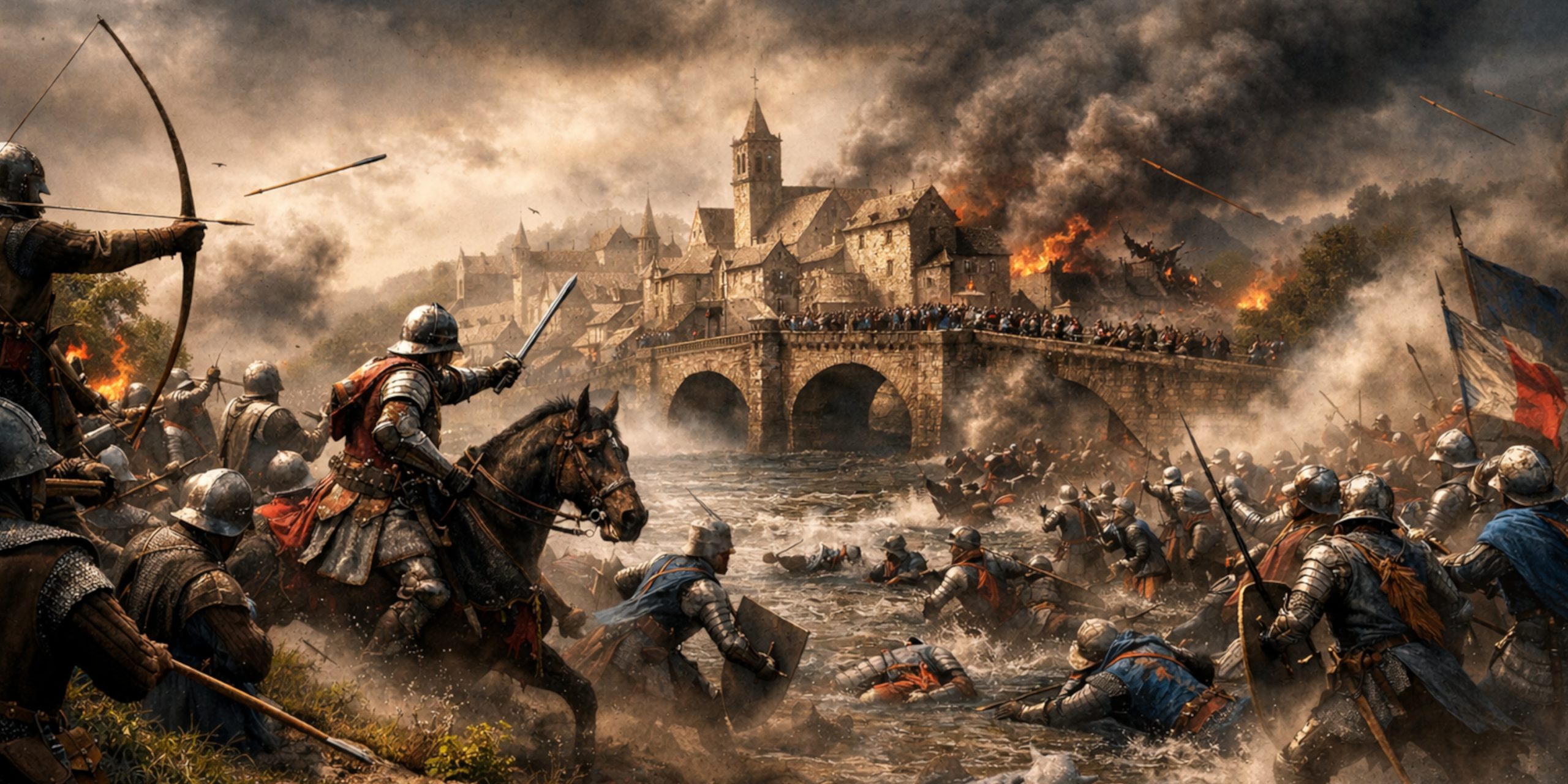
Longbowmen opened the engagement, sending arrows into confused ranks of soldiers who had not yet organised themselves. English men-at-arms followed quickly, charging into the disordered enemy.
What followed was less a tidy medieval battle and more a violent rout.
French troops attempting to form defensive lines were overwhelmed. Many fled toward the river while others attempted to retreat into Bergerac itself. English troops pushed forward relentlessly, capturing large numbers of prisoners.
Among the captured were several important French nobles, whose ransom payments later became extremely lucrative.
For a medieval army, this was the equivalent of winning the lottery.
Battle Timeline
| Stage | Event |
|---|---|
| Early August 1345 | Henry of Grosmont advances through Gascony toward Bergerac |
| Day of battle | English scouts locate French forces outside the town |
| Opening engagement | Longbowmen attack the French camp |
| Main assault | English men-at-arms charge into disorganised defenders |
| French collapse | Many French soldiers flee or are captured |
| Aftermath | Bergerac falls under English control |
The entire engagement appears to have been decided within a short period. Some accounts suggest it was effectively over in a matter of hours.
Archaeology
Compared with famous battlefields like Towton or Visby, the archaeology of Bergerac is limited. Urban development around the Dordogne has complicated large scale excavation.
However, scattered finds from the wider region provide a sense of the equipment used during the Gascon campaigns.
Archaeologists have recovered:
- Arrowheads typical of English longbow use
- Fragments of mail armour
- Medieval buckles and weapon fittings
Local historical surveys have also identified potential encampment areas near the river where medieval forces may have assembled.
Much of the battlefield itself remains buried beneath centuries of settlement. In other words, Bergerac hides its secrets rather well.
Medieval battlefields often do.
Contemporary Accounts
Chroniclers writing in the mid fourteenth century emphasised the shock of the French defeat.
The historian Jean Froissart wrote that the English attack struck the French before they could properly organise themselves.
“The English fell upon them suddenly and with great force, so that the French were taken in great disarray.”
Another account notes the scale of the captures rather than the slaughter.
“Many knights and squires were taken prisoner, and the ransom was great.”
Medieval warfare was often brutal, but noble prisoners represented profit. Capturing them alive could be more valuable than killing them.
A detail not lost on the men doing the fighting.
Aftermath and Legacy
The capture of Bergerac transformed the campaign in Gascony. English forces suddenly controlled a major strategic crossing on the Dordogne River.
Even more important were the prisoners. Their ransoms generated enormous wealth for the English commanders and their soldiers. Medieval warfare had a distinctly entrepreneurial side.
Grosmont followed up the victory with further aggressive campaigns, culminating in another decisive success at the Battle of Auberoche later that year.
Historians now recognise the Gascon campaign of 1345 as one of the most effective English offensives of the early Hundred Years’ War.
Bergerac was the opening act.
And it was a very good one.