Ancient Greece gets credited with a lot, sometimes fairly, sometimes lazily. Not every clever idea sprang fully formed from Athens, and the Greeks were excellent borrowers. What they did better than almost anyone else was refine, systemise, and explain. They turned practical tricks into ideas that could be taught, argued over, and improved. That habit changed the direction of history.
Below is a grounded look at what they actually invented, what they adapted, and why it still matters.
Mathematics and Geometry
Greek mathematics moved beyond counting and accounting into something abstract and surprisingly ambitious. The real leap was not the answers, but the method. Proof became the gold standard.
Think of figures like Euclid, whose Elements laid out geometry as a logical system built from axioms. It is dry reading, but it shaped how mathematics has been taught for over two thousand years. Pythagoras and his followers explored numerical relationships with a near religious obsession, linking numbers to music, harmony, and the structure of the cosmos.
From surveying land to designing temples, this mathematical mindset had practical consequences. You can trace a line from Greek geometry to Roman engineering and then straight into modern science classrooms. That is an unusually long afterlife for chalk and diagrams.
Medicine and the Study of the Body
Greek medicine took a sharp turn away from superstition, even if it did not abandon it completely. Disease stopped being a punishment from the gods and became something that could be observed and treated.
The central figure here is Hippocrates. The Hippocratic Corpus is uneven and sometimes wrong, but its insistence on careful observation was revolutionary. Symptoms were recorded, patterns noted, and treatments debated. Doctors began to think like investigators rather than priests.
Greek physicians also understood the importance of diet, exercise, and environment. Their theories of bodily humours are obsolete, but the underlying idea that health has physical causes still underpins medicine today. As a historian, I find this shift quietly radical. It is the moment when medicine starts to look forward instead of upward.
Engineering, Mechanics, and Practical Technology
Greek engineers were far more inventive than the popular image of philosophers in sandals suggests. They loved clever solutions, especially ones that showed off ingenuity.
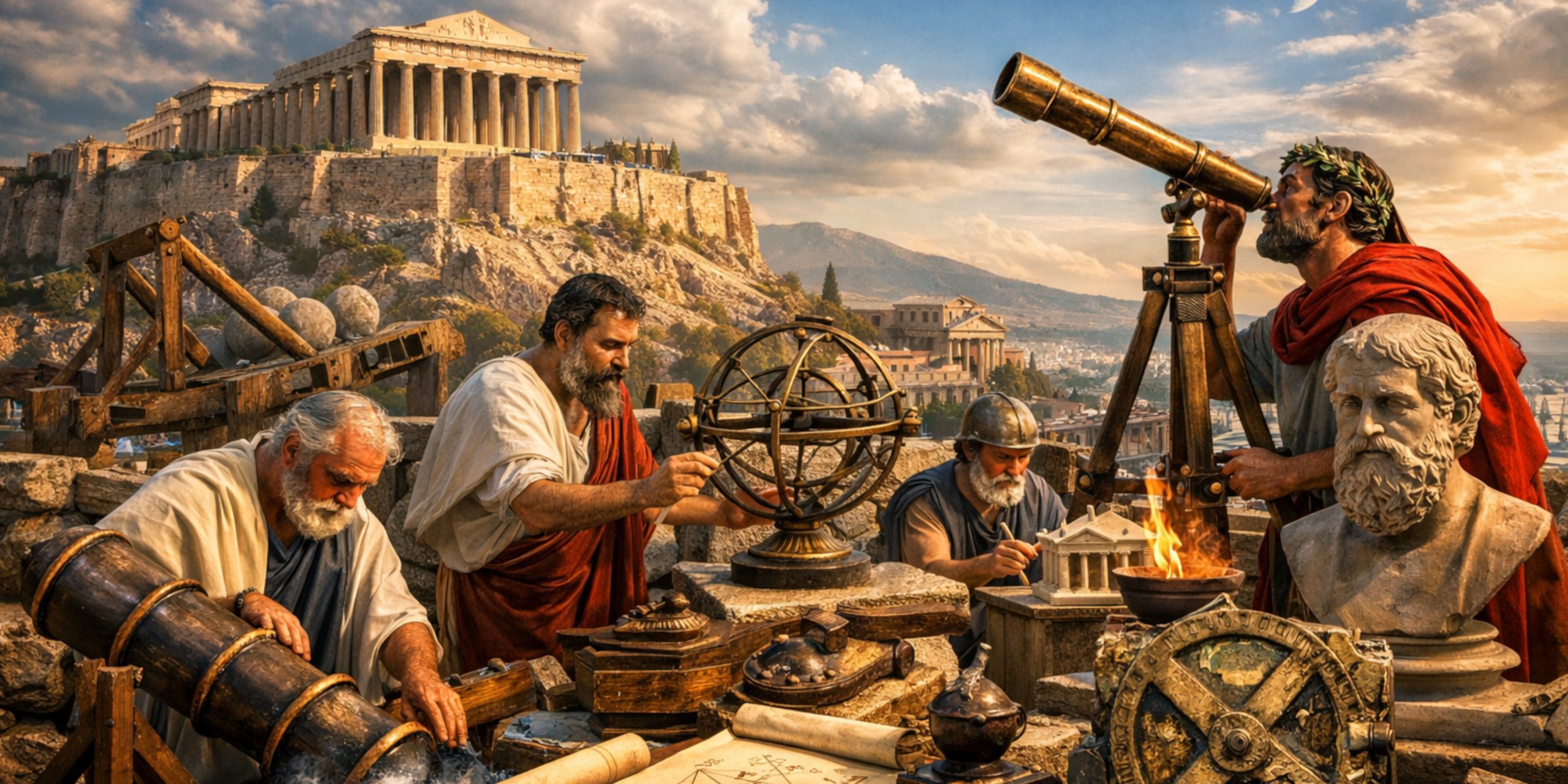
No one embodies this better than Archimedes. His screw pump, still used in irrigation today, is a masterclass in elegant design. His work on levers, pulleys, and buoyancy laid the groundwork for mechanical engineering.
The Greeks also developed early automata, water clocks, and complex siege engines. These were not industrial machines in the modern sense, but they show a willingness to experiment and to push materials to their limits. There is a playful curiosity here that feels very human, and very modern.
Astronomy and Understanding the Cosmos
Greek astronomy combined observation with bold theorising. Sometimes they got it wrong, but they always asked interesting questions.
Figures like Aristarchus of Samos proposed a heliocentric model centuries before it became acceptable. Hipparchus mapped stars and calculated eclipses with remarkable accuracy.
Perhaps the most astonishing artefact is the Antikythera Mechanism, a geared device used to predict celestial events. It feels out of place in the ancient world, like something dropped from a later century. It is a reminder that ancient technology could be far more sophisticated than we often assume.
Architecture and Building Design
Greek architecture is often reduced to columns and symmetry, but the real innovation lies in proportion and planning. Temples were designed to be seen from specific angles, with subtle optical corrections to counteract distortion.
The orders, Doric, Ionic, and Corinthian, were not just decorative styles. They were systems that balanced strength, aesthetics, and function. Greek builders understood load, spacing, and material behaviour in a practical way that later cultures eagerly copied.
This was architecture as applied mathematics, and it shaped civic spaces across the Mediterranean. Even now, government buildings borrow Greek forms to signal stability and authority. That visual language has been doing heavy lifting for a very long time.
Political and Social Innovation
Democracy deserves careful handling. The Greek version was limited, exclusionary, and often chaotic. Still, the idea that citizens could debate laws and hold leaders accountable was a genuine innovation.
In Athens, political participation became a civic duty rather than a privilege of birth alone. Courts, assemblies, and rotating offices created a system that valued argument and persuasion. It was messy, frequently unfair, and sometimes disastrous, but it was new.
As a historian, I find this both inspiring and sobering. The Greeks invented democracy, then spent centuries arguing about why it did not work properly. That feels familiar.
Philosophy, Logic, and the Art of Thinking
Greek philosophy was not a single invention, but a method. Asking why became as important as knowing what.
Socrates questioned everything, Plato systemised ideas, and Aristotle categorised the world with relentless enthusiasm. Logic, ethics, metaphysics, and political theory all took shape here. These were tools for thinking, not answers set in stone.
What matters is that disagreement was expected. Philosophy became a public activity, something to be argued over in marketplaces and schools. That habit of critical debate is one of Greece’s most enduring legacies.
Literature, Drama, and Storytelling
Greek drama introduced structure to storytelling. Tragedy and comedy explored human flaws, power, and fate in ways that still resonate.
Playwrights like Sophocles and Aristophanes understood pacing, character, and audience reaction with remarkable insight. Their innovations in plot and dialogue became templates for Western theatre.
Even the idea of analysing literature critically begins here. Stories were not just entertainment. They were tools for examining society, politics, and morality.
Seven Swords Takeaway
Ancient Greece did not invent everything it touched, but it transformed ideas into systems that could survive time, conquest, and cultural change. Its real achievement was intellectual confidence, the belief that the world could be understood, debated, and improved through human reason.
That confidence still shapes how we learn, argue, and build. It is an inheritance worth examining carefully, without myth-making, but also without cynicism. The Greeks were not modern, but they were curious in a way that feels uncomfortably close to home.
Watch the documentary: