A Historian’s Guide to the Old Midwinter
Yule has the sort of reputation that makes a historian lean forward a little. It sits at the crossroads of pagan ritual, seasonal hardship and the universal human desire to brighten a long winter. Long before it was absorbed, reshaped and repurposed by later faiths, Yule marked a turning point in the year, when communities watched the sky and hoped the sun had not given up altogether. Its customs grew from that simple fear and that simple hope.
The strength of Yule is that it was never only one thing. It was a feast, a toast, a sacrifice, a community gathering and an excuse to pretend the livestock had not started looking at you nervously. The sagas are not subtle about the seriousness of it. When the nights reach their longest, people reach for each other.
Origins of Yule
The festival began in Scandinavia and the wider Germanic world, shaped by a climate that forced people to take winter seriously. The Old Norse name jól appears in early poetry and myth, tied to Odin, who takes the title Jólnir, the Yule One. This already tells us something. If the Allfather himself is presiding over the festivities, you know the drinking will not be modest.
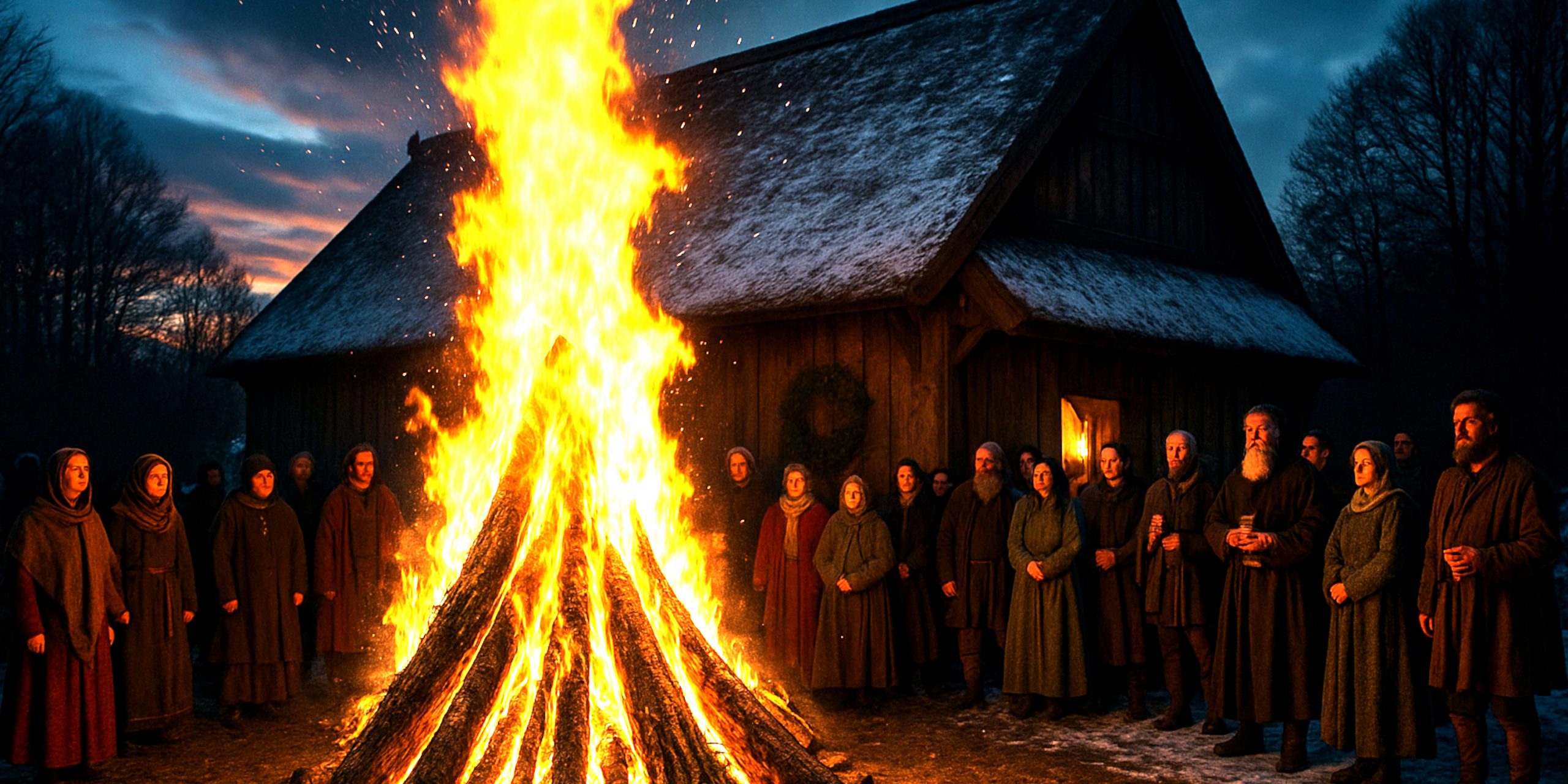
Yule revolved around the solar cycle. The long night was not just a nuisance but a cosmic threat. The turning of the sun after the solstice carried enormous symbolic power. Communities marked it with offerings and with fires that pushed back the darkness, if only a little. Much like today, morale mattered in winter, though it was arguably more life preserving than spirit lifting.
Key Traditions and Customs
Yule brought together a bundle of practices, each with its own job to do. The sources are uneven, but patterns do emerge.
Feasting
A proper Yule feast was not optional. It was both a religious duty and a chance to reaffirm communal bonds. Animals slaughtered at this time saved precious winter fodder and provided a symbolic gesture of plenty. It also kept people fed, which is important when the fields provide nothing except the promise of future frostbite.
Yule Logs
The Yule log was more than a decorative stump. It was chosen with care, burned slowly and sometimes kept alight for several days. Its embers were thought to protect the home. In an age before central heating, a reliable fire was as good a guardian spirit as any.
Blót
Yule blóts were sacrifices to the gods, the ancestors and the spirits bound to the land. Not all offerings were dramatic, though some certainly were. Ale, mead and food were common gifts, partly because they were valuable and partly because humans have always reasoned that the divine might appreciate a decent drink.
Wild Hunt
The midwinter nights were believed to bring out otherworldly forces. Odin leading the Wild Hunt across the sky was a striking image. If you heard strange winds or ghostly sounds, it was not the weather but spectral riders. A historian might say this is a colourful blend of folklore and fear, though I admit it does explain why people stayed indoors.
How Yule Influenced Later Celebrations
When Christianity spread through northern Europe, Yule was not erased so much as redirected. Old habits stick, particularly when those habits involve fires, food and socialising. Many midwinter traditions now associated with Christmas have deep roots in Yule lore. Evergreen greenery, gatherings around warmth, gift giving and even the timing of the celebration reflect this older festival.
This blending was practical rather than ideological. Missionaries found it easier to adapt familiar customs than to forbid everything and watch morale collapse. You could say that Yule survived by changing costumes.
Symbolism of Light, Renewal and Community
At the heart of Yule lies a simple message. Light returns. The wheel of the year turns. Communities endure. The imagery may vary, but the emotional core has remarkable persistence. Even today, people who do not practise any old pagan custom still put candles in windows, gather in warm rooms and brace themselves for January. The symbolism never lost its weight.
There is also a plain truth in the social aspect. Midwinter isolation is a poor idea. Yule reminded people that survival was a team sport long before anyone invented that phrase.
Yule in Modern Revival
Modern pagan and heathen groups continue to celebrate Yule with a mix of reconstructed ritual and creative interpretation. Some revive formal blóts, others focus on symbolic acts and seasonal gatherings. What separates revival from nostalgia is intention. People are not simply recreating the past but forging meaning from it.
Even those without spiritual aims enjoy the aesthetic of Yule. Candlelight, evergreen boughs, feasting, storytelling and a general refusal to surrender to winter all hold their appeal.
Why Yule traditions remain
Yule endures because it addresses something fundamental. It is a festival built on the recognition of darkness and the stubborn insistence on warmth. You do not need to believe Odin is thundering across the clouds to understand that. Anyone who has faced a long, cold evening and thought a good fire might solve at least one of life’s problems knows the feeling well.
The festival’s strength is its honesty. Winter is difficult. People gather anyway. Light fades. People make more. As a historian, I find that quality rather admirable. It is a ritual that grew out of real need, real fear and real hope, and it still speaks across the centuries.
Watch the documentary: