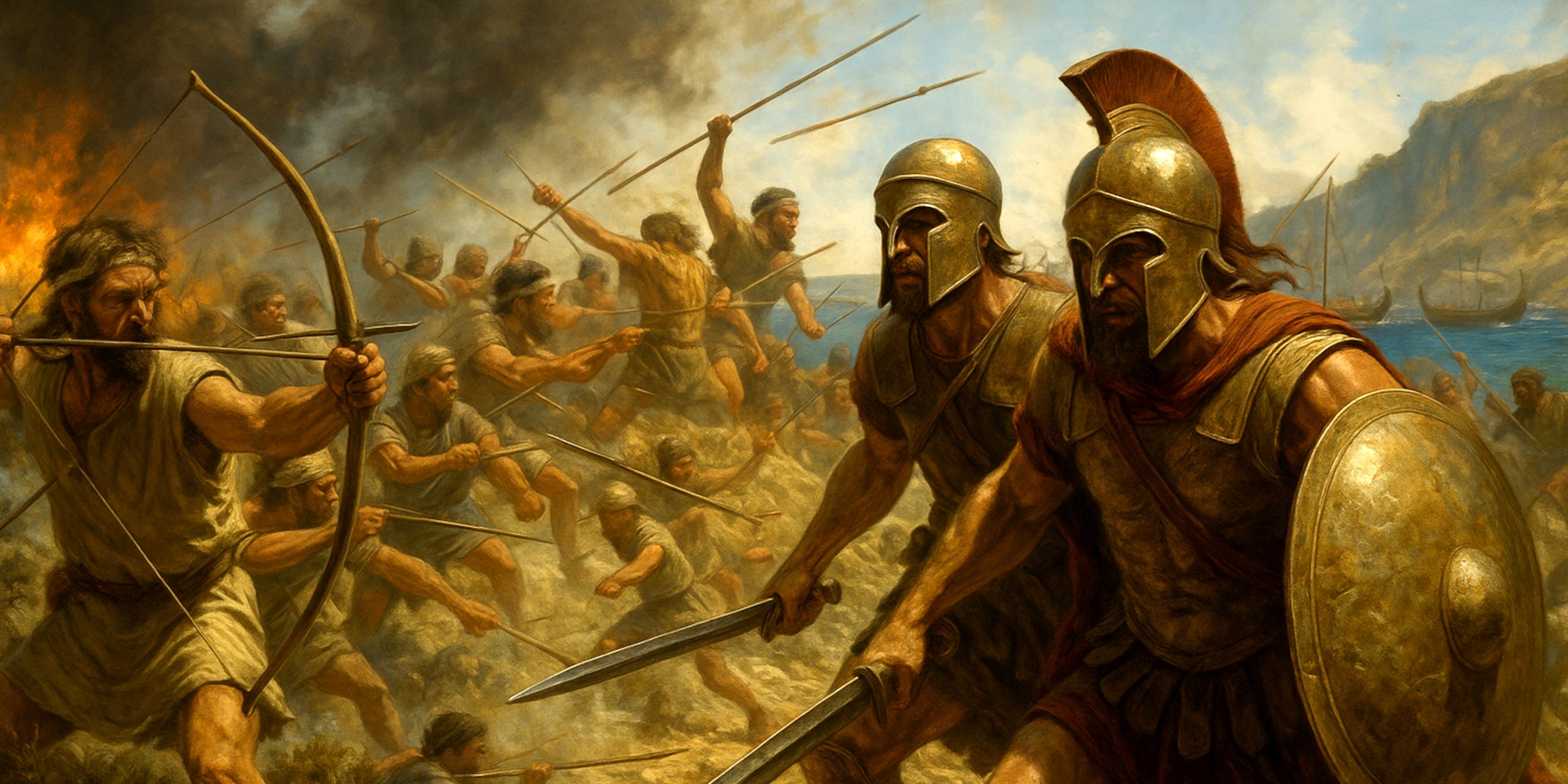
The Battle of Sphacteria in 425 BC sits at a curious crossroads in the Peloponnesian War. It was a moment when the supposedly unbreakable Spartan hoplite reputation cracked under the combined pressure of Athenian naval agility, light infantry tactics and several unfortunate fires. As a historian, I have always found Sphacteria rather refreshing. It proves that even the most disciplined warriors can have a very bad day if the enemy decides to bring archers, slingers and a good dose of improvisation.
The capture of hundreds of Spartan soldiers shocked the Greek world. It also provided Athens with a morale boost that would echo through its political speeches for years. This was not Thermopylae in reverse but it had a similar energy, only with more arrows and considerably less heroic posing.
Background
The battle emerged from an Athenian attempt to block Spartan logistics at Pylos under the command of Demosthenes. The Spartans attempted to drive the Athenians out but were repelled. A contingent of Spartan hoplites found themselves stranded on the nearby island of Sphacteria when the Athenian navy sealed the bay. What followed was essentially a siege, a stand off, then a frantic scramble when the Athenians landed troops on the island.
Forces
Commanders
| Side | Commander | Notes |
|---|---|---|
| Athens | Demosthenes, Cleon | Cleon arrived later but claimed the glory. Demosthenes did the tactical heavy lifting. |
| Sparta | Epitadas | Killed in the fighting. His replacement Hippagretas was also incapacitated. |
Troop Numbers
| Side | Estimated Strength | Composition |
|---|---|---|
| Athens | around 800 hoplites, 800 archers, several hundred peltasts and Messenian light troops | A varied force skilled in harassment tactics |
| Sparta | around 420 hoplites stranded on the island | Elite infantry, lighter support minimal |
Arms and Armour
Athenian Equipment
- Linen or composite cuirasses
- Bronze helmets of Attic and Chalcidian styles
- Hoplite spears, short swords of the xiphos variety
- Light troops armed with javelins, slings, bows
- Peltasts with small crescent shields
Spartan Equipment
- Bronze cuirasses and simple red cloaks worn in camp rather than battle
- Corinthian style helmets, increasingly open faced by this period
- Doru spears and the lakonikon, a short and sturdy Spartan sword
- Heavy hoplite shields providing strong frontal defence but unwieldy on uneven ground
Leaders and Troop Composition Table
| Category | Athens | Sparta |
|---|---|---|
| Primary Infantry | Hoplites with xiphos swords and spears | Hoplites with lakonikon swords and spears |
| Light Forces | Archers, slingers, peltasts, javelin men | Minimal light support |
| Auxiliary Support | Messenians familiar with the terrain | None of note |
| Tactical Focus | Mobility, ranged pressure, flanking | Shield wall, direct engagement |
History and Evolution of the Battle
The battle unfolded in distinct stages. The Spartans initially held strong positions but struggled with lack of water, food and rest. A stray spark from the Athenian fleet ignited the island’s scrub, clearing the Spartan cover. With the vegetation gone, the hoplites became far more exposed and the light Athenian troops found a field day ahead of them.
Demosthenes launched a landing operation supported by peltasts and archers who harassed the Spartans relentlessly. The hoplites tried to maintain formation but the rough terrain and constant barrage broke their cohesion. Messenian guides led crack troops behind Spartan lines, creating a pincer movement that finally exhausted the defenders.
The Spartans, cornered and with leaders incapacitated, chose surrender. The Greek world stood still for a moment. Spartans surrendered? It was as if someone claimed an owl had taught philosophy to a goat. Unthinkable, yet undeniable.
Advantages and Disadvantages
Athenian Advantages
- Numerical superiority in light troops
- Superior naval mobility
- Effective use of terrain once vegetation burned away
- Ability to rotate fresh troops
Athenian Disadvantages
- Hoplites less effective in direct confrontation with Spartans
- Risky landing operations in confined waters
Spartan Advantages
- Elite hoplite infantry
- Strong discipline and cohesion
- Moral prestige that usually intimidated opponents
Spartan Disadvantages
- No cavalry or missile troops
- Limited supplies
- Poor terrain for heavy infantry
- Encircled by naval forces
Battle Timeline
| Timeframe | Event |
|---|---|
| Early 425 BC | Demosthenes fortifies Pylos |
| Spartan response | Attempt to dislodge Athenians fails |
| Siege begins | Spartan hoplites stranded on Sphacteria |
| Accidental fire | Vegetation burns, exposing Spartan positions |
| Athenian landing | Light troops take initiative, pushing Spartans uphill |
| Final encirclement | Messenians outflank Spartan lines |
| Surrender | Surviving Spartans lay down arms |
Archaeology
Archaeological work on Pylos and the surrounding coastline has revealed fortifications consistent with Thucydides’ descriptions. The soil strata show charcoal layers that may correspond to the scrub fires described in ancient accounts. There are also concentrations of lead sling bullets that match Athenian light troop activity.
No major hoplite armour caches have been recovered from Sphacteria itself, which is unsurprising given later disturbances and the value of bronze to scavengers. What has been found supports a landscape of sudden skirmishes rather than a long static siege.
Contemporary Quotes
Thucydides captures the shock of the Spartan surrender with characteristic restraint:
The fact that the Spartans had surrendered was a great event in Greek opinion, for it was contrary to their national practice.
Plutarch later commented, with a touch more flourish:
The Spartans lay down their arms, a sight many believed they would never live to see.
I sympathise with the ancient commentators. Some events truly do make a historian pause, tilt their head and mutter that perhaps the world has changed a little.
Legacy
The victory gave Athens unprecedented leverage. It encouraged political hawks such as Cleon and reinforced confidence in Athenian naval strategy. For Sparta, the loss was humiliating, although predictably they masked the sting behind stern silence and tight lips.
The prisoners became bargaining chips. Their presence halted Spartan raids in Attica for several years, proving that even Sparta could be coerced if enough of its hoplites were held hostage.
The battle also demonstrated a broader truth of classical warfare. Heavy infantry purity might win set piece engagements but flexibility, light troops and terrain can turn a conflict upside down.