A Complete Guide to the Caribbean’s Iconic Wooden Sword
The Taíno macana carries the weight of a battlefield tool shaped by island life, ritual, and necessity. It belongs to a world before iron reached the Caribbean in quantity, a world where warriors relied on hardwood, stone, bone, skill, and speed. It deserves far more attention than it usually receives, particularly since it influenced how Europeans understood Indigenous warfare in the Greater Antilles
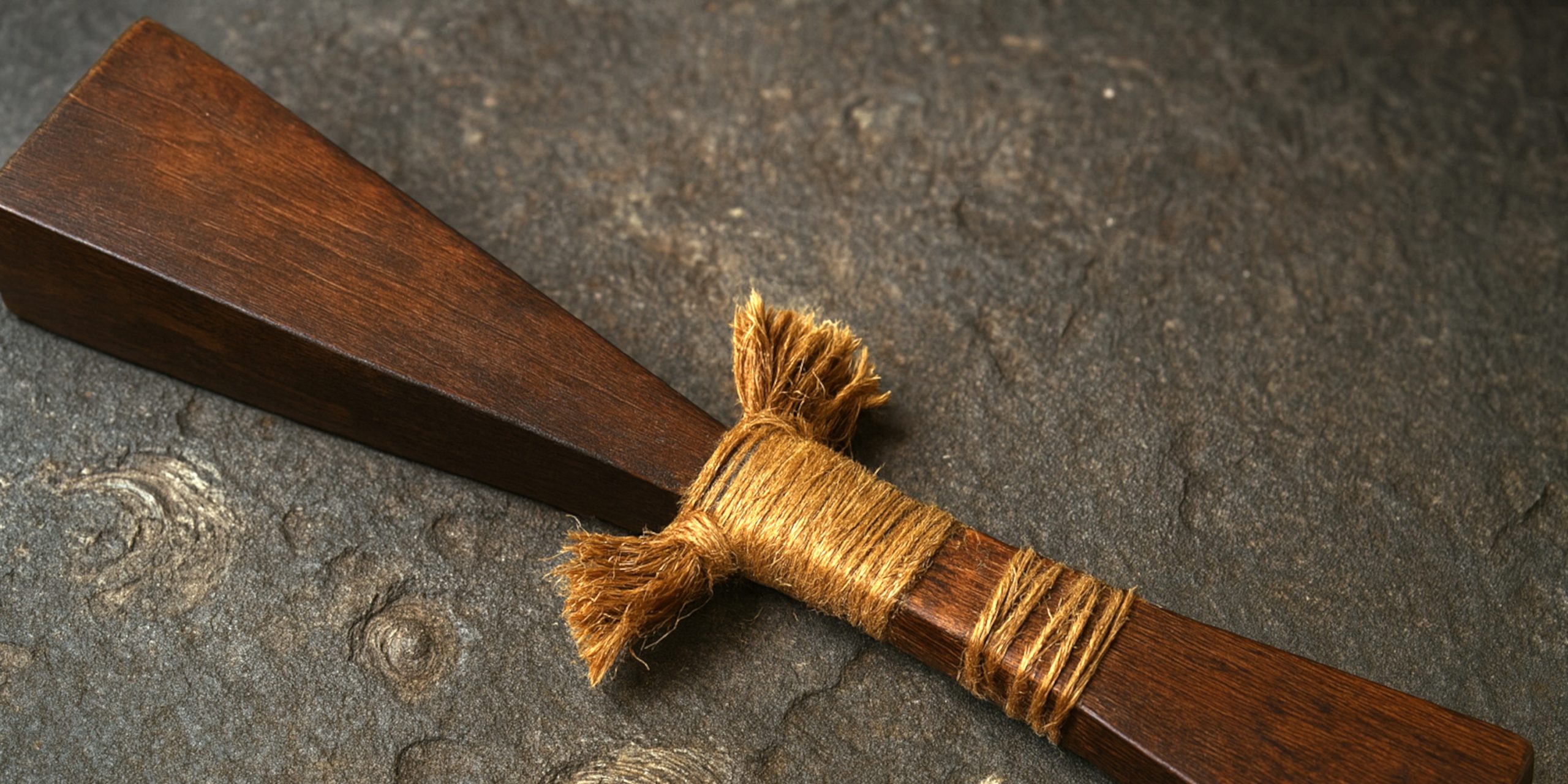
The macana was the principal striking weapon of the Taíno peoples of the Caribbean. Although often called a wooden sword, its form varied across regions. Some were long, flattened clubs. Others were shorter, broader paddles that could crush bone or split hide shields. The absence of metal did not limit its lethality. Dense tropical hardwood could deliver startling force when swung by a trained warrior.
Surviving accounts by early Spanish observers range from reluctant admiration to outright fear. A few chroniclers noted that a macana blow could shatter a steel cuirass, which may be an exaggeration, although the weapon certainly posed a threat to soldiers unarmoured or lightly protected.
Specification
General Features
- Material: Caribbean hardwoods such as guayacan or mahogany
- Form: Elongated club with a flattened striking edge
- Grip: Integral to the shaft, sometimes wrapped or carved
- Length range: Typically 60 to 100 centimetres, though long variants exceeded this
- Weight: Estimated between 0.7 and 1.8 kilograms, depending on thickness and length
Specification Table
| Feature | Typical Description |
|---|---|
| Material | Dense hardwood, often guayacan |
| Overall length | 60 to 100 cm |
| Blade width | 7 to 15 cm |
| Cross section | Flattened oval or rectangular |
| Edge treatment | Smoothed, sharpened wood, sometimes with inset stone flakes in some regions |
| Intended use | Striking, crushing, disabling opponent limbs |
| Grip | Carved as part of shaft, sometimes decorated |
History and Evolution
The macana grew out of older Caribbean and northern South American club traditions. Taíno societies refined it into several forms used for warfare, hunting, and ceremony.
Early variants were little more than straight clubs. Over time, the weapon became broader, flatter and more paddle-like. This made it better suited for powerful, sweeping strikes. Some mainland relatives carried embedded stone flakes, although pure wooden edges appear to have been the standard among the classic Taíno.
By the late fifteenth century, macanas were produced at scale and stored in community houses for mobilisations. When the Spanish arrived, the macana was present across the Greater Antilles, often used in coordinated ambushes against armoured and mounted intruders.
Colonial rule disrupted Taíno warfare, yet the macana endured as a ceremonial object in some communities and as a symbol of resistance in Caribbean cultural memory.
Advantages and Disadvantages
Advantages
- Made from extremely dense hardwood that could cause serious blunt trauma
- Quick to produce compared with metal weapons
- Resistant to corrosion in coastal environments
- Effective against lightly armoured foes
- Adaptable in length and shape for different fighting styles
Disadvantages
- Less effective against fully armoured European infantry
- Pure wooden edges dull quickly with repeated impacts
- Requires significant upper body strength for maximum effect
- Surviving original examples are extremely rare due to climate and material decay
Comparison with Similar Weapons
| Weapon | Region | Material | Combat Role | Key Difference |
|---|---|---|---|---|
| Taíno Macana | Caribbean | Hardwood | Blunt force striking | Pure wooden construction with paddle profile |
| Aztec Macuahuitl | Mesoamerica | Wood with obsidian blades | Cutting and slashing | Razor-sharp obsidian made it far more lethal on edges |
| South American Palo or Garrote | Northern South America | Hardwood | Clubbing | Generally lighter and rounder than macanas |
| Polynesian Patu | Pacific | Wood or bone | Close-quarters striking | Compact size designed for grappling range |
| Māori Mere | New Zealand | Nephrite or bone | Precise skull and joint strikes | Shorter and more refined, used with thrusts and chops |
Compared with obsidian-edged macuahuitl, the macana delivered force through weight rather than slicing. Against unarmoured foes, both were formidable. Against steel, the macana relied on its shock rather than penetration.
Legacy
Few Indigenous weapons from the Caribbean survive in modern memory, partly because so few physical specimens endured. Yet the macana remains a symbol of Taíno identity, community defence, and resistance during the early colonial period.
The weapon also offers insight into woodworking traditions. It helps correct outdated assumptions that Indigenous Caribbean warfare was primitive or ineffective. Spanish chroniclers who faced macanas in combat often wrote in tones that admit surprise, even reluctance, at how much punishment the weapons could deliver.
The macana features today in:
- Taíno revitalisation movements
- Caribbean museum displays
- Academic works on early colonial encounters
- Reconstructions for experimental archaeology
Where to See Macanas
Original Taíno wooden weapons are very scarce. A few institutions hold examples or fragments attributed to Taíno communities.
Museum Locations
- Museo del Hombre Dominicano, Santo Domingo
- Museo de las Américas, San Juan
- Smithsonian Institution, Washington
- Peabody Museum of Archaeology and Ethnology, Harvard University
- British Museum, London, for comparative Caribbean ethnographic items
Most surviving macanas are either fragmentary or preserved in environments that prevented decay. Some museums display modern reconstructions to help visitors understand original profiles.
Collector’s Guide
Authentic macanas are among the rarest Indigenous weapons on the market. Their survival is limited, making them highly sought after by collectors of pre-Columbian and early colonial artefacts. Many advertised pieces are later replicas or ceremonial sticks, so caution is essential.
Collecting Notes
- Genuine Taíno macanas must show correct hardwood species and prehistoric or early colonial tool marks
- Provenance is vital due to the frequency of replicas
- Most sales occur through private dealers rather than public auctions
- Condition varies greatly, often fragmentary
Estimated Auction Prices
| Type | Condition | Typical Price Range |
|---|---|---|
| Confirmed Taíno macana (complete or near complete) | Museum quality | 30,000 to 70,000 GBP |
| Fragmentary example | Partial shaft or blade | 5,000 to 15,000 GBP |
| Early colonial attributed macana | Mixed provenance | 8,000 to 25,000 GBP |
| Modern reproduction | Contemporary craft | 150 to 500 GBP |
Values change depending on documentation, fibre analysis, radiocarbon testing, and curator certification.
The Seven Swords Takeaway
The Taíno macana deserves its place among the world’s significant Indigenous weapons. It shows how communities without metalworking produced effective and culturally rich arms through craftsmanship, adaptation, and deep knowledge of local materials. For historians and collectors, it remains a rare and revealing window into Caribbean pre-contact life.