Anyone hoping for a tidy Roman pantheon arranged like a modern organisational chart is in for disappointment. The Roman gods were many, quarrelsome and inherited from a mixture of Italic belief, Greek influence and local cults absorbed through conquest. What emerged was a religious system so sprawling that even experienced priests sometimes looked as if they needed a sit down.
Yet this varied pantheon had purpose. The gods guided households, shaped armies and legitimised emperors. They appeared in festivals, omens, household shrines and state propaganda, forming a religious world both practical and mythic.
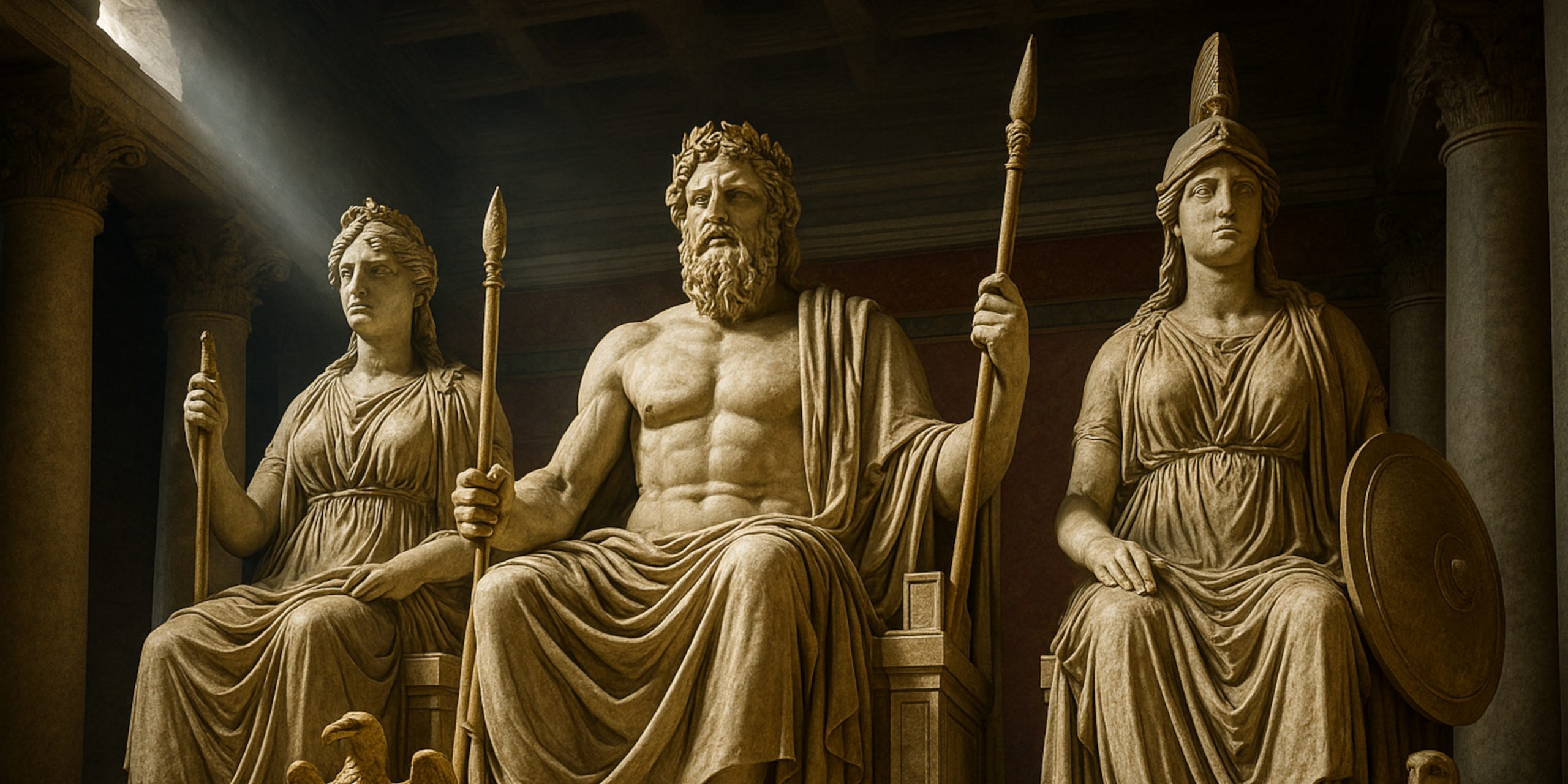
The Capitoline Triad
At the summit of Roman public religion stood three gods whose authority resonated through every corner of civic life.
Jupiter
The supreme sky god. Protector of Rome and enthusiast of thunder. His priests insisted he preferred white oxen for sacrifice, a detail that hints at the particular tastes of deities who deal in lightning.
Juno
Guardian of women, marriage and the Roman people. Her role as protector of the state made her presence essential in moments of crisis, which in Roman history is to say most years.
Minerva
Goddess of wisdom, crafts and strategic warfare. Less fond of reckless combat than Mars and far more interested in the planning stage, she represents the Roman ideal that sharp thinking often wins battles before swords leave their scabbards.
The Major Gods and Their Domains
Mars
Originating as a rural guardian, Mars evolved into the defining face of Roman military power. His festivals marked the opening of the campaigning season, a time when senators pretended they were not praying for someone else’s sons to fight the wars.
Venus
Goddess of beauty, desire and the divine ancestor of Aeneas. Her mythic pedigree was a gift to ambitious Romans keen to claim celestial relatives, particularly the Julian family who made sure no one forgot about it.
Neptune
Ruler of seas and storms. Roman sailors called upon him for protection, often with the pleading tone of men who had witnessed Mediterranean weather with their own eyes.
Apollo
Imported from Greece with minimal editing. Patron of healing, prophecy, music and poetry. Favoured by emperors who wished to appear refined, even when their track record suggested otherwise.
Diana
Goddess of the hunt, nature and the moon. Her sanctuary at Lake Nemi maintained a ritual where the priesthood changed hands through mortal combat. Roman religion never lacked drama.
Vulcan
God of fire, smithing and volcanic force. His festival in high summer was essentially an anxious prayer that one’s neighbourhood would not burst into flames.
Household Gods and Everyday Worship
Roman religion thrived in courtyards and kitchens as much as in grand temples. Families worshipped the Lares, guardians of home and neighbourhood, and the Penates, protectors of food stores. Small offerings were made daily. These rituals reminded Romans that the divine governed everything from dinner to destiny, a concept that would alarm any modern believer in personal independence.
Imported Gods and Cultural Blending
Conquest did not flatten local beliefs. Rome quite sensibly folded new gods into its system, rarely resisting the chance to adopt an extra protective power.
Isis
The Egyptian goddess soared in popularity among women in Rome. Her cult promised emotional connection and renewal, a refreshing contrast to Jupiter’s fondness for throwing lightning at people.
Mithras
A mystery faith embraced by soldiers. Rituals took place in underground chambers where initiates watched Mithras heroically dispatch a bull. The symbolism fascinated Romans, though one imagines the smell of enclosed rituals left something to be desired.
Cybele
The Great Mother. Her worship featured ecstatic ceremonies and loud processions that bewildered conservative politicians and delighted those who enjoyed theatrical religion.
Rituals and Festivals
Roman rituals demanded precision. A single mispronounced word could require the entire ceremony to start again. If this feels excessive, remember that Rome was a society where priests read the future by inspecting the livers of animals.
Festivals filled the calendar and shaped time itself. They offered moments of joy, chaos, purification and reflection.
Saturnalia
A December celebration of reversal and merriment. Social roles were briefly overturned, gifts exchanged, gambling permitted and dignity temporarily suspended. If a historian ever invents time travel, Saturnalia will be crowded.
Lupercalia
A February rite of purification and fertility. Priests dashed through the streets lightly clothed, tapping spectators with goat hide. Women believed the ritual encouraged fertility. Rome’s enthusiasm for public spectacle was never subdued.
Parilia
An April festival honouring shepherds and livestock. Rural in tone and rich with smoke, fire and chanting. A pleasant reminder that Roman religion predated marble temples.
Floralia
Dedicated to Flora. Celebrated in bright colours, lively performances and a general spirit that made prudish senators quite nervous.
Consualia
Honouring Consus, overseer of grain stores. Chariot races dominated the festivities. Myths place the abduction of the Sabine women during an early Consualia celebration, which says a great deal about early Roman diplomacy.
Vulcanalia
A summer festival praying protection against destructive fires. Offerings of fish were tossed into flames. Interpretations vary. Practicality is not among them.
Lemuria
A nocturnal rite in May to placate restless spirits. Heads of households walked barefoot, scattering black beans to distract ghosts. Roman neighbours developed impressive levels of tolerance for odd behaviour.
Religion, Politics and Power
Public religion and politics moved hand in hand. Augustus revived ancient rituals to steady a fractured state. Later emperors wielded divine associations with varying degrees of subtlety. Caligula lacked subtlety entirely. Hadrian preferred the intellectual elegance of classical cults, which at least made his propaganda easier to look at.
Priesthoods such as the augurs and the Vestals held significant authority. The Vestal Virgins in particular enjoyed prestigious privileges, including prime seating at games. One suspects many senators would have traded half their estates for such benefits.
Legacy of the Roman Pagan Gods
The Roman gods may no longer command official sacrifices, yet they linger everywhere. They shape language, astronomy, political symbolism and art. Jupiter appears in jovial, Mars lends his name to martial and Venus brightens more than one scientific discipline.
Renaissance scholars revived them with extravagant enthusiasm. The Enlightenment borrowed Roman civic ideals. Modern neopagan groups resurrect aspects of their worship with admirable creativity, though one doubts the ancient priesthoods would recognise the tax forms.
What remains is a testament to endurance. The gods outlived the empire that housed them. They have proved impossible to forget, which is perhaps the finest victory any deity could hope for.
The Seven Swords Takeaway
The Roman pagan gods formed a vast and evolving system that guided households, armies and emperors. Their festivals shaped the year, their myths shaped identity and their rituals shaped the character of Rome itself. For historians, they remain a reminder that belief in antiquity was not a private matter. It was community, politics, culture and sometimes a frantic offering when the auspices looked worrying.