A historian spends long enough in Roman religion and eventually Mithras wanders into view, usually through a dimly lit corridor beneath a barracks. The cult is one of those fascinating corners of the ancient world where evidence is rich in material form yet stubbornly quiet about meaning. It rewards curiosity, although occasionally it smirks at us from two thousand years away.
Seven Facts about the Cult of Mithras
1. Mithraea were underground or windowless
The characteristic mithraeum was a low, enclosed chamber that created an intimate atmosphere and no doubt a lingering smell of lamps. These spaces were designed to evoke a cave, reflecting the mythic setting of Mithras slaying the bull.
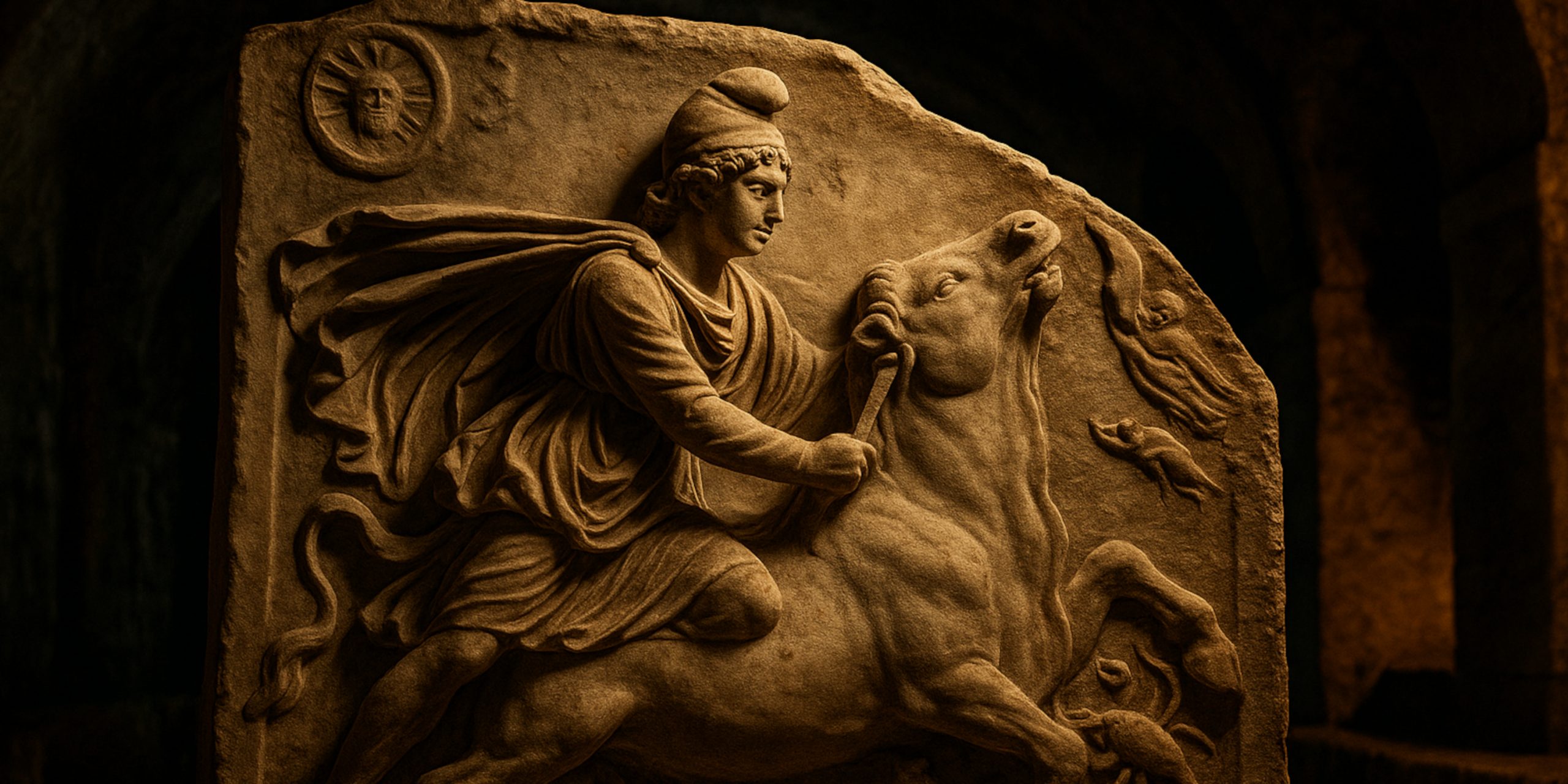
2. The tauroctony was the central image
Every mithraeum had a representation of Mithras killing the bull. The exact symbolism is still a scholarly battlefield. Some argue for astral meaning, others for agricultural cycles. If you ever want to see a group of experts argue politely for several decades, this is the place to look.
3. Membership was overwhelmingly male
The surviving evidence shows men almost exclusively. Soldiers, merchants and imperial functionaries make up the majority. It was not a military cult in a strict sense, but it clearly suited men who lived in close-knit groups and spent a great deal of time away from home.
4. The cult spread widely across the empire
From Roman Britain to the Syrian frontier, mithraea turned up in forts, cities and ports. The pattern of distribution often followed the army and trade networks, showing how mobile communities adopted and transplanted the cult.
5. Initiation was structured into grades
Inscriptions and frescoes list seven grades, from Corax to Pater. Each seems to have had its own ritual function. What exactly happened during each stage remains frustratingly obscure, proof that ancient secret societies took their confidentiality surprisingly seriously.
6. Ritual meals were central
Benches along the sides of mithraea were used for shared meals. These gatherings were as much about social bonding as religious expression. One imagines a group of legionaries trying to eat politely while sitting shoulder to shoulder in a narrow stone chamber.
7. The cult coexisted with other religions
Mithraism did not attempt to uproot traditional Roman religion. Followers could honour Mithras and still participate in civic rites. This flexibility helped it thrive in a religious landscape where plurality was normal.
Seven Myths about the Cult of Mithras
1. Mithraism was a Roman version of Christianity
The temptation here is understandable. A saviour figure, ritual meals, underground spaces, a male community. Yet the connections break down quickly. Mithras was not a dying and rising god, there is no doctrine of salvation, and the cult had no scriptural tradition. The resemblance exists mainly in the imagination of Victorian scholars, who sometimes let inventive enthusiasm overtake evidence.
2. Mithraism was exclusively a soldiers’ cult
Although the army played a major role in its spread, merchants, imperial slaves and administrators are well represented. The empire was a crowded place, and many people enjoyed belonging to a club that offered ritual structure and social status.
3. The cult involved literal bull sacrifice at every meeting
The famous tauroctony often encourages this misunderstanding. In reality, continual bull sacrifice would have been too expensive for weekly gatherings. The symbolic bull in the imagery was not a shopping list.
4. Mithras was a sun god in the simple sense
Mithras is linked to the sun, especially as Sol appears often alongside him, yet he is not identical with it. Their interactions in art show cooperation rather than equivalence. The relationship is subtle, and Roman religion did subtlety surprisingly well when it wished.
5. Mithraic ritual was universally the same
Local traditions varied. A mithraeum in Rome differed in detail from one in the Rhineland or the Danube provinces. The core framework was shared, but communities adapted the cult to their own conditions, proving that ancient religion was never quite as uniform as textbooks imply.
6. Women were absolutely barred everywhere
While the cult was overwhelmingly male, a few inscriptions hint at female involvement at the margins, often as donors. To call it a shared spiritual space would be stretching things, yet the sharp exclusivity often claimed in modern retellings is not fully borne out by the evidence.
7. The cult was violently suppressed by Christians
Its decline appears gradual and linked to changing urban development and shifting religious tastes. There are isolated signs of Christian hostility, but little that supports dramatic scenes of mithraea smashed by zealots. Most simply fell out of use, were filled in and forgotten until a construction crew turned up centuries later.
The Seven Swords Takeaway
Studying Mithraism is a reminder of what the ancient world does best. It offers us fragments, asks us to be patient and occasionally tells us, quite firmly, that we are not invited into the inner circle. As a historian I find that oddly charming. The cult may be gone, but the questions it raises are still lively, and the archaeology keeps us busy enough to feel we are edging closer to understanding, even if Mithras himself might enjoy watching us fumble in the half-light.
Watch the documentary: