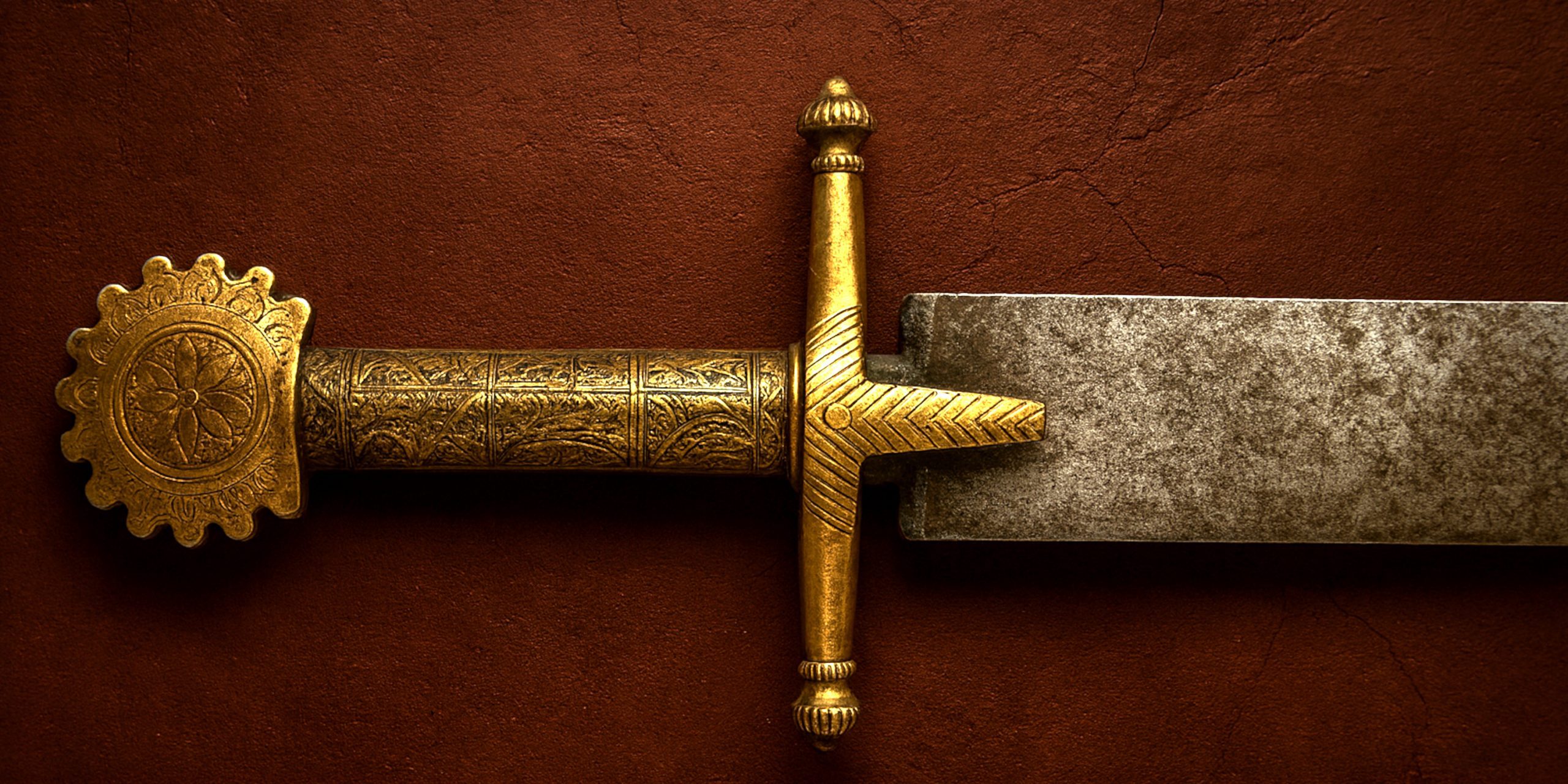
The Takouskara sits among the lesser known blades of North Africa, yet it tells a story that reaches across trade routes, tribal conflict and regional craftsmanship. Often associated with the Tuareg and related Saharan communities, the weapon developed as both a practical sidearm and a badge of status. Its lines share familiar ground with the broader family of Sahelian and Maghrebi swords, but its proportions and ornamentation give it a personality of its own.
Today the Takouskara attracts collectors who enjoy its blend of cultural identity and striking geometric decoration. It remains harder to find than its cousins such as the Takoba, which adds a certain tension to the hunt.
Specification
| Feature | Typical Details |
|---|---|
| Blade length | 40 to 55 cm, usually straight or faintly curved |
| Overall length | 55 to 75 cm |
| Blade type | Double edged iron or steel, often unfinished or only lightly polished |
| Fuller | Usually absent, though shallow grooves appear on some examples |
| Hilt | Iron or brass guard, wooden or leather wrapped grip, with regional geometric motifs |
| Pommel | Flat or squared metal plate set against leather binding |
| Scabbard | Leather covered wood, decorated with plaited designs or stamped metal |
History and Evolution
The Takouskara formed part of the weapon suite of Saharan cultures from roughly the late medieval period through the early twentieth century. Its development ran parallel to the Takoba, but the Takouskara tended to be shorter and handier for mounted skirmishing or quick personal defence.
Several influences shaped its evolution.
• Trade with the Maghreb brought steel blades from Morocco and Algeria.
• Contact with Sub Saharan communities encouraged experiments in decoration and leatherwork.
• The rise of caravan raiding and territorial disputes increased the need for lightweight, dependable blades.
By the nineteenth century the weapon had settled into its recognisable form. Some examples from this period show imported European blades cut down to local taste. Others were forged by regional smiths whose work can be identified through distinctive chisel marks.
Advantages and Disadvantages
Advantages
• Compact design suited to horseback fighting and rapid movement.
• Simple construction that resists harsh desert conditions.
• Strong cultural symbolism, often given as a gift or mark of status.
• Scabbards and hilts display craftsmanship that appeals to collectors.
Disadvantages
• Shorter reach than many contemporary swords.
• Variable blade quality due to mixed sources of steel.
• Authentic examples in good condition are now limited, increasing cost and risk of misattribution.
Comparison with Similar Weapons
| Weapon | Key Similarities | Key Differences |
|---|---|---|
| Takoba | Shared cultural origin, straight double edged blades | Takoba is significantly longer with a broader blade and large rectangular pommel |
| Kaskara | Straight, double edged, used in Saharan and Sudanese regions | Kaskara blades tend to be longer and more flexible, with cross guards shaped differently |
| Flyssa | North African craftsmanship, decorative motifs | Flyssa has a markedly slimmer profile and an angular, needle like point |
| Nimcha | Used across Maghreb and coastal areas | Nimcha is curved with a distinct S shaped guard and mariner influence |
The Takouskara occupies a niche between a full sized sword and a long dagger. It borrows from regional design language while retaining a compact efficiency that sets it apart.
Legacy
The Takouskara became a symbol of identity for several Saharan groups. Its scabbard work in particular preserves patterns associated with clans and trade guilds. European travellers of the nineteenth century often collected these weapons as examples of local craft rather than battlefield tools, which helped preserve several fine pieces.
Although modern ceremonial versions exist, the authentic historical examples speak most clearly about cultural exchange across the desert frontier. Their restrained size and clean geometry continue to draw interest from arms historians who value weapons that carry both practical and artistic weight.
Where to See
The weapon appears in collections that focus on Saharan material culture or North African arms.
• Musée du Quai Branly, Paris
• Pitt Rivers Museum, Oxford
• National Museum of Niger, Niamey
• Various private European collections specialising in Tuareg heritage
As with many regional weapons, examples are dispersed, and catalogues are sometimes inconsistent in naming conventions, so similar swords may be listed under Takouba or regional variants.
Collectors Guide and Auction Prices
Collectors look for several characteristics when assessing a Takouskara.
• Intact scabbards with original leatherwork
• Hilts with traditional geometric stamping
• Locally forged blades rather than imported refits
• Provenance from tribal regions of Mali, Niger or southern Algeria
Condition Grades
| Grade | Features | Typical Price Range |
|---|---|---|
| Excellent | Complete scabbard and hilt, minimal corrosion, strong provenance | 900 to 1,600 GBP |
| Good | Light corrosion, partial scabbard wear, decorative clarity intact | 500 to 800 GBP |
| Fair | Missing leatherwork, heavy pitting, uncertain origin | 250 to 450 GBP |
| Poor | Fragmentary or heavily restored pieces | under 200 GBP |
Recent Auction Notes
• Mid level examples have sold at European arms auctions for 600 to 900 GBP.
• High quality nineteenth century pieces with strong Tuareg provenance occasionally reach 1,500 GBP or more.
• Prices remain volatile due to limited supply and uncertain classification of borderline examples.
Collectors should take time with authentication since the Takouskara shares traits with several nearby weapon forms. Expert appraisal can prevent confusion with shortened Takoba blades or regional daggers.