The world of Aztec warfare has long fascinated me. It blends strict military ranks, religious fervour and a level of ritual that can unsettle even hardened historians. Yet it is also a place of profound bravery. The warriors who rose through its ranks did so with remarkable skill, stubborn endurance and the sort of ambition that made or unmade entire city states.
Below are the most famous figures and classes in Aztec martial history. Some are well recorded, others slip between chronicles and archaeology like ghosts. All left marks strong enough to survive the fall of an empire.
The Jaguar Warriors
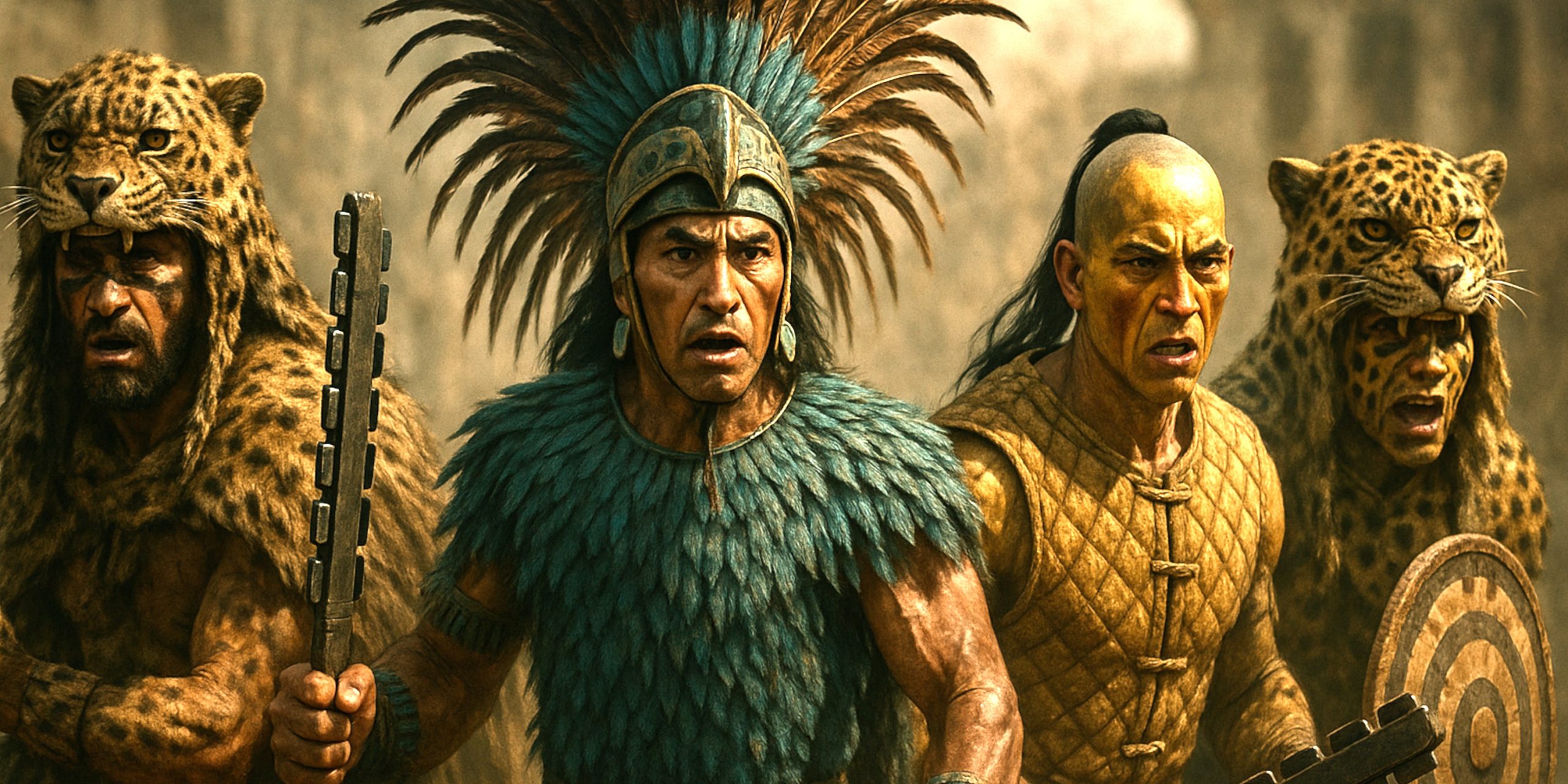
The Jaguar Warriors, or Ocēlōmeh, were elite fighters celebrated for their ferocity. They wore jaguar pelts, helmets carved to mimic a roaring cat and maintained an ethos that seemed to rattle even seasoned Spanish observers. Their status required capturing at least four enemy warriors alive, which gives you a sense of the confidence needed to stroll onto an Aztec battlefield.
Their battlefield role involved breaking lines, protecting officers and dealing rapid strikes against enemy elites. A hardened Jaguar Warrior could terrify a nervous recruit simply by walking into view.
Spanish chronicler Bernal Díaz wrote with a mix of awe and alarm:
“They came at us in such a rush, with their cries and great courage, that the ground itself seemed to tremble.”
The Eagle Warriors
The Eagle Warriors, or Cuāuhtli, held similar prestige but carried a different symbolism. They represented the sun’s eternal struggle and the promise of rebirth after death. Their attire was bright and unmistakable, and admittedly a nightmare for anyone trying to stay inconspicuous. Still, this visibility was intentional. Eagle Warriors were meant to lift morale and intimidate foes.
They excelled at mobile combat, flanking manoeuvres and shock attacks. Joining their ranks required the same capture requirements as the Jaguar Warriors, although contemporary accounts suggest the Eagles took particular pride in exceeding the quota. Overachievement, it seems, is not a modern invention.
Tlacateccatl and the Commanders
The Tlacateccatl served as a top general, often overseeing entire campaigns. This was not a ceremonial job. Commanders were expected to fight, lead by example and keep the entire military hierarchy functioning. One Tlacateccatl recorded in the sources, Tlacotzin, continued to hold influence even after the fall of Tenochtitlan, which hints at both his political and martial aptitude.
Another key rank, the Tlacochcalcatl, maintained control over armouries and strategic planning. Their decisions shaped battles long before the first projectile flew.
The Shorn Ones
These warriors were the most feared group in the Aztec world. Known as the Cuachicqueh, they shaved their heads except for a single braid and painted their faces yellow. Spanish troops met them only a handful of times but remembered it with real unease.
They swore not to retreat and often held chokepoints or attacked Spanish cavalry with startling precision. A conquistador described them as “men who seemed bound to die before they would surrender ground.”
I do envy their discipline, though I would not volunteer to share a trench with them.
Notable Named Aztec Warriors
Tlahuicole
A Tlaxcalan warrior captured by the Aztecs and later honoured for his strength. Instead of sacrificing him outright, they invited him to fight in gladiatorial combat to display his prowess. He defeated multiple opponents before finally falling. Even the Aztecs, never short on confidence, recognised his ability.
Nezahualcoyotl
Better known as a philosopher king, he still deserves a place here due to his tactical mind and his role in shaping the Triple Alliance’s early military stance. His legacy outshines most generals and includes poetry, city planning and a rather stern legal code.
Cacamatzin
A noble who resisted Spanish expansion and rallied warriors during the siege of Tenochtitlan. His speeches, recorded by indigenous chroniclers, show a man determined to hold identity and land even in the face of overwhelming odds.
Arms and Armour
Aztec warriors carried weapons that balanced pragmatism with ritual identity. Their craftsmanship still impresses modern archaeologists.
Macuahuitl
A wooden sword lined with obsidian blades. Capable of slicing deeply, sometimes described by Spaniards as sharp enough to sever a horse’s head.
Though I suspect the conquistador telling that tale may have enjoyed a bit of exaggeration, the weapon was unquestionably lethal.
Tepoztopilli
A polearm with obsidian edges, ideal for thrusting and slashing in tight formations.
Atlatl
A spear thrower used to deliver darts with frightening velocity. Veteran users could pierce Spanish armour plates.
Shields (Chimalli)
Colourful, layered with cotton padding and sometimes feathers, but surprisingly capable of absorbing blows.
Armour
Most elite warriors wore quilted cotton armour called ichcahuipilli. It was light, adaptable and more comfortable in the climate than the steel suits worn by Europeans. The bright uniforms of Jaguars and Eagles doubled as both battlefield display and a social identifier.
Archaeology
The Templo Mayor excavations in Mexico City have gifted historians more than a few pleasant surprises. Offerings containing obsidian blades, wooden macuahuitl fragments, helmets shaped like jaguars and eagle headdresses allow us to understand real craftsmanship rather than rely on Spanish metaphor.
One notable discovery was a ceremonial shield decorated with turquoise mosaics. Seeing it in person feels strange, because it retains a level of colour that makes the past seem far closer than you expect. Archaeologists have also uncovered training grounds and remains of armouries that confirm the scale of Aztec military organisation.
Excavations at various causeways show evidence of the final clashes during the siege. Arrowheads, sling stones and obsidian fragments scatter the soil, turning each trench into a quiet testimony of resistance.
Contemporary Voices
The Florentine Codex preserves words spoken by Aztec elders shortly after the conquest. One line in particular carries weight.
“We are crushed to the ground, but the sun will rise again.”
It captures the mix of resilience and mourning that defines so many accounts from the era.
Spanish chroniclers also contributed scattered observations, though with the expected bias. Bernal Díaz noted the precision and bravery of Aztec troops even while framing them as adversaries.
These layered voices help us recover the human reality of warfare, not just the political narrative.
Legacy
Even after the empire’s collapse, Aztec warriors became part of Mexico’s cultural memory. Their images appear in murals, literature and national symbolism. Modern martial arts groups study their techniques, and archaeologists continue to uncover training systems that show how meticulous the society was about preparing its fighters.
For all the violence of the era, the warriors who stood on those temple platforms or marched in jaguar skins understood courage in ways few of us ever will. Studying them is not simply a matter of cataloguing weapons. It is a reminder of how identity, belief and ambition shaped the outcome of an entire world.