Some figures slip into history with a flourish of steel. Alexandre Exquemelin wandered in through the back door with a medical kit and a talent for observation, yet he left more influence on our understanding of piracy than most captains who ever waved a cutlass. His book became the spine of Golden Age pirate mythology, even if he never meant to write legend. Half reluctant adventurer, half careful witness, he remains one of the most intriguing voices of the seventeenth century Caribbean.
Early Life and Background
Exquemelin was born in the Spanish Netherlands, most likely in what is now northern France or Belgium. The records are as cooperative as a hungover privateer, which means they offer very little. We know he came from a Flemish or French speaking background and was apprenticed to the French West India Company. The company brought him to the Caribbean where he soon discovered that life as an indentured servant was less a career path and more a prolonged attempt to dodge poverty and dehydration.
His early years in the New World were marked by illness and hard labour. These were formative in the sense that they convinced him he wanted nothing to do with the French Company again. Once free of his contract, he joined the buccaneers of Tortuga. The transition from corporate drudgery to pirate surgeon was, shall we say, dramatic.
Exquemelin the Buccaneer Surgeon
Serving as a surgeon among buccaneers was a practical role, though it did come with a higher chance of being asked to amputate a limb on a moving deck. He treated wounds from musket fire, sabre cuts, splinter injuries and assorted disasters that occur when men with rum are handed gunpowder.
He served under several noted privateers, including Henry Morgan. His account of Morgan is one of the great narrative anchors of seventeenth century piracy. It is descriptive, occasionally scandalous, and at times so bluntly phrased that you can feel his disapproval crackling through the page.
Weapons of the Buccaneers
While Exquemelin was not a fighting man by preference, he was surrounded by those who followed more combative hobbies. The weaponry of the period included:
- Cutlasses with broad blades suited for close fighting.
- Flintlock pistols, often carried in pairs because accuracy was a polite suggestion rather than a promise.
- Muskets used during boarding actions or shore raids.
- Boarding pikes and hand grenades for more enthusiastic assaults.
Exquemelin’s descriptions rarely linger on technical details, but his accounts of injuries speak volumes. You can reconstruct the arsenal from the wounds alone.
Ships of Exquemelin’s Era
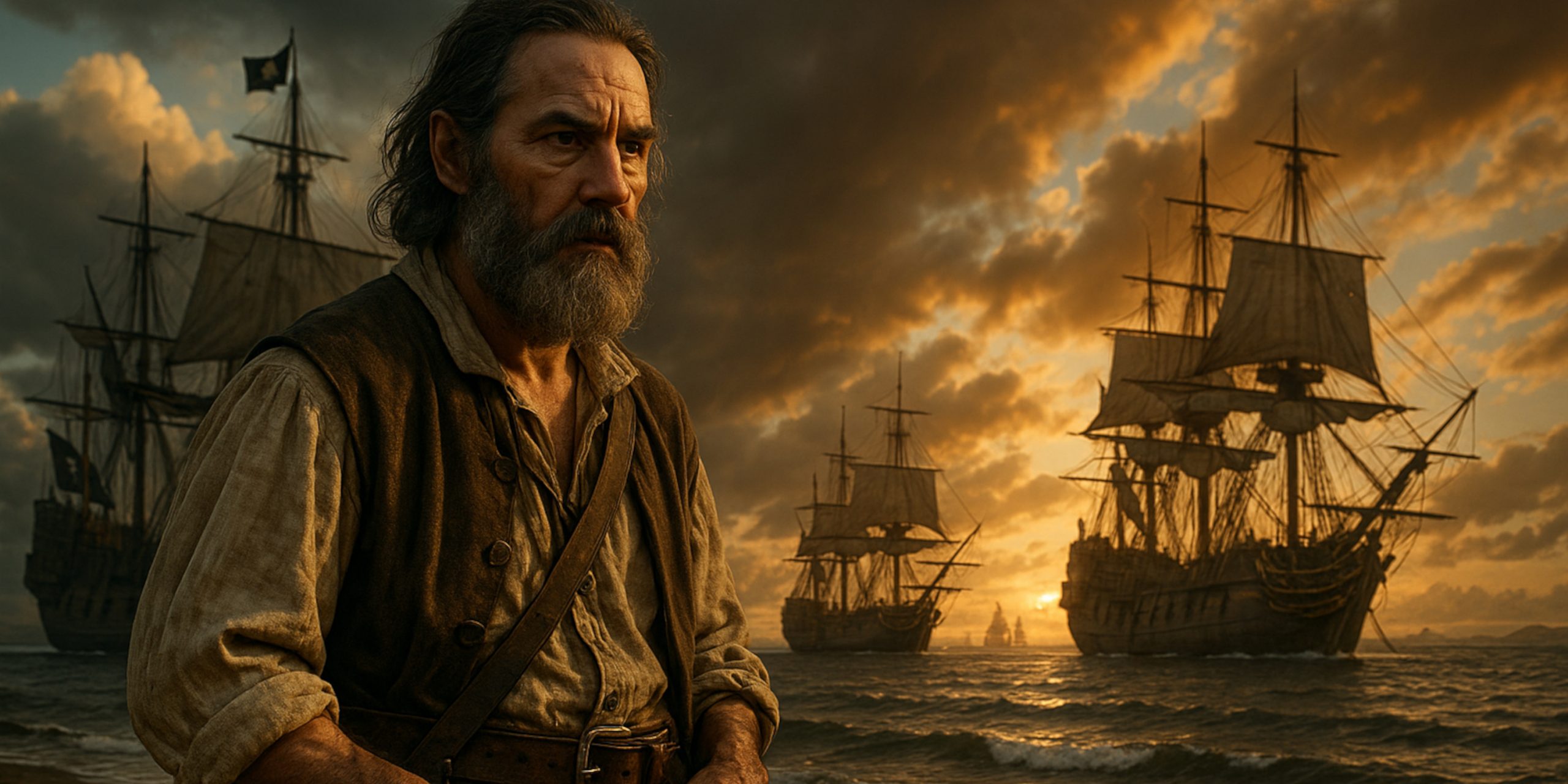
The buccaneers operated a mixture of vessels. Exquemelin mentions pinnaces, barques and small frigates. These ships were fast, lightly built and capable of slipping into shallow waters where larger Spanish treasure ships hesitated to venture.
Henry Morgan’s fleet, which Exquemelin saw first hand, included vessels taken as prizes and retrofitted with a worrying number of cannons for their size. Pirates were the original masters of upcycling, though admittedly their process had fewer safety checks.
Battles and Raids
Exquemelin witnessed several major operations, most notably Morgan’s expedition against Portobelo in 1668 and the assault on Panama in 1671. His writing offers the rare combination of on deck immediacy and moral side-eye. He admired their daring but not necessarily their ethics.
Notable Campaigns
Portobelo, 1668
Morgan’s men stormed the Spanish stronghold using tactics that were brutal, improvised and occasionally effective. Exquemelin noted their audacity while carefully distancing himself from certain atrocities.
Maracaibo and Gibraltar, 1669
A prolonged confrontation that involved clever manoeuvring, hostage taking and more than one narrow escape. Exquemelin records the rising tensions between the buccaneers and Spanish defenders with clinical precision.
Panama, 1671
This was the grand spectacle of Morgan’s career. Exquemelin offers the most detailed account we possess. He described the march across the isthmus, the starvation, the confusion, the final chaotic battle and Morgan’s less than honourable conduct regarding the division of loot.
Bounty and Treasure
The buccaneers were driven by profit, even if it rarely lived up to their dreams. Exquemelin recorded several hauls, noting that Morgan’s Panama expedition produced far less wealth than the men expected. The disappointment among the buccaneers was palpable. Some accused Morgan of holding back a generous portion for himself. Exquemelin did not explicitly confirm it, but his silence had the suggestive weight of a raised eyebrow.
Treasure took many forms. Coin, bullion, jewellery, cacao, textiles, livestock and anything portable. Exquemelin’s descriptions show the raw practicalities of plunder rather than the glittering romantic nonsense popular culture later supplied.
Contemporary Quotes from Exquemelin
A few lines reveal his mindset better than any historian’s commentary.
- On Henry Morgan’s ruthlessness:
“He used all means imaginable to force them to reveal their goods.” - On the buccaneers’ treatment of prisoners:
“They put them to cruel tortures, seeking to know where they had hidden their money.” - On the march to Panama:
“Hunger pressed us so hard that we were forced to eat the leather of our shoes.”
He was not a man who dressed up the truth. His prose has the clipped honesty of someone who has seen enough misery to skip the embellishment.
The Book that Created a Legend
His memoir, usually known as The Buccaneers of America, was first published in Dutch in 1678, then translated into several languages. Each translation altered the content, and some added creative flourishes that would have made Exquemelin wince. Despite this, the core of the work became the foundation of pirate historiography.
He shaped the modern cultural image of buccaneers more than any other writer. The irony is delightful. The man who stumbled into piracy reluctantly ended up the genre’s unintentional architect.
His Later Life and Fate
After his Caribbean adventures, Exquemelin returned to Europe. He worked as a barber surgeon in Amsterdam and later served as a ship’s surgeon for the Dutch West India Company. Records suggest he lived at least into the early eighteenth century, though the exact date of his death has the same reliability as pirate promises.
He disappears quietly from the paperwork, leaving scholars to hunt him across archives with roughly the same success rate as a treasure map drawn on a tavern table.
Legacy
Exquemelin’s legacy rests on his eyewitness testimony. Without him, the history of the buccaneers would be a fog of half remembered tales. His book remains essential, not because it flatters its subjects, but because it refuses to. He wrote what he saw. He withheld nothing. A rare triumph of honesty in a world that thrived on exaggeration.
For a historian, he is a gift. For a pirate apologist, he is an inconvenience.
Watch the documentary: