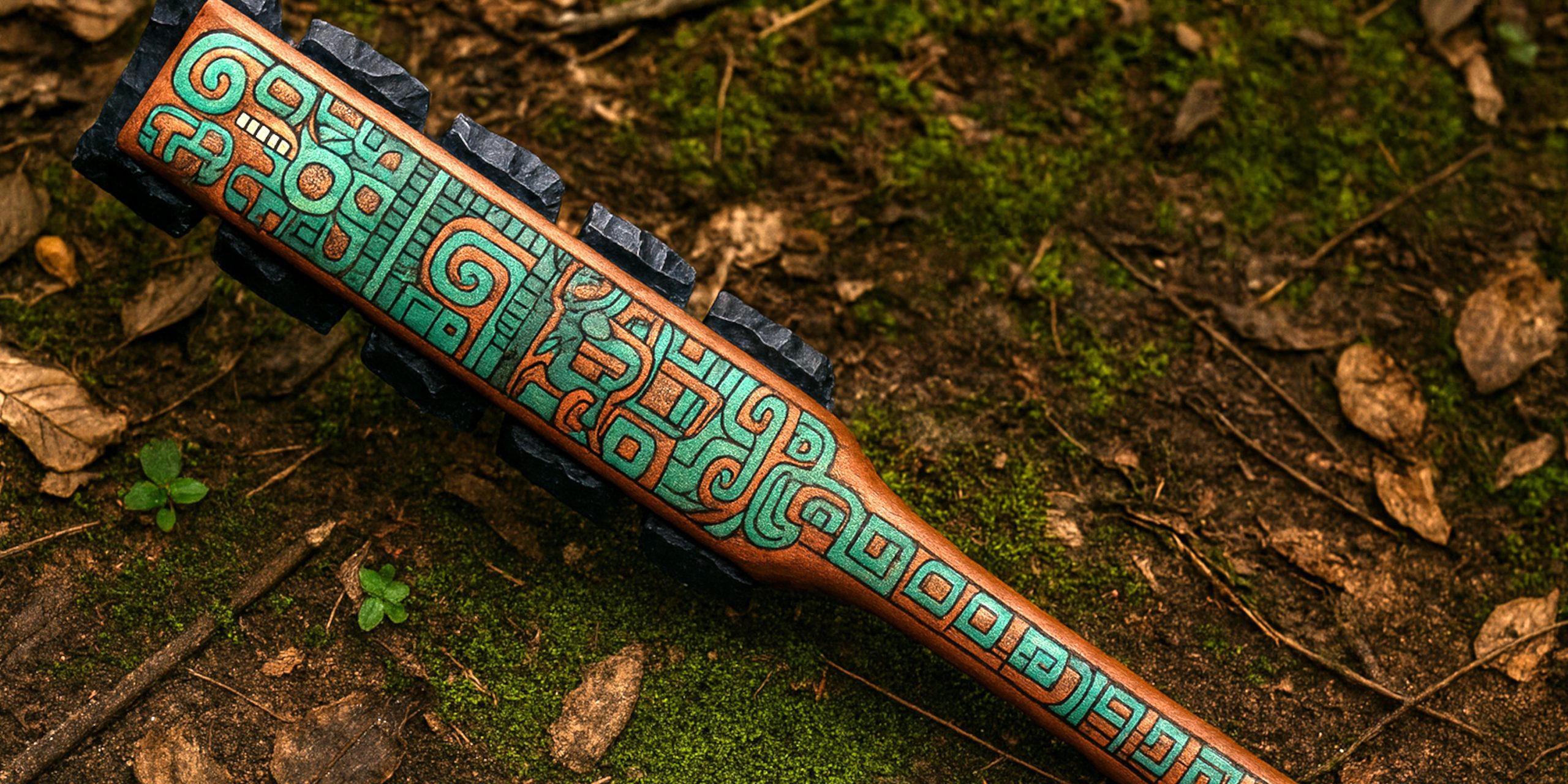
The short macuahuitl sits in the shadow of its larger siblings, yet it played a practical role in the armouries of several Mesoamerican cultures. Compact and sharp, it combined hardwood engineering with obsidian technology to create a weapon that felt quick in the hand and suited close combat. Its reputation grew not from length or reach, but from a reliable ability to cut with surprising precision.
The short macuahuitl refers to a reduced version of the full-length macuahuitl used across central Mexico. Warriors valued it for its manoeuvrability in tight formations and within urban fighting, where streets and temple terraces often restricted sweeping strikes. Despite its modest size, its obsidian blades could open deep wounds with a single controlled swing.
Specification
Typical characteristics of a short macuahuitl
| Feature | Details |
|---|---|
| Total length | About 40 to 60 centimetres |
| Material | Hardwood body, usually from local species such as oak or tzompantli wood |
| Edges | Fixed obsidian blades set in resin |
| Weight | Between 0.8 and 1.2 kilograms |
| Grip | Integral wooden handle |
| Primary use | Close combat, shock engagements, capturing enemies |
Key performance traits
- Fast recovery time after strikes
- Effective for cutting and slashing
- Compact form suited to shield-and-weapon pairings
- Less reach compared to the full macuahuitl
History and Evolution
The short macuahuitl grew out of a long tradition of wooden-bladed weapons across Mesoamerica. Its roots stretch back to earlier Teotihuacan and Toltec blade-set clubs, though the Aztecs refined the design into recognisable forms.
Several factors shaped its evolution:
- Urban warfare demanded shorter, faster weapons
- Training schools (telpochcalli and calmecac) taught cadets to use compact weapons before progressing to longer ones
- Tribute lists indicate widespread distribution among vassal regions
- Spanish chroniclers described smaller macuahuitl variants carried by lower-ranked warriors
While the long macuahuitl became a symbol of elite warriors, the short form remained a reliable workhorse across armies.
Advantages and Disadvantages
Advantages
- Quick to swing and recover
- Easier to use in shield walls and narrow lanes
- Cheaper to produce than the larger versions
- Less fatiguing during prolonged fighting
- Obsidian edges created extremely sharp cutting surfaces
Disadvantages
- Limited reach compared to longer weapons
- Obsidian blades could chip under heavy impact
- Less intimidating presence on the battlefield
- Reduced ability to break through thicker armour
Comparison with Similar Weapons
| Weapon | Strengths | Weaknesses | Notes |
|---|---|---|---|
| Short macuahuitl | Fast, sharp, efficient in close quarters | Limited reach | Ideal for urban or ritual combat settings |
| Full macuahuitl | Greater reach and power | Heavier and slower | Favoured by elite warriors |
| Macuahuitl sword-club hybrids | Increased versatility | Less specialised | Used in some border regions |
| Wooden clubs without obsidian | Durable and cheap | Far less cutting ability | More common among levies |
The short macuahuitl stands closer to a sidearm than a primary battlefield tool, offering agility over reach.
Legacy
Although Spanish conquest narratives often emphasise the fearsome long macuahuitl, the shorter variant remained equally important for understanding the everyday warrior experience. Its legacy survives through codex illustrations, tribute records, archaeological finds of obsidian flakes and depictions in modern reconstructions.
Modern enthusiasts, martial artists and museum collections recognise the short macuahuitl as a fine example of Indigenous engineering. Its combination of natural materials and practical design continues to attract academic interest.
Where to See
You can find examples or reconstructions in several institutions:
- Museo Nacional de Antropología, Mexico City
- Templo Mayor Museum, Mexico City
- Museo Amparo, Puebla
- British Museum, London, which holds related Mesoamerican clubs and obsidian weaponry
- Regional museums in Tlaxcala and Oaxaca with contextual displays
While complete short macuahuitl specimens are rare, many collections preserve fragments, obsidian blade sets and artistic depictions.
Collectors Guide
Rarity
Authentic pre-Hispanic short macuahuitl are extremely rare. Most surviving examples are ceremonial pieces or fragments. Modern replicas dominate the market, crafted by specialists who follow archaeological references.
What collectors look for
- Quality of the hardwood body
- Authenticity of the obsidian arrangement
- Accurate resin and hafting techniques
- Faithful proportions based on codices
- Maker reputation for replicas
Market and Auction Prices
| Item | Typical Price Range | Notes |
|---|---|---|
| Authentic obsidian blade fragments | £50 to £150 | Often sold with provenance certificates |
| Replica short macuahuitl by recognised makers | £150 to £400 | High quality, functional reproductions |
| Museum-grade replicas | £500 to £1,200 | Hand crafted with accurate materials |
| Full authentic macuahuitl fragments | £2,000 to £6,000 | Rare, usually incomplete |
Collectors should be cautious, as claims of fully authentic complete specimens are almost always unfounded. Provenance and documentation matter far more than condition.