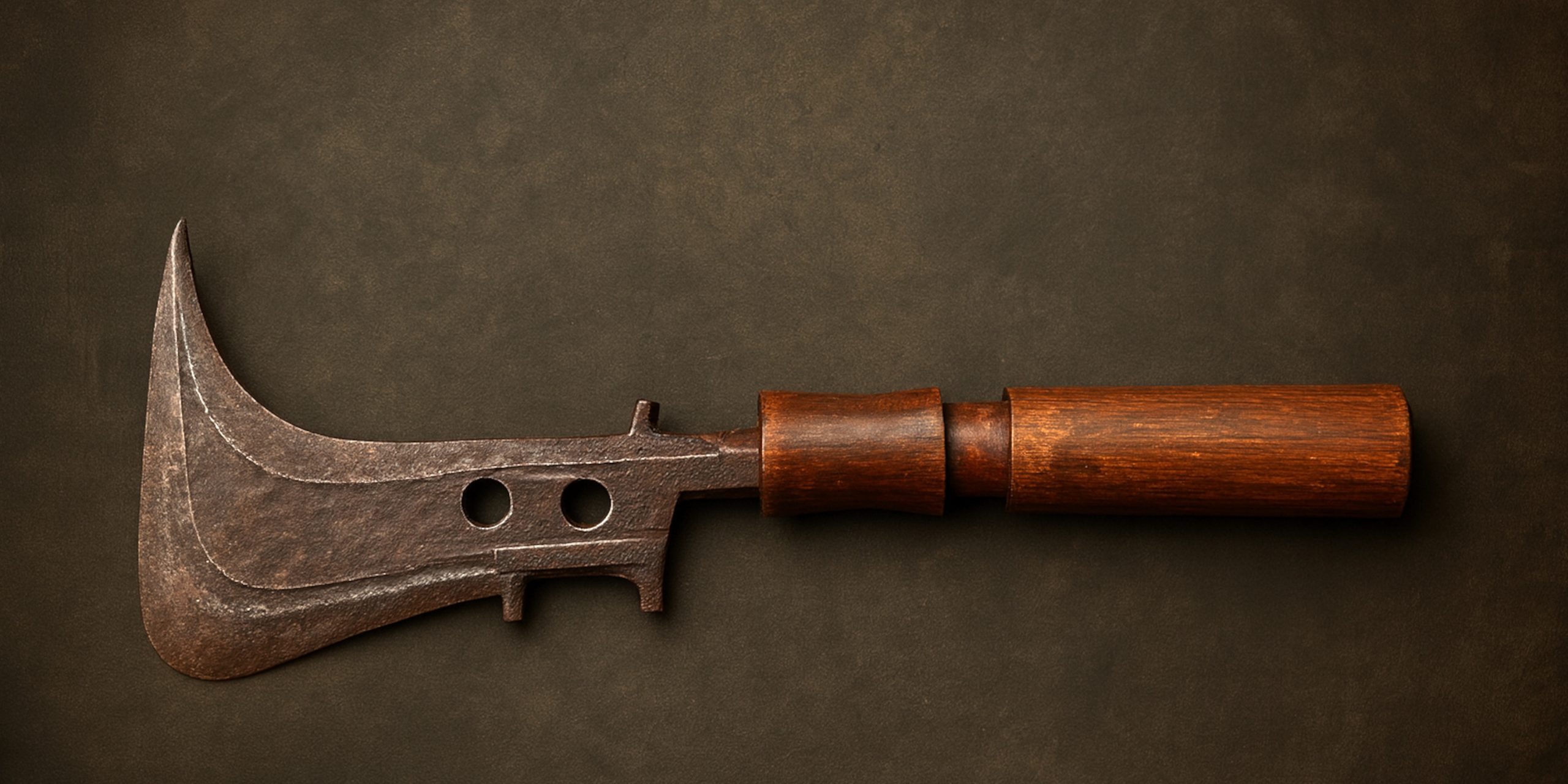
The Mangbetu sword is one of the most striking and unique African weapons, notable for its intricate design and deep cultural significance. Forged by the Mangbetu people of northeastern Democratic Republic of Congo, the weapon blurs the line between utility and art.
The Mangbetu sword is often identified by its sharply curved blade and elaborate forged designs, including spirals, hooks, or deeply incised patterns. It was not simply a tool of war but also a symbol of social status, artistry, and identity. The Mangbetu elite often carried these swords during ceremonies or public appearances to reinforce their prestige.
Specifications
| Feature | Details |
|---|---|
| Blade length | Typically 40 to 60 cm |
| Blade shape | Curved or hooked, with decorative cut-outs |
| Material | Iron (often high-quality, hand-forged) |
| Hilt | Wrapped in fibre, wood, or occasionally brass |
| Overall weight | Around 0.8 to 1.2 kg |
| Balance | Front-heavy for slashing use |
| Decoration | Incised lines, pierced holes, spiral hooks |
History and Evolution
The Mangbetu people were renowned for their ironworking skills. Their sword designs date back at least to the 18th century, though oral traditions suggest earlier origins. By the late 19th century, as European colonial presence intensified in Central Africa, the swords evolved from purely functional weapons into more ceremonial items. This period saw an increase in ornamental features as Mangbetu nobility used them to signify authority and distinction.
The unique shape of the blade is thought to be both symbolic and practical. Its pronounced curvature and flared ends may have been inspired by regional farming tools but were refined for combat and display. After colonial conquest, the weapons gradually lost their role in warfare but remained important in rituals and rites of passage.
Advantages and Disadvantages
Advantages:
- Visually intimidating and culturally distinctive
- Front-weighted blade suitable for powerful chopping
- Easily brandished for ceremonial display
- Custom forging made each piece unique
Disadvantages:
- Poor thrusting capability due to curve and weight
- Less versatile than straight swords in prolonged combat
- Designed more for symbolism than endurance
- Not ideal against armoured opponents
Comparison with Similar Weapons
| Feature | Mangbetu Sword | Kuba Ikul | Kaskara (Sudan) |
|---|---|---|---|
| Blade Shape | Strongly curved, ornate | Leaf-shaped, blunt tip | Straight, double-edged |
| Function | Ceremonial and combat | Symbolic and ceremonial | Primarily martial |
| Origin | Congo (DRC) | Congo (DRC) | Sudan and Chad |
| Construction | High-quality iron | Wood or iron | Iron or steel |
| Symbolism | High | Very high | Moderate |
The Mangbetu sword stands apart for its fusion of aesthetics and function. Unlike the more austere Kaskara or the flat ceremonial Ikul, it shows a deliberate intent to balance beauty and menace.
Legacy
Today, Mangbetu swords are recognised globally as masterpieces of African metallurgy and design. They are frequently featured in museum collections and have become emblematic of Mangbetu culture. Though no longer in active use, the weapon persists in popular memory through ethnographic art, photography, and anthropological literature.
During the early 20th century, Mangbetu art, including weapons, was celebrated in European expositions, further embedding its legacy as a cultural artefact rather than a battlefield implement.
Where to See One
- Royal Museum for Central Africa (Tervuren, Belgium): Several ceremonial Mangbetu swords with detailed documentation.
- British Museum (London): Houses Mangbetu artefacts, including weaponry.
- Musée du quai Branly (Paris): Features Mangbetu metalwork and blades in their African ethnology collection.
- National Museum of the Democratic Republic of Congo (Kinshasa): Displays locally recovered and preserved examples.
Collector’s Guide
Mangbetu swords are highly desirable among collectors of African tribal weapons. Authentic pieces often show signs of age, such as patina on the blade and worn fibre grips. Reproductions exist, often less refined in blade symmetry and lacking the deep iron incisions typical of originals.
Estimated Auction Prices (recent years):
| Item Type | Condition | Estimated Price (GBP) |
|---|---|---|
| 19th-century ceremonial sword | Excellent | £800 to £1,500 |
| Early 20th-century sword | Good | £400 to £800 |
| Damaged or fragmentary blade | Fair/Poor | £150 to £300 |
Swords with strong provenance, such as those collected during early colonial expeditions or exhibited in expositions, often fetch higher values.
Buying Tips:
- Look for asymmetrical hooks, pierced blades, and hand-forged imperfections.
- Provenance and tribal documentation enhance value.
- Beware of overly polished pieces lacking wear.
The Mangbetu sword remains a potent emblem of artistry and authority from Central Africa. While its original martial function has faded, its cultural and aesthetic impact endures through preserved artefacts and the study of Mangbetu heritage.