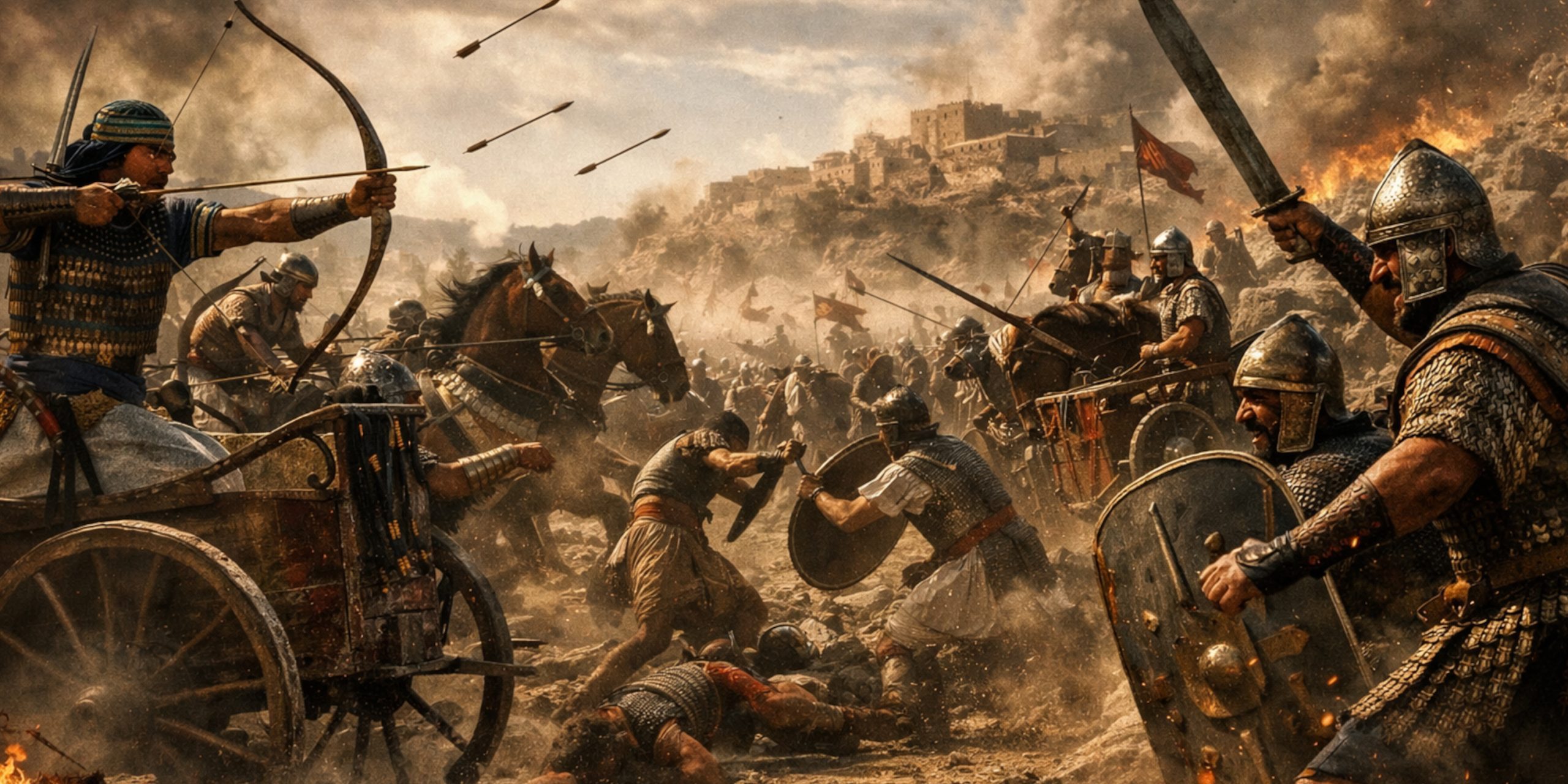
The Battle of Amurru sits in that frustrating category of ancient warfare where the consequences are clear but the fighting itself is half obscured by propaganda, damaged tablets, and royal egos. What we can say with confidence is that Amurru, a small but strategically vital Levantine kingdom, became a pressure point in the long contest between Egypt and the Hittite Empire during the late thirteenth century BC. Control of this coastal buffer state meant access to trade routes, ports, and influence across Syria, which explains why two great powers were willing to posture, march, and occasionally bleed over it.
Amurru’s fate is tightly bound to the reign of Ramesses II and his Hittite rival Muwatalli II. The struggle for the region culminated not in a single clean clash, but in a series of campaigns and reversals that fed directly into the much larger confrontation at Kadesh. Amurru was the prize that kept changing hands, usually after one side promised protection and the other threatened annihilation. Ancient diplomacy was refreshingly blunt.
Background and causes
Amurru occupied a narrow stretch of land along the Levantine coast, north of modern Lebanon. Its value lay less in its manpower and more in its position. Whoever held Amurru could project power along the coast and keep supply lines open between Anatolia, Syria, and Egypt’s Asiatic territories.
Originally aligned with Egypt, Amurru defected to the Hittites during the reign of Seti I. Ramesses II was never inclined to forgive this, and early in his reign he moved north to reassert Egyptian authority. The fighting around Amurru should be understood as part of this wider campaign, rather than a single neatly dated battle with a fixed battlefield and a commemorative plaque.
Forces
Egyptian and Hittite armies operating in Amurru were expeditionary forces, not full imperial levies. This matters, because it shapes the scale and intensity of the fighting.
| Side | Estimated strength | Composition |
|---|---|---|
| Egyptian Empire | 15,000 to 20,000 | Infantry divisions, chariot corps, allied Levantine troops |
| Hittite Empire | 18,000 to 25,000 | Infantry, heavy chariots, allied vassal contingents |
These numbers are estimates based on campaign logistics and later records. Ancient kings loved inflating figures, usually in inverse proportion to how well things actually went.
Leaders
Egyptian command
- Ramesses II, Pharaoh and supreme commander
- Senior officers drawn from the Amun, Ra, Ptah, and Seth divisions
Hittite command
- Muwatalli II, Great King of Hatti
- Vassal princes from Syria, including Amurru itself during periods of Hittite control
Both rulers styled themselves as warrior kings. Only one had the luxury of commissioning wall reliefs explaining why an indecisive outcome was actually a crushing victory.
Arms and armour
The fighting in and around Amurru looked much like other Late Bronze Age conflicts in the Levant, with an emphasis on mobility, missiles, and shock action.
Egyptian equipment
- Composite bows with bronze arrowheads
- Khopesh sickle swords for close combat
- Spears with leaf shaped bronze heads
- Linen body armour, sometimes reinforced with leather
- Two man chariots with light wooden frames
Hittite equipment
- Composite bows and heavy javelins
- Straight bronze swords, often longer than Egyptian blades
- Thrusting spears for infantry blocks
- Scale armour for elite troops
- Heavier three man chariots designed for shock and stability
The contrast in chariot design is especially telling. Egyptian chariots favoured speed and missile fire, while Hittite models leaned towards mass and impact. Neither was perfect, and Amurru’s broken terrain was unkind to both.
Battle timeline
- c. 1275 BC: Amurru shifts allegiance from Egypt to the Hittite Empire
- Early reign of Ramesses II: Egyptian forces campaign north, retaking Amurru after local resistance collapses
- Shortly after: Hittite counter pressure forces Amurru back into their sphere
- Following years: Continued skirmishing and manoeuvre in Syria, leading directly to the Battle of Kadesh
If this sounds messy, that is because it was. Late Bronze Age warfare rarely offered clean conclusions.
Archaeology and evidence
There is no single archaeological layer labelled “Battle of Amurru,” which will disappoint anyone hoping for a dramatic burn layer and a helpful sign. Evidence instead comes from diplomatic texts, campaign inscriptions, and material culture consistent with military occupation.
- Hittite tablets from Hattusa reference Amurru as a vassal state
- Egyptian reliefs and inscriptions describe northern campaigns under Ramesses II
- Weapons finds in coastal Syria match Late Bronze Age military activity, though attribution remains cautious
In short, the paperwork survived better than the battlefield.
Contemporary voices
Egyptian sources, unsurprisingly, frame events as a triumph of royal will:
“His Majesty advanced northward like Montu, none could stand before him.”
Hittite records are less theatrical but equally confident, describing Amurru as rightfully restored to Hatti’s protection. Both sides agree on one thing, Amurru mattered enough to fight over.
Outcome and significance
The struggle for Amurru ended without a decisive military solution. Control of the region fluctuated until diplomacy achieved what armies could not. The eventual Egyptian Hittite peace treaty, one of the earliest known international treaties, effectively stabilised the region.
For the historian, Amurru is valuable precisely because it exposes the limits of imperial power. Even the greatest Bronze Age armies could win battles and still fail to secure lasting control. Geography, local politics, and sheer exhaustion had a vote too.
Legacy
Amurru’s repeated defection became a cautionary tale in ancient statecraft. Buffer states were useful, but unreliable. The campaigns around Amurru helped shape Ramesses II’s foreign policy and pushed both empires toward accommodation rather than endless war.
It is not the most famous battle of the age, but it is one of the most instructive. Sometimes history turns not on a single decisive clash, but on a stubborn strip of land that refuses to behave.