The Mongol armies that burst out of the steppe in the thirteenth century were not a single blur of horsemen. They were a carefully balanced system built around two complementary forces, light cavalry and heavy cavalry, drilled to fight together with unsettling efficiency. As a historian, what still strikes me is not raw speed or brutality, but organisation. The Mongols planned wars like engineers plan bridges, and their cavalry was the load bearing structure.
This article looks at how Mongol light and heavy cavalry worked, what they carried, how they fought, and what the archaeology now confirms. Along the way, I will gently dismantle a few popular myths, because history deserves better than Hollywood arrows that never run out.
The Steppe System and the Mongol Way of War
The Mongols did not invent mounted warfare, but they perfected it. Life on the Eurasian steppe produced expert riders before it produced expert walkers. Children learned to ride almost as soon as they could stand. Herding demanded mobility, endurance, and cooperation. War simply sharpened these skills.
Under leaders like Genghis Khan, the Mongols imposed strict discipline and a decimal command structure that made large armies flexible rather than chaotic. Units were trained to manoeuvre independently and to recombine on command. Cavalry was not divided by social class or feudal obligation. It was divided by battlefield role.
Light Cavalry, The Eyes, Teeth, and Nerves
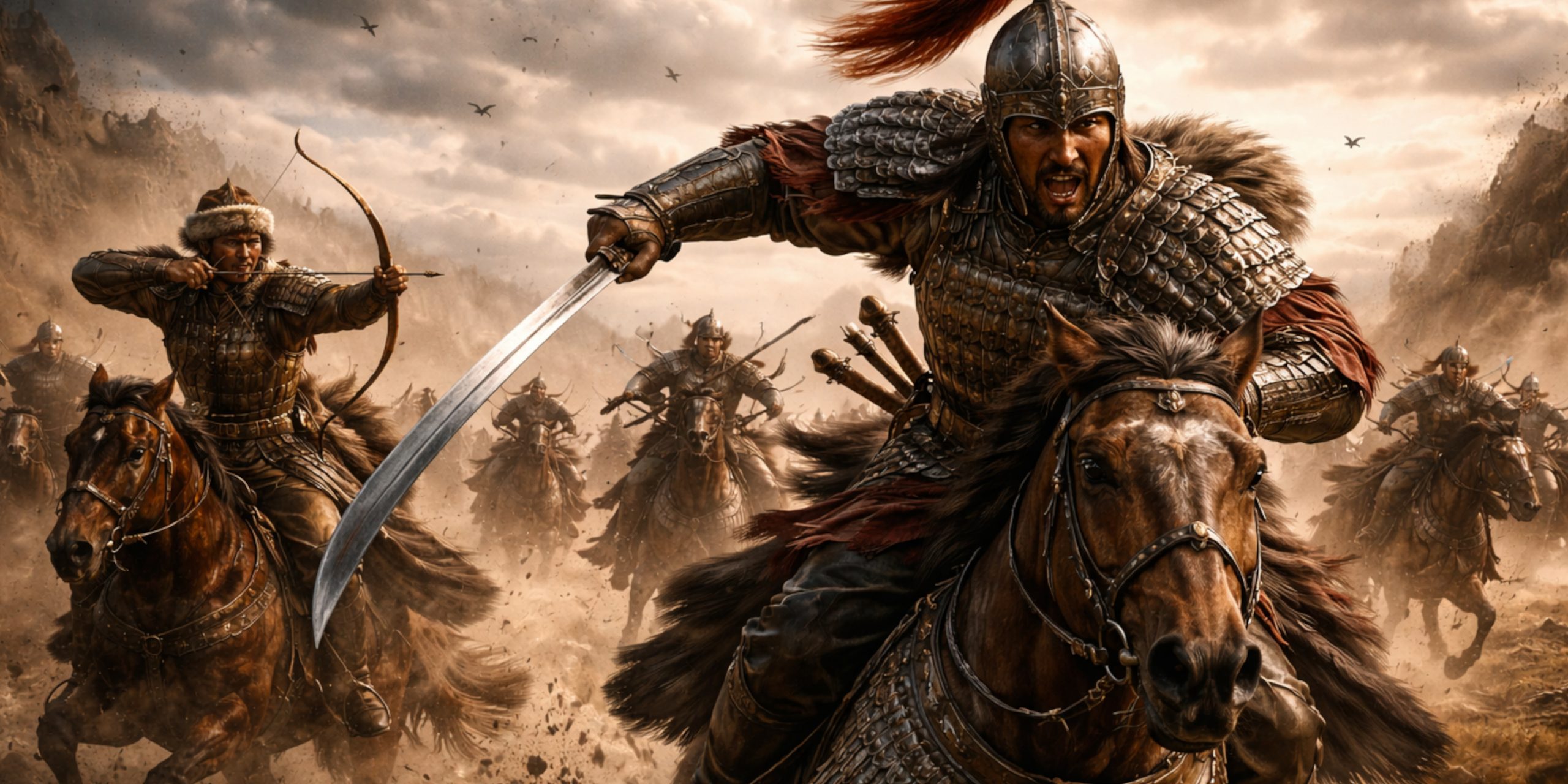
Light cavalry formed the backbone of Mongol armies. These were the horse archers who scouted, harassed, provoked, and exhausted the enemy long before a decisive clash.
Their primary weapon was the composite bow, built from wood, horn, and sinew. Short, powerful, and terrifyingly efficient, it could punch through armour at close range and still wound at distance. Riders carried multiple bows tuned for different ranges, along with several quivers of arrows designed for specific jobs, including armour piercing, whistling signals, and broadheads for unarmoured targets.
Tactically, light cavalry excelled at:
- Reconnaissance across vast distances.
- Feigned retreats that lured enemies into pursuit.
- Continuous missile harassment that shattered formations and morale.
A common mistake is to imagine these riders skirmishing loosely. In reality, they operated in tight coordination, rotating forward to shoot and falling back to reload while others advanced. It was less chaos, more clockwork.
A Persian chronicler later wrote that the Mongols fought “as if one soul moved many bodies,” which is high praise from someone on the receiving end.
Heavy Cavalry, The Hammer Behind the Storm
Once the enemy was disordered, panicked, or overextended, the heavy cavalry moved in. These were not medieval knights in steppe cosplay. Mongol heavy cavalry remained mobile, tactical, and disciplined.
They wore lamellar armour made from iron, hardened leather, or lacquered rawhide. Plates were laced together, allowing flexibility without sacrificing protection. Horses were often armoured as well, especially in later campaigns against well equipped foes in China, Central Asia, and Eastern Europe.
Weapons reflected their role:
- Lances for the initial impact.
- Sabres and straight swords for close combat.
- Maces and axes for fighting armoured opponents.
The psychological effect of a heavy cavalry charge after hours or days of harassment cannot be overstated. Enemies were already tired, hungry, and demoralised. The charge was often the final argument.
Arms and Armour of Mongol Cavalry
Mongol equipment was practical, adaptable, and often locally sourced or copied. This was not a static kit.
Swords Used by Mongol Cavalry
Mongol cavalry used several sword types depending on period and region:
- Curved sabres, ideal for slashing from horseback. These became more common over time and influenced later steppe and Islamic swords.
- Straight double edged swords, inherited from earlier steppe traditions and still favoured for thrusting.
- Single edged long knives or short swords worn as backup weapons.
These were not ceremonial pieces. Many surviving examples show heavy wear, repairs, and resharpening. The romance of pristine weapons does not survive contact with real warfare.
Armour and Protection
Helmets were usually conical with nasal guards or face plates. Armour was modular, allowing damaged sections to be replaced. This mattered in campaigns thousands of miles from home.
One detail I always appreciate is the use of silk shirts under armour. Silk fibres could wrap around arrowheads, making them easier to extract. Medieval field medicine was rarely kind, but it was sometimes clever.
Tactics, Coordination, and Battlefield Control
Mongol cavalry warfare relied on communication. Flags by day, torches by night, and horns carried commands across the battlefield. Light cavalry fixed and shaped the enemy. Heavy cavalry delivered the decisive blow. If conditions were not right, the Mongols simply disengaged and tried again tomorrow. Patience was a weapon.
This approach baffled European chroniclers who expected battles to be settled in a single dramatic clash. The Mongols were perfectly happy to win slowly, which is not very chivalric but extremely effective.
Archaeology and Material Evidence
Archaeological finds across Mongolia, China, Russia, and Eastern Europe have confirmed much of what the sources describe.
Key discoveries include:
- Lamellar armour plates from Karakorum and other Mongol centres.
- Arrowheads in multiple shapes and weights, supporting accounts of specialised ammunition.
- Horse tack and stirrups designed for stability and long distance riding.
Burials often include horses or riding equipment, reinforcing the central role of cavalry in Mongol identity. What archaeology also shows is variation. There was no single standard kit. Flexibility was built into the system.
Contemporary Voices
Medieval observers struggled to explain what they were seeing.
The Franciscan envoy Giovanni da Pian del Carpine wrote that the Mongols were “most obedient and exceedingly disciplined, more than any people I have seen.”
A Chinese source from the Jin dynasty described Mongol horsemen as fighters who “came like thunder and withdrew like smoke,” which is poetic, if deeply unhelpful for defending your city.
From the Islamic world, Ibn al Athir lamented that the Mongols seemed to fight without fear of death, which says as much about their opponents’ despair as Mongol courage.
Strengths, Limits, and a Historian’s View
It is tempting to present Mongol cavalry as unbeatable. They were not. Dense forests, poor pasture, strong fortifications, and prolonged sieges exposed weaknesses. When denied mobility or horses, their advantages shrank fast.
Still, as a system, Mongol light and heavy cavalry represent one of the most refined military machines of the medieval world. They remind us that warfare is not just about weapons, but about training, logistics, discipline, and knowing when not to fight.
Also, if your enemy can shoot accurately while riding flat out and then pretend to panic convincingly, you are already having a very bad day.
Legacy of Mongol Cavalry Warfare
The Mongols reshaped warfare across Eurasia. Their methods influenced later Islamic, Russian, and even European cavalry traditions. The emphasis on mobility, intelligence gathering, and combined arms would resurface centuries later under different names.
Their light and heavy cavalry were not opposites. They were partners. One softened the target, the other finished the job. Simple in concept, brutally effective in practice.