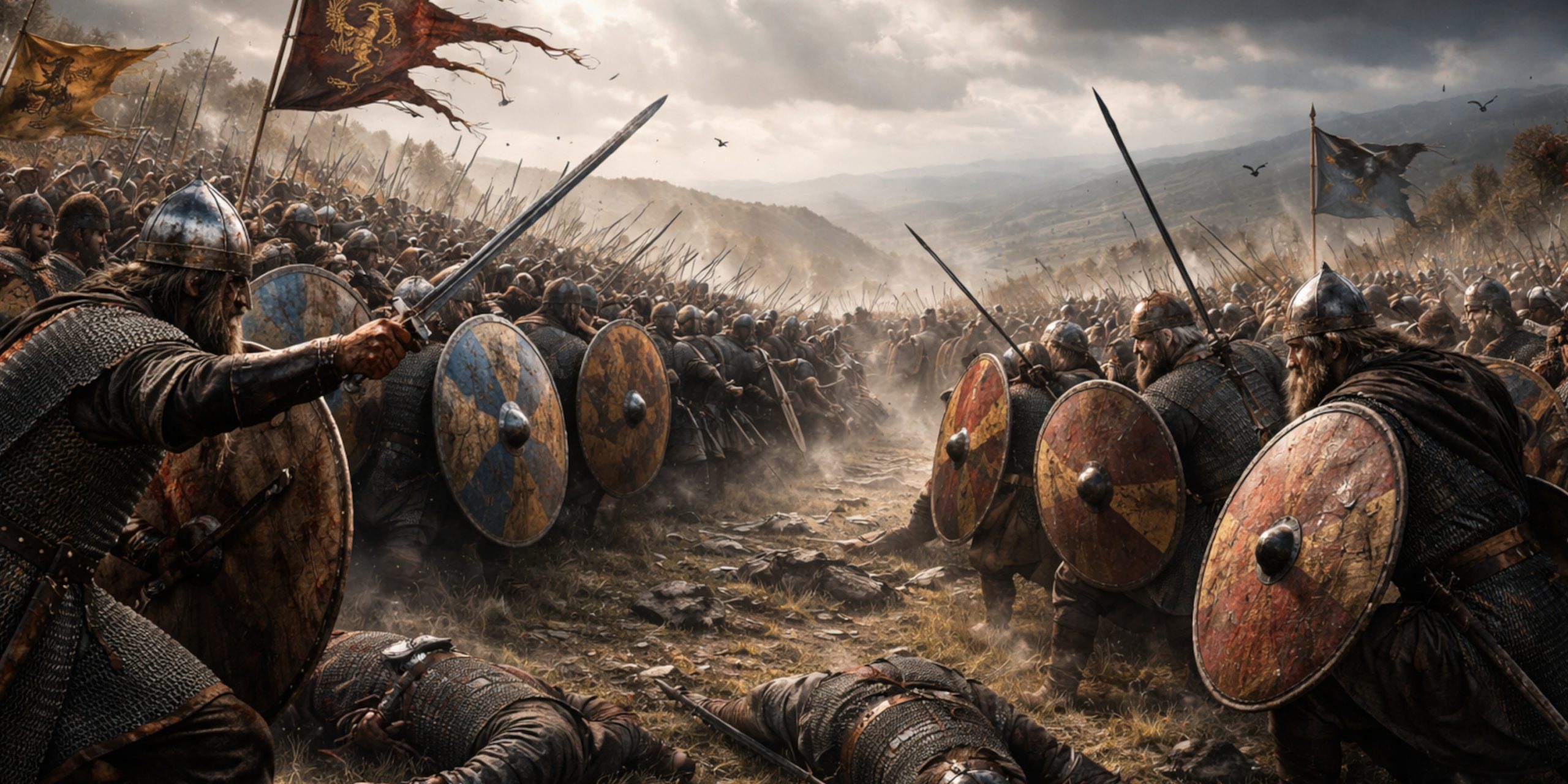
The Battle of Hingston Down, fought in 838, sits at a fault line in early medieval British history. It was one of those moments when regional power, long contested and rarely settled, tipped decisively in one direction. On the slopes near the Tamar valley, the West Saxon king Ecgberht confronted a coalition of Cornish Britons and Viking raiders. What followed reshaped the political map of south-west Britain and quietly marked the end of Cornwall as an independent military force.
This was not a grand clash remembered for heroic speeches or bannered hosts. It was brutal, pragmatic, and decisive. As a historian, I find it compelling precisely because it lacks romance. It feels like real power politics, settled with shields, spears, and grim determination.
Historical Background
By the early ninth century, Wessex was expanding with intent. Ecgberht had already humbled Mercia and pushed West Saxon authority further west than any of his predecessors. Cornwall, culturally Brittonic and fiercely independent, resisted this pressure and sought allies where it could find them.
The Vikings, newly active along Britain’s coasts, were willing partners. Their interest was not political loyalty but opportunity. Raiding alongside Cornish forces offered access to West Saxon lands, wealth, and prestige. For Cornwall, it was a last throw of the dice against Saxon dominance.
Location and Terrain
Hingston Down lies near the modern Cornwall Devon border, overlooking river crossings and routes east into Wessex. The ground rises gently, offering commanding views but little natural cover.
For shield wall warfare, this was open, unforgiving terrain. There was nowhere to hide poor discipline or a wavering line. Once engaged, the battle could only end one way.
Forces
West Saxon Kingdom of Wessex
Led by King Ecgberht, the West Saxon army represented a mature and increasingly professional fighting force by early medieval standards.
Cornish and Viking Alliance
The opposing army combined Cornish warbands with Viking raiders, likely drawn from ships operating in the Bristol Channel or Irish Sea.
Estimated Strength
| Side | Estimated Numbers |
|---|---|
| Wessex | 2,000 to 3,000 |
| Cornish and Vikings | 1,500 to 2,500 |
These figures remain educated estimates. Contemporary sources were far more interested in outcomes than headcounts.
Leaders
West Saxons
• King Ecgberht of Wessex
• Sub kings and ealdormen from Devon and Somerset
Cornish and Vikings
• Cornish regional leaders, names unrecorded
• Viking war leaders, likely ship captains rather than kings
The anonymity of the Cornish and Viking commanders tells its own story. Power lay with Wessex, and the chroniclers wrote accordingly.
Arms and Armour
West Saxon Equipment
• Swords, including early pattern Anglo Saxon single edged swords and developing double edged types
• Long spears used both for thrusting and overhand throwing
• Round wooden shields with iron bosses
• Helmets, rare but present among elite warriors
• Mail shirts for nobles and royal retainers
Cornish and Viking Equipment
• Broad bladed Viking swords of Petersen Type B and C
• Seaxes and fighting knives
• Spear heavy infantry with lighter shields
• Minimal armour, with helmets limited to high status warriors
Sword fighting here was secondary to formation combat. Spears decided the early stages, swords finished what the spear wall began.
The Battle Timeline
Morning
Both armies assembled on open ground near Hingston Down. Skirmishing was minimal. This was not a battle of manoeuvre but of nerve.
Midday
Shield walls engaged. The Saxon line held firm, absorbing pressure from Cornish infantry and Viking shock fighters.
Afternoon
The Cornish and Viking line began to fragment. Once cohesion failed, Viking aggression turned to individual combat rather than formation fighting.
Late Afternoon
West Saxon forces pressed the advantage. The allied army broke and fled. Pursuit was likely limited, but the defeat was absolute.
Outcome and Consequences
The victory secured Wessex control over Cornwall’s eastern approaches and ended any realistic prospect of Cornish military independence. Cornwall was not immediately absorbed culturally or administratively, but its ability to resist was broken.
For the Vikings, the battle was a warning. Raiding could be profitable, but fighting organised Saxon kings on open ground carried real risk.
For Ecgberht, it was confirmation that Wessex had become the dominant power in southern England. His grandson, Alfred, would inherit a kingdom forged in battles like this one.
Archaeology and Evidence
No large scale excavation has definitively identified the battlefield. This is common for ninth century engagements, where material culture blends seamlessly into everyday settlement debris.
Finds from the wider region include:
• Anglo Saxon spearheads and shield bosses
• Early medieval swords recovered from rivers and wetlands
• Defensive earthworks nearby, possibly reused from earlier periods
The absence of clear evidence does not weaken the case for Hingston Down. It reflects how lightly early medieval armies travelled and how thoroughly the land has been reused since.
Contemporary Sources and Quotes
The Anglo Saxon Chronicle records the event with stark economy, noting that Ecgberht fought against the Cornish and their Viking allies and won.
One later paraphrase captures the tone neatly:
“There the West Saxons gained the field, and the Britons fled.”
No triumphalism. No poetry. Just the blunt acknowledgment that one side prevailed and the other ceased to matter.
Historical Significance
Hingston Down rarely makes popular lists of famous battles, which is a shame. It demonstrates how kingdoms were built not through singular legendary moments but through steady, often grim victories at the edges of power.
As a historian, I admire its honesty. No speeches survive because none were remembered. No heroes stand out because the outcome depended on discipline, leadership, and preparation. It was the sort of battle that quietly changed everything, then got on with it.