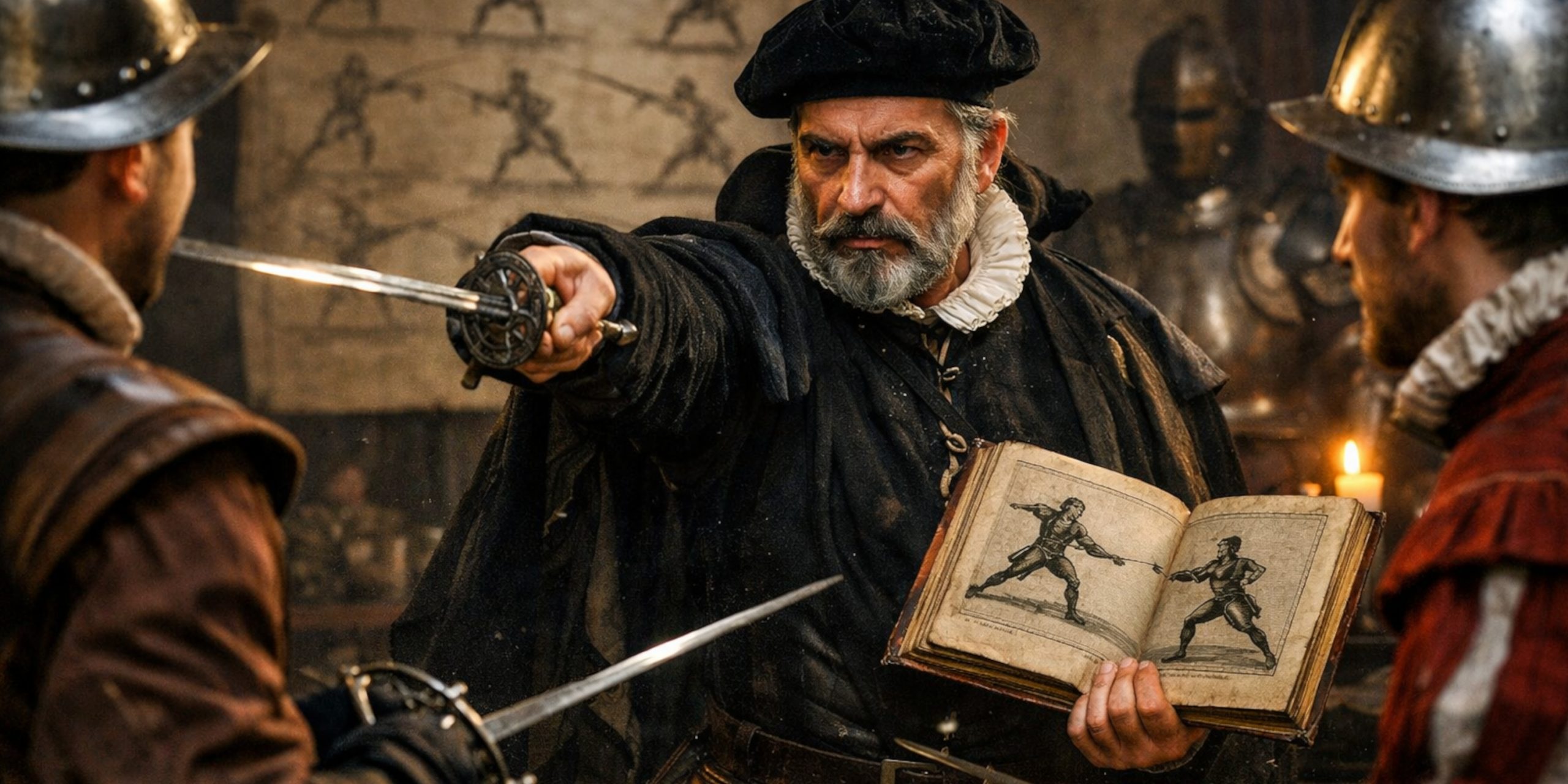
Salvator Fabris fills that in that rare category of historical figures who managed to shape an entire discipline while leaving just enough mystery behind to keep historians arguing politely over coffee. He was not the first great rapier master, but he was one of the most influential, and certainly one of the most demanding. Fabris did not teach fencing as a performance. He taught it as survival with principles.
Early Life and Background
Salvator Fabris was born around 1544 in Padua, a city that already breathed scholarship and martial theory. Northern Italy at the time was crowded with fencing masters, each convinced their system was the sensible one and that everyone else was courting disaster. Fabris emerged from this competitive environment with a style that prized structure, control, and geometry over bravado.
Little is recorded about his early training, which is frustrating but also revealing. Masters of his calibre rarely appeared fully formed. Fabris was clearly shaped by the Italian rapier tradition, yet his work suggests long experience testing theory against people who did not want to cooperate. His fencing feels practical because it almost certainly was.
Career and Patronage
Fabris eventually entered the service of King Christian IV of Denmark, a notable appointment that placed him at one of the most cultured courts in Europe. This was not a ceremonial role. Royal patronage meant expectations, scrutiny, and the need to teach nobles who assumed skill should arrive quickly.
It is worth pausing here to admire the quiet confidence required to teach fencing at court without turning it into theatre. Fabris did not soften his system for aristocratic egos. His work assumes discipline, patience, and a willingness to stand in uncomfortable positions for very good reasons.
De lo Schermo, overo Scienza d’Arme
Published in 1606, Fabris’s treatise De lo Schermo, overo Scienza d’Arme is the foundation of his legacy. The title translates loosely to “On Defence, or the Science of Arms,” which already tells you what kind of man you are dealing with. This is fencing as a science, not a flourish.
The book is lavishly illustrated, yet the illustrations are deceptive. The deep lunges and low stances look dramatic, but they are expressions of balance and reach rather than spectacle. Fabris consistently emphasises control of measure, opposition of the blade, and the dominance of line.
As a historian, I always enjoy how unapologetically demanding the text is. Fabris assumes the reader is serious. There is no sense that fencing should be easy, quick, or forgiving. It is meant to work, and working systems rarely care about comfort.
Fabris’s Fencing Philosophy
Fabris taught that defence and offence are inseparable. A correct action protects you while it threatens your opponent. This idea runs through every page of his work. The sword is not waved, it is placed. The body is not thrown forward, it is structured.
His preference for extended guards and deep lunges has sparked centuries of debate. Critics argue they are too static. Practitioners respond that they are stable, powerful, and brutally efficient when executed properly. Both sides are correct in their own way, which is often the mark of a serious martial system.
What stands out most is Fabris’s obsession with line. If you control the line, you control the fight. Everything else is secondary.
Weapons and Equipment
Fabris primarily wrote for the rapier, though his principles translate well to other civilian sidearms of the period. His rapier is long, well-balanced, and used with a deliberate economy of motion. There is little room for wasted cuts or hopeful thrusts.
He also addresses the use of the dagger in the off-hand, treating it as a tool of control rather than aggression. The dagger closes lines, binds blades, and creates moments of certainty in a chaotic exchange. Fabris was not interested in flashy dual-wielding. He wanted answers to problems.
Influence on European Fencing
Fabris’s impact reached far beyond Italy. His treatise circulated widely, influencing German, Dutch, and Scandinavian fencing traditions. Many later masters borrowed his ideas, sometimes openly, sometimes while pretending they had invented them themselves.
Modern historical European martial arts owe Fabris a considerable debt. His clarity, structure, and insistence on first principles make him endlessly attractive to practitioners trying to rebuild lost systems with honesty rather than guesswork.
Personality Between the Lines
Fabris never tells us much about himself directly, but his personality leaks through the text. He was exacting, confident, and quietly intolerant of sloppy thinking. There is no indulgence for reckless courage or romantic violence. Skill is measured by outcomes, not intention.
As a historian, I find this refreshing. Fabris reads like someone who had seen enough poor fencing to last a lifetime and decided to leave behind something better.
Legacy
Salvator Fabris remains one of the great architects of rapier fencing. His work endures because it asks hard questions and offers hard answers. It does not flatter the reader, and it does not promise easy mastery.
Four centuries later, his system still provokes debate, practice, and the occasional sore thigh from holding a lunge longer than feels reasonable. That alone tells you his fencing was built to last.
Watch the presentation: