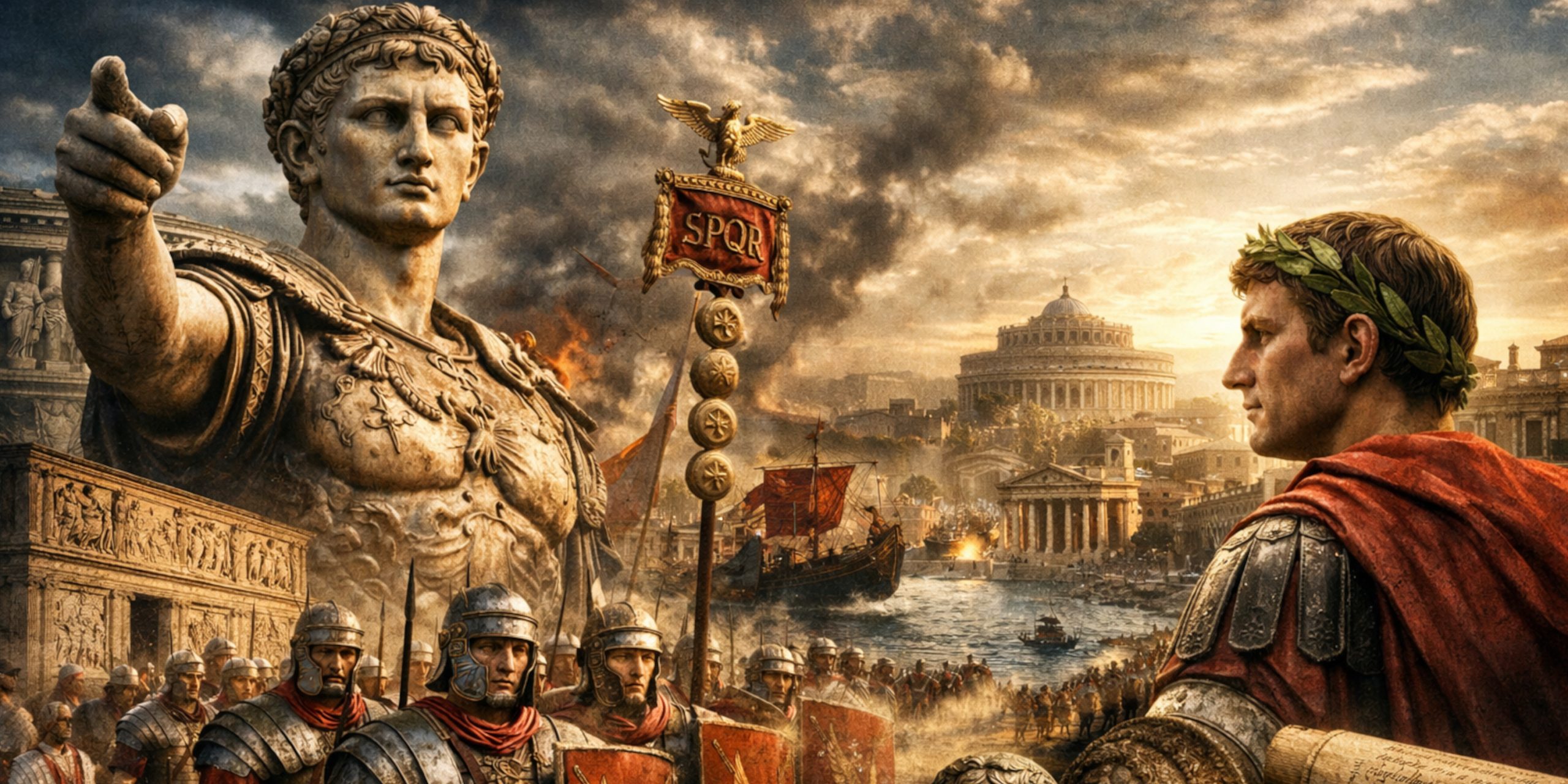
Augustus is often described as Rome’s first emperor, though he would have bristled at the title. What he actually did was more subtle and more impressive. He ended a century of civil war, dismantled the Republic without ever admitting to it, and created a political system that lasted, with tweaks and stress fractures, for centuries. As a historian, I find Augustus endlessly fascinating because his greatest weapon was restraint. He knew when not to act, when to wait, and when to let others think they were in control.
From Octavian to Augustus
Born Gaius Octavius in 63 BC, Augustus entered history as the adopted heir of Julius Caesar. At first glance he looked unremarkable, a sickly teenager surrounded by older, more experienced rivals. What followed was a masterclass in survival. He outmanoeuvred Mark Antony, neutralised Lepidus, and presented himself as the restorer of order rather than another warlord chasing glory.
By 27 BC, Octavian theatrically returned power to the Senate. In response, the Senate granted him the title Augustus, meaning revered or majestic. It was political theatre at its finest. Rome got peace, Augustus got control, and everyone pretended the Republic still existed.
Arms and Armour of the Augustan Age
Augustus rarely led from the front in the traditional heroic sense, but his reign reshaped Roman military equipment and organisation. The army he inherited was loyal to generals rather than the state. The army he left behind answered to the emperor.
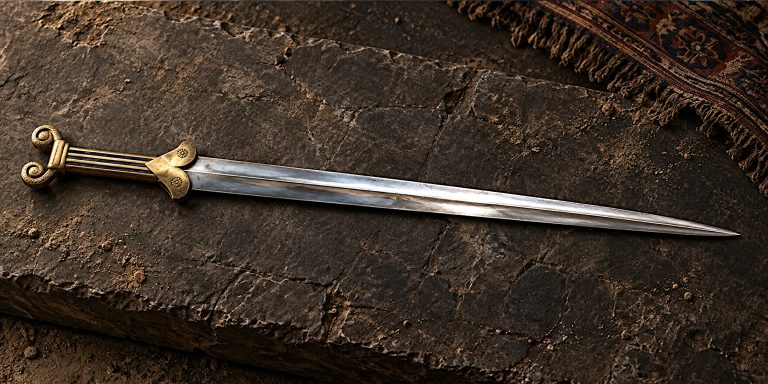
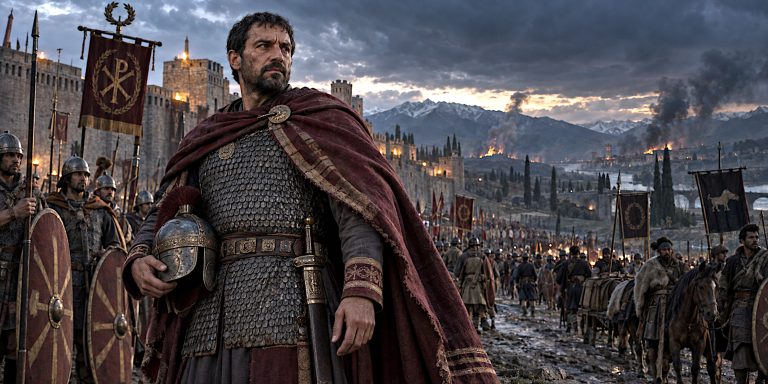
Legionaries of his era were typically equipped with the gladius Hispaniensis, a short stabbing sword refined during earlier Republican campaigns. Body armour varied, with chainmail lorica hamata still common, alongside early forms of segmental armour that would later define imperial legions. Helmets became more standardised, improving protection without sacrificing visibility, a practical choice that reflected Augustus’ preference for discipline over spectacle.
Cavalry auxiliaries and specialist troops were increasingly drawn from the provinces, bringing with them regional equipment and fighting styles. This quiet diversification strengthened Rome’s armies and tied provincial elites to imperial power.
Battles and Military Acumen
Augustus was not a battlefield virtuoso like Caesar, and he knew it. His true military strength lay in delegation and planning. During the civil wars he relied heavily on capable commanders, most notably Marcus Agrippa, whose naval victories were decisive.
The Battle of Actium in 31 BC remains the turning point of his career. Agrippa’s command of the fleet and Augustus’ strategic patience crushed Antony and Cleopatra, ending large scale civil conflict. After becoming princeps, Augustus focused on consolidation rather than reckless expansion. Spain and the Alps were subdued, Egypt was secured as a personal imperial province, and Rome’s frontiers were cautiously extended.
His greatest military failure came late in life with the disaster in the Teutoburg Forest, where three legions were annihilated. Augustus reportedly took the loss hard, and it likely reinforced his belief in defensible borders over endless conquest. That restraint shaped Roman strategy for generations.
Governing Through Image and Law
Augustus understood that power needed legitimacy. He reformed laws on marriage and morality, revived ancient religious offices, and sponsored building projects on a vast scale. Temples, forums, and monuments reshaped Rome’s skyline and its identity.
The famous claim that he found Rome a city of brick and left it a city of marble is propaganda, but effective propaganda. Architecture under Augustus was never just decoration. It was messaging in stone.
Artifacts From the Reign of Augustus
Physical traces of Augustus are unusually rich. The statue of Augustus of Prima Porta presents him as youthful, calm, and divinely favoured, an image carefully curated rather than realistic. The Ara Pacis, or Altar of Peace, remains one of the clearest expressions of Augustan ideology, blending family values, religious piety, and imperial authority into a single monument.
Coins from his reign are particularly revealing. Augustus used currency as a mass communication tool, spreading his image and titles across the empire. These objects are small, portable, and brutally honest about how he wanted to be seen.
Where to See Augustan Material Today
Rome remains the best place to encounter Augustus. The Vatican Museums house the Prima Porta statue. The Ara Pacis Museum preserves the altar itself in remarkable condition. The Roman Forum still bears the imprint of Augustan rebuilding, from temples to civic spaces.
Beyond Italy, museums in Paris, London, and Berlin hold sculptures, inscriptions, and coins from his reign, many recovered from provincial contexts that show how imperial imagery travelled far from the capital.
Latest Archaeology and New Perspectives
Recent archaeology has shifted focus away from Rome alone. Excavations in Spain and Gaul reveal how Augustan urban planning reshaped provincial cities. In Egypt, papyri from the early imperial period shed light on administration, taxation, and daily life under direct imperial rule.
There is also renewed interest in Augustus’ mausoleum, recently restored and reinterpreted. Far from a simple tomb, it was a political statement about dynasty, memory, and permanence. Each new layer uncovered adds nuance to the man who claimed to restore tradition while inventing something entirely new.
Legacy and Final Thoughts
Augustus did not rule by fear alone, nor by charisma. He ruled by patience, symbolism, and an almost modern understanding of public perception. His system was not perfect, and it depended heavily on his personal authority. Even so, it outlived him.
As a historian, I admire Augustus without romanticising him. He ended chaos but at the cost of political freedom. He brought stability while narrowing who could truly hold power. That tension is his real legacy. Rome gained peace, but it also gained an emperor who proved that absolute power could wear the mask of moderation.
Watch the documentary: