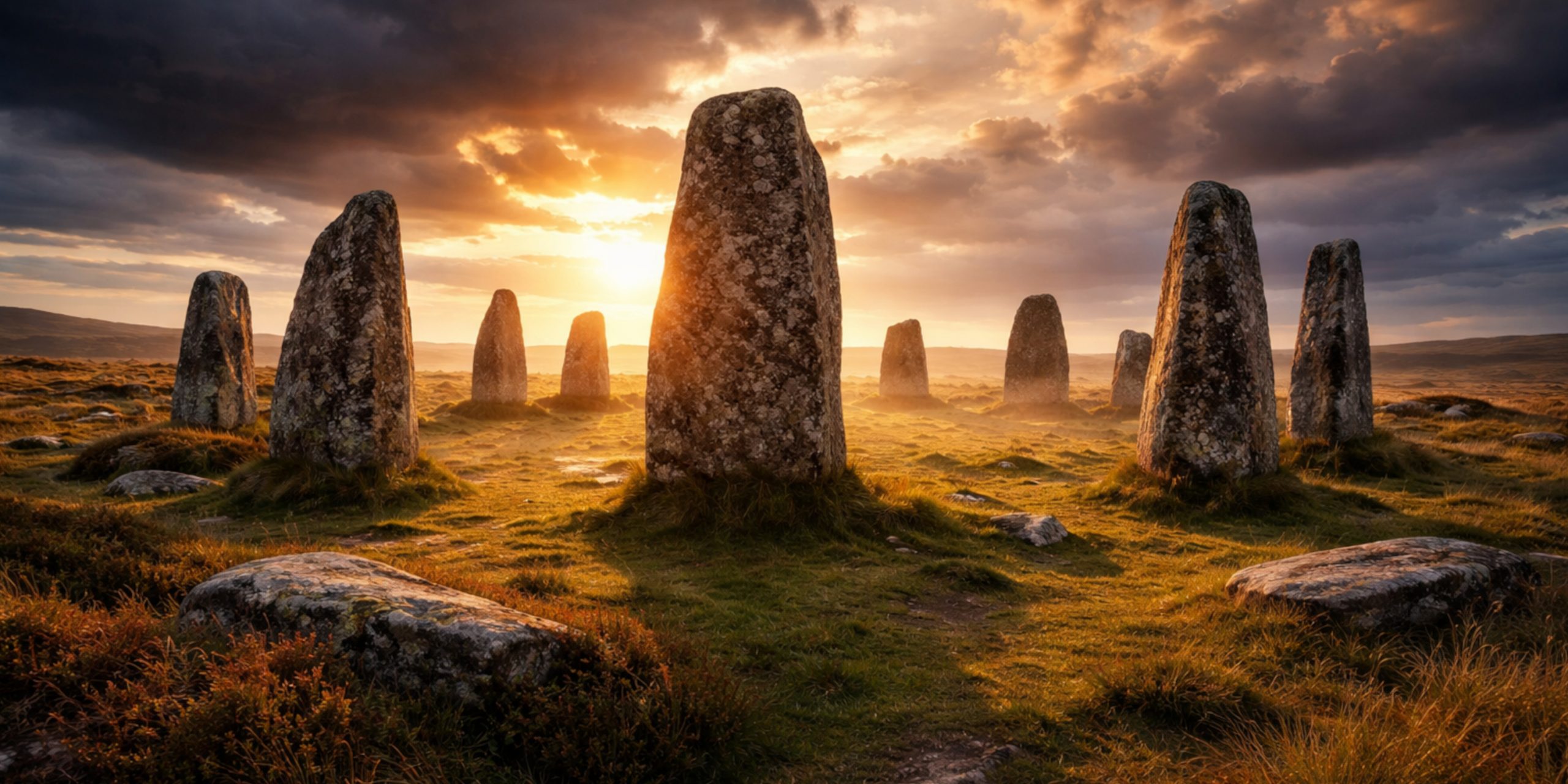
A Complete Overview of What We Know
Trying to catalogue every stone circle in the British Isles is an exercise in controlled frustration. Archaeologists currently recognise somewhere between 1,300 and 1,500 sites across Britain and Ireland, depending on how strictly a circle is defined and whether damaged or partial monuments are included. That number still shifts. Some sites are rediscovered through aerial survey and lidar. Others disappear quietly under plough soil or forestry.
What follows is a web-structured overview rather than a raw gazetteer. It explains where stone circles are found, how they vary by region, what archaeology can say with confidence, and where interpretation remains uncertain.
What Counts as a Stone Circle
Most stone circles date to the Late Neolithic and Early Bronze Age, roughly 3000 to 1500 BC. They are deliberately arranged rings or arcs of upright stones, sometimes complete, often incomplete. Some were rebuilt or altered over generations. Others were left to weather exactly as placed.
There is no single design rule. Circles range from four or five stones to vast rings enclosing whole landscapes. Some include recumbent slabs, entrance gaps, or associated cairns. Others stand alone.
What unites them is intent. These were not casual boundary markers or construction leftovers. Every stone represents labour, planning, and choice.
England
England contains several hundred known stone circles, though many survive only as partial rings or isolated uprights.
Cumbria stands out. The Lake District has one of the densest concentrations in the country, with circles often positioned to frame mountain skylines rather than celestial events. The placement feels theatrical in a restrained, deliberate way.
Wessex presents a different tradition. Monumental scale dominates here, with vast earthworks, avenues, and circles forming connected ceremonial landscapes. Some sites were repeatedly rebuilt, reshaped, and reinterpreted over centuries, suggesting long-term cultural importance rather than a single moment of construction.
Elsewhere in England, smaller circles appear in Oxfordshire, Derbyshire, Cornwall, and Devon. Many of these are closely tied to later folklore, which often preserves the memory of sacred or taboo ground long after original meanings were forgotten.
Scotland
Scotland is the true heartland of stone circles.
Aberdeenshire alone contains hundreds, including a distinctive regional type featuring a massive horizontal recumbent stone flanked by two tall uprights. These are consistently oriented toward the southern sky, often aligned with lunar standstills. The repetition suggests shared knowledge passed across generations.
Orkney represents something else entirely. Here, stone circles sit within dense ritual landscapes that include tombs, causeways, and settlement remains. Geometry, spacing, and movement through space seem carefully considered. These were not isolated monuments but parts of larger ceremonial systems.
On the western mainland and islands, circles often show long sequences of use. Timber settings, burials, and stone rings overlap, revealing continuity rather than replacement.
Wales
Wales has fewer stone circles, but placement is often precise. Many stand near ancient routeways, ridgelines, or later parish boundaries. Some stones were moved considerable distances despite the modest size of the circles, implying symbolic value beyond simple visibility.
Several Welsh sites show evidence of reuse into the Bronze Age and later periods, reinforcing the idea that these locations remained meaningful long after their original builders were gone.
Ireland
Irish stone circles are concentrated mainly in the southwest, particularly in Cork and Kerry. They tend to be smaller and more tightly dated than many British examples, pointing to a strong regional tradition rather than widespread imitation.
Solar alignments are more common here, especially toward winter sunsets. Excavations frequently reveal evidence of feasting, burning, and structured deposition. These were active social spaces, not passive markers.
Ireland’s circles feel intimate compared to the monumental scale seen in parts of Britain, but they are no less deliberate.
What Were Stone Circles For
There is no single answer, and any claim that there is should be treated with suspicion.
Archaeology shows that stone circles were used for gatherings, seasonal rituals, burial practices, and acts of remembrance. Some align with solar or lunar events. Many do not. The obsession with astronomy often overlooks evidence for social activity such as feasting, repeated fire use, and long-term revisiting.
What matters is that these places were returned to. Stones were replaced, settings adjusted, and meanings renewed. Stone circles were processes as much as structures.
Survival, Loss, and Rediscovery
A large proportion of known circles survive only in part. Agricultural clearance, stone robbing, and later building projects removed countless monuments. In some cases, medieval churches or farm boundaries incorporated stones from earlier circles.
Modern survey techniques continue to identify flattened or buried rings. Cropmarks and soil patterns hint at how many have already been lost.
Even a single surviving stone can mark the centre of a vanished monument.
Watch the documentary:
50 Most Important Stone Circles in the British Isles
Below is the same selection of 50 major stone circles, converted into a clean bullet format for web use. Ages are approximate and reflect current archaeological consensus, usually based on radiocarbon dating of associated material rather than the stones themselves.
Stonehenge
Wiltshire, England
Diameter approx. 33 m
Stones approx. 80
Date c. 3000 to 1600 BC
Avebury
Wiltshire, England
Diameter approx. 331 m
Stones approx. 100
Date c. 3000 to 2200 BC
Ring of Brodgar
Orkney, Scotland
Diameter approx. 104 m
Stones 27 surviving of around 60
Date c. 2600 to 2400 BC
Callanish I
Isle of Lewis, Scotland
Diameter approx. 13 m
Stones 13 plus central monolith and avenues
Date c. 2900 to 2600 BC
Castlerigg
Cumbria, England
Diameter approx. 32 m
Stones 38
Date c. 3200 BC
Stones of Stenness
Orkney, Scotland
Diameter approx. 44 m
Stones 4 surviving of around 12
Date c. 3100 BC
Long Meg and Her Daughters
Cumbria, England
Diameter approx. 100 m
Stones 59
Date c. 1500 BC
Machrie Moor Circle 1
Arran, Scotland
Diameter approx. 14 m
Stones 6
Date c. 2500 BC
Machrie Moor Circle 2
Arran, Scotland
Diameter approx. 18 m
Stones 8
Date c. 2500 BC
Machrie Moor Circle 3
Arran, Scotland
Diameter approx. 17 m
Stones 9
Date c. 2400 BC
Machrie Moor Circle 4
Arran, Scotland
Diameter approx. 13 m
Stones 6
Date c. 2400 BC
Rollright Stones
Oxfordshire, England
Diameter approx. 31 m
Stones 77
Date c. 2500 BC
Arbor Low
Derbyshire, England
Diameter approx. 40 m
Stones around 50 fallen
Date c. 2500 BC
Stanton Drew Great Circle
Somerset, England
Diameter approx. 113 m
Stones 27
Date c. 2500 to 2200 BC
Stanton Drew North Circle
Somerset, England
Diameter approx. 30 m
Stones 8
Date c. 2500 BC
Swinside
Cumbria, England
Diameter approx. 27 m
Stones 55
Date c. 2800 BC
Nine Ladies
Derbyshire, England
Diameter approx. 11 m
Stones 9
Date c. 2500 BC
Boscawen-ûn
Cornwall, England
Diameter approx. 25 m
Stones 19
Date c. 2500 BC
Merry Maidens
Cornwall, England
Diameter approx. 23 m
Stones 19
Date c. 2500 BC
The Hurlers North Circle
Cornwall, England
Diameter approx. 35 m
Stones 30
Date c. 1500 BC
The Hurlers Middle Circle
Cornwall, England
Diameter approx. 33 m
Stones 28
Date c. 1500 BC
The Hurlers South Circle
Cornwall, England
Diameter approx. 35 m
Stones 30
Date c. 1500 BC
Drombeg
County Cork, Ireland
Diameter approx. 9 m
Stones 17
Date c. 1100 BC
Templebryan North
County Cork, Ireland
Diameter approx. 46 m
Stones 28
Date c. 2000 to 1500 BC
Bohonagh
County Cork, Ireland
Diameter approx. 18 m
Stones 12
Date c. 1500 BC
Kenmare Stone Circle
County Kerry, Ireland
Diameter approx. 25 m
Stones 15
Date c. 2000 to 1500 BC
Grange Stone Circle
County Limerick, Ireland
Diameter approx. 46 m
Stones 113
Date c. 2000 BC
Loanhead of Daviot
Aberdeenshire, Scotland
Diameter approx. 20 m
Stones 10
Date c. 2500 BC
East Aquhorthies
Aberdeenshire, Scotland
Diameter approx. 25 m
Stones 11
Date c. 2500 BC
Tomnaverie
Aberdeenshire, Scotland
Diameter approx. 25 m
Stones 8
Date c. 2500 BC
Clava Cairns Central Ring
Inverness-shire, Scotland
Diameter approx. 21 m
Stones 11
Date c. 2500 BC
Clava Cairns Southwest Ring
Inverness-shire, Scotland
Diameter approx. 25 m
Stones 9
Date c. 2500 BC
Clava Cairns Northeast Ring
Inverness-shire, Scotland
Diameter approx. 25 m
Stones 12
Date c. 2500 BC
Sunhoney
Aberdeenshire, Scotland
Diameter approx. 20 m
Stones 8
Date c. 2500 BC
Cairn T
Orkney, Scotland
Diameter approx. 20 m
Stones 12
Date c. 2800 BC
Tregeseal East
Cornwall, England
Diameter approx. 21 m
Stones 19
Date c. 2500 BC
Tregeseal West
Cornwall, England
Diameter approx. 22 m
Stones 22
Date c. 2500 BC
Dyffryn Ardudwy
Gwynedd, Wales
Diameter approx. 16 m
Stones 12
Date c. 2000 BC
Moel Ty Uchaf
Denbighshire, Wales
Diameter approx. 12 m
Stones 10
Date c. 2000 BC
Penmaenmawr Circle
Conwy, Wales
Diameter approx. 10 m
Stones 8
Date c. 2000 BC
Stannon
Cornwall, England
Diameter approx. 42 m
Stones 47
Date c. 2500 BC
Grey Wethers North
Devon, England
Diameter approx. 33 m
Stones 20
Date c. 2500 BC
Grey Wethers South
Devon, England
Diameter approx. 33 m
Stones 20
Date c. 2500 BC
Fernworthy
Devon, England
Diameter approx. 25 m
Stones 28
Date c. 2500 BC
Temple Wood North
Argyll, Scotland
Diameter approx. 12 m
Stones 13
Date c. 3000 BC
Temple Wood South
Argyll, Scotland
Diameter approx. 12 m
Stones 12
Date c. 3000 BC
Balbirnie
Fife, Scotland
Diameter approx. 20 m
Stones 11
Date c. 3000 BC
Castle Dore Circle
Cornwall, England
Diameter approx. 38 m
Stones fragmentary
Date c. 2000 BC
The Seven Swords Takeaway
Stone circles endured in the landscape long enough to accumulate folklore, superstition, and ritual long after their original purpose faded. People avoided them, renamed them, or explained them through legend rather than erase them entirely.
That persistence may be the clearest insight we have. These were places where communities anchored memory, belief, and identity. The details differ from region to region, but the impulse remains consistent.
We may never pin down every meaning, but the effort invested across thousands of years tells us enough. These places mattered. The landscape still remembers where they stood.