The Battle of Cynwit sits slightly off the main tourist trail of early medieval warfare, which is precisely why it deserves attention. Fought in the depths of the Viking wars against Wessex, it shows how desperation, geography, and a timely lack of caution on the enemy side can change the course of a campaign. For a brief, sharp moment, the Vikings learned that even a cornered Anglo Saxon force could still bite.
Cynwit was not a set piece battle in the classical sense. It was a siege that ended badly for the besiegers, and worse for their reputation.
Historical Background
By 878, Wessex was under intense pressure. Viking armies had overrun much of Anglo Saxon England, and Alfred the Great was reduced to fighting a war of survival. One Viking force pushed deep into the south west, raiding Devon and threatening to cut off remaining resistance.
A local Anglo Saxon garrison withdrew into a fortified hill position known as Cynwit, sometimes linked to Countisbury Hill. The Vikings assumed starvation would do the work for them. They were wrong, and history has never let them forget it.
Forces
Anglo Saxon Defenders
| Element | Details |
|---|---|
| Estimated strength | 300 to 400 |
| Command | Ealdorman Odda |
| Composition | Local fyrd, household retainers |
| Position | Hillfort with limited access points |
Viking Attackers
| Element | Details |
|---|---|
| Estimated strength | 800 to 1,200 |
| Command | Ubba, possibly a son of Ragnar |
| Composition | Danish warriors, shieldwall infantry |
| Position | Encircling the hillfort |
The numbers favoured the Vikings. Terrain and morale did not.
Leaders
- Ealdorman Odda
A regional commander rather than a royal general. His decision to stay inside the fort until conditions favoured a breakout was cautious, patient, and deeply unglamorous. It worked. - Ubba
A Viking leader of formidable reputation. His confidence bordered on complacency, a recurring occupational hazard for successful raiders.
Arms and Armour
Anglo Saxon Equipment
- Swords
- Pattern welded single edged swords
- Broad bladed double edged swords influenced by Frankish designs
- Spears
- Leaf shaped iron spearheads, primary battlefield weapon
- Shields
- Round wooden shields with iron bosses
- Armour
- Limited mail shirts among wealthier warriors
- Helmets were rare but present
Viking Equipment
- Swords
- Petersen Type H and Type K swords
- Imported Frankish blades, highly prized
- Axes
- Bearded axes for close combat
- Spears
- Heavily used in shieldwall fighting
- Armour
- Mail shirts common among veteran warriors
- Conical helmets with nasal guards
The irony is hard to miss. The better equipped army lost because equipment alone does not win battles.
The Battle Timeline
- Early 878
Viking force advances into Devon and traps an Anglo Saxon garrison at Cynwit. - Days of siege
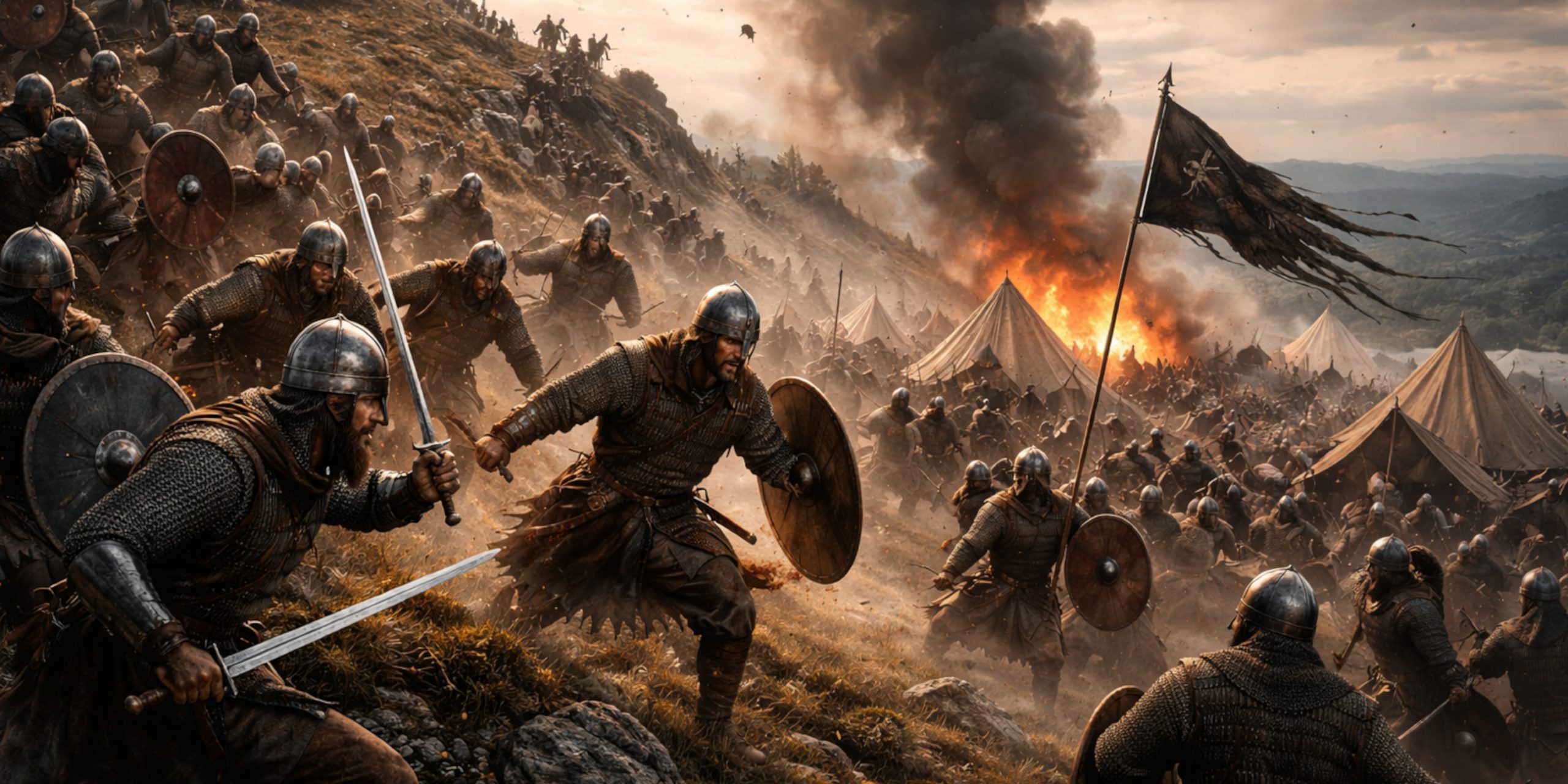
Vikings choose not to storm the hillfort, expecting hunger to force surrender. - Night assault
Anglo Saxons launch a sudden downhill attack, using darkness and surprise. - Collapse of Viking camp
Ubba is killed. Viking lines break rapidly. - Aftermath
Survivors flee to their ships. The Raven banner is captured.
The entire engagement may have lasted less than an hour. It was decisive nonetheless.
Archaeology
Cynwit itself has not yielded dramatic battlefield archaeology, which is frustrating but not unusual for early medieval sites. What supports the historical account is the strategic logic of Countisbury Hill, with its steep slopes and commanding views.
No mass graves have been identified, and weapon finds are sparse. This absence is often used to question the battle’s scale, though it aligns with a swift rout rather than prolonged fighting. Archaeology does not contradict the sources, it simply refuses to be theatrical.
Contemporary Quotes
The Anglo Saxon Chronicle records the outcome with notable satisfaction:
“The ealdorman fought against them, and there was made great slaughter, and Ubba was slain.”
The restraint is telling. When medieval chroniclers are this brief, it usually means the point has already been made.
Significance and Legacy
Cynwit did not end the Viking threat. It did something subtler and arguably more important. It proved that Viking armies could be beaten without a king present, without a grand alliance, and without divine intervention spelled out in capital letters.
For Alfred, it bought time. For the local population, it bought hope. For the Vikings, it delivered a sharp lesson in overconfidence.
There is also a quiet humour to Cynwit. The Vikings chose not to attack because they felt safe. They died because they felt safe. History has always had a fondness for that kind of irony.
Watch the documentary: