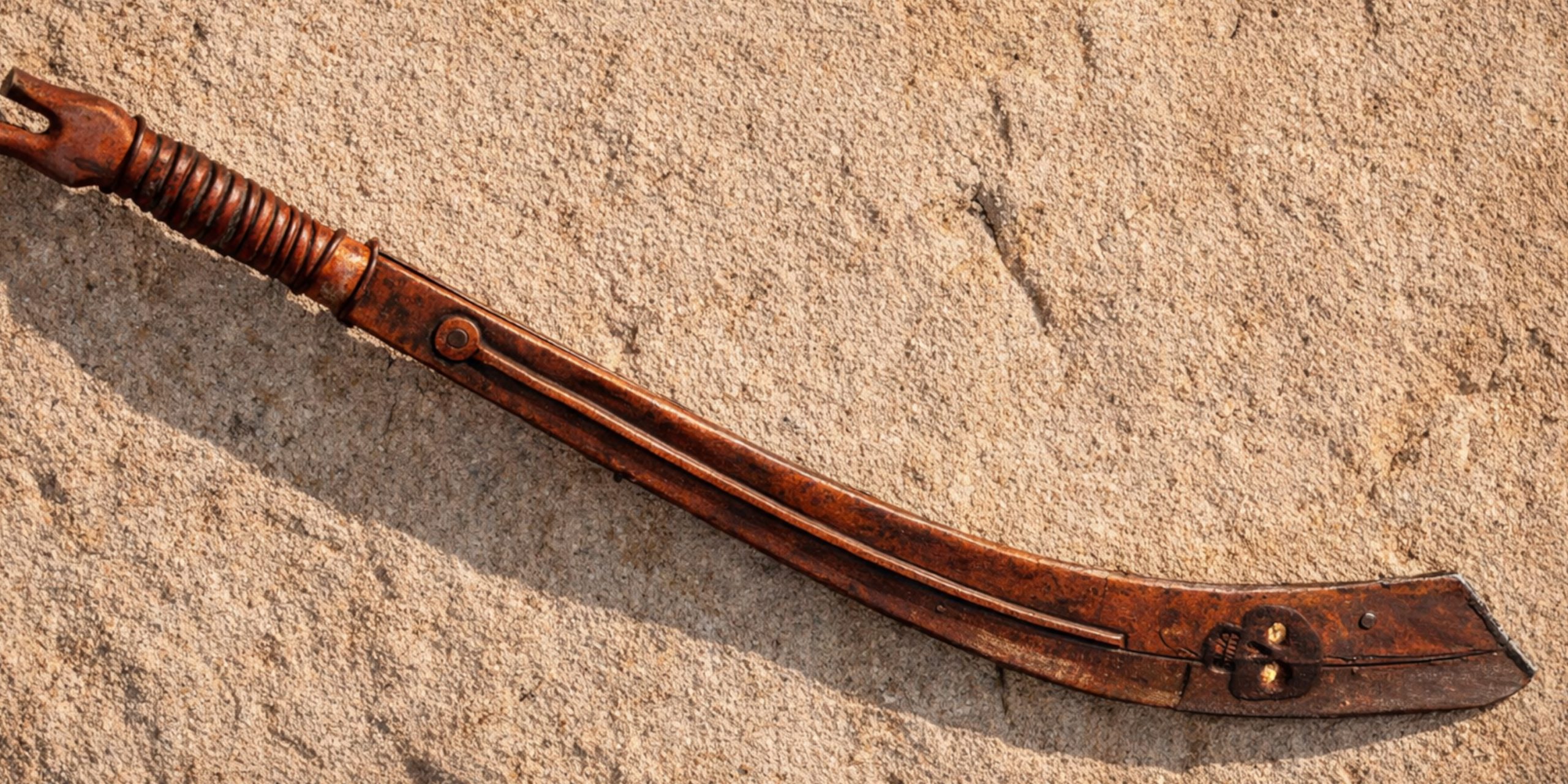
What is often described as an “Iroquois war club sword variant” is a Haudenosaunee war club, most commonly the gunstock form, fitted with a metal cutting or thrusting blade. It remains fundamentally a club, built for impact and close fighting, but the addition of a blade turns it into a hybrid weapon capable of cutting, hooking, and limited thrusting. These bladed clubs are well documented across the Eastern Woodlands and Great Lakes during the historic period and survive today in major museum collections.
Specifications
Bladed war clubs were not standardised weapons. They were individually made and adapted, often using whatever trade blades or materials were available. Even so, recurring characteristics allow a general technical profile.
Typical dimensions and materials
| Feature | Typical range | Notes |
|---|---|---|
| Overall length | c. 50 to 80 cm | Compact enough for woodland combat and raids |
| Weight | c. 1 to 1.5 kg | Balanced for heavy blows without rapid fatigue |
| Wood | Dense hardwood | Commonly maple, ash, oak, or hickory |
| Blade material | Iron or steel | Usually repurposed trade blades or simple forged inserts |
| Blade mounting | Slotted and pinned | Often reinforced with resin, lead, or pewter |
| Decoration | Incising, pigment, tacks | Red pigment and carved designs are common on period pieces |
Common blade configurations
- Side mounted blade at the elbow, used for slashing or hooking in close quarters
- Triangular or spear like blade near the head, favouring thrusting attacks
- Multi blade constructions, rare and usually associated with Plains cultures rather than Iroquois examples
History and evolution
Indigenous club traditions
Among the Haudenosaunee, clubs were long established as primary fighting weapons rather than secondary tools. Their effectiveness in close combat, raids, and ambushes made them central to warfare in wooded terrain.
Adoption of metal blades
With the arrival of European trade goods, iron and steel offered new possibilities. Instead of replacing the club with a sword, many warriors enhanced a familiar weapon by adding a blade. The result combined impact trauma with cutting capability, without sacrificing durability or handling.
The gunstock form
The gunstock shape is closely associated with the 18th and 19th centuries in the Eastern Woodlands and Great Lakes. Whether inspired by firearms or developed independently, the shape provides leverage, a hooked striking profile, and a convenient location for mounting a blade.
Advantages and disadvantages
Advantages
- Severe impact trauma even without reliance on the blade
- Hybrid capability combining blunt force with cutting or hooking actions
- Effective in confined spaces and grappling range
- Robust construction compared with dedicated swords
- Strong psychological presence in close combat
Disadvantages
- Short reach compared with spears or long bladed weapons
- Forward weighted handling limits rapid changes of direction
- Blade mounts are vulnerable to cracking, loosening, or corrosion over time
Comparison with similar weapons
| Weapon | Strengths | Where the sword club excels |
|---|---|---|
| Ball headed war club | Simplicity and pure impact | Adds cutting and hooking potential |
| Tomahawk | Reach, penetration, tool use | Greater mass and stopping power |
| Trade knife | Speed and ease of carry | More decisive trauma on contact |
| Short sword | Reach and sustained fencing | Superior durability and effectiveness in cramped terrain |
Legacy
The bladed war club occupies a distinctive place in North American arms history. It reflects cultural continuity, practical adaptation, and the selective integration of foreign materials into Indigenous weapon traditions. Today, these weapons are studied as artefacts of warfare, craftsmanship, and cross cultural exchange, rather than curiosities or novelties.
Where to see examples
Authentic bladed war clubs can be found in major public collections and specialist Indigenous museums, particularly those holding Eastern Woodlands and Great Lakes material. These institutions provide contextual interpretation that goes beyond simple display, focusing on cultural meaning as well as construction and use.
Collector’s guide, including auction prices
Collecting Indigenous weapons requires careful attention to legality, provenance, and ethics. Documentation and transparency matter as much as condition.
Factors affecting value
- Clear provenance and collection history
- Credible tribal attribution
- Early date and original surface patina
- Integrity of blade and mounting
- Quality of carving, pigment, or decorative work
- Absence of major cracks or modern repairs
Condition issues to watch for
- Cracks radiating from the blade slot
- Corrosion staining around metal fittings
- Loose or replaced blades
- Heavy varnishing or modern surface treatments
Typical auction price ranges
| Category | Description | Approximate range |
|---|---|---|
| Entry level | Later examples with simpler form | £800 to £2,500 |
| Mid range | Well made pieces with good attribution | £3,000 to £8,000 |
| High end | Exceptional carving and strong provenance | £10,000 and above |
| Market outliers | Rare or famous examples | Significantly higher, sometimes six figures |
Prices vary widely, and attribution or provenance issues can halve or double value overnight.
Practical buying advice
- Prioritise documentation over dramatic appearance
- Treat vague labels with caution
- Request detailed images of blade seating and repairs
- If the story outweighs the object, the price probably reflects that