Macbeth mac Findláich ruled Scotland from 1040 to 1057. History remembers him in the long shadow cast by Shakespeare, yet the man himself was a capable ruler shaped by kinship politics, frontier warfare, and a hard northern landscape that rewarded pragmatism over poetry. When the sources are read carefully, a steadier figure emerges: a king who held power for nearly two decades, travelled abroad as a recognised monarch, and governed during a period of relative stability by early medieval standards.
Origins and Rise to Power
Macbeth was born around 1005 into the ruling elite of Moray, a region that often stood apart from southern Scotland both culturally and politically. His father, Findláech mac Ruaidrí, was Mormaer of Moray and descended from the Cenél Loairn, giving Macbeth a legitimate royal lineage. This matters. Scottish kingship in the eleventh century was elective within a royal kin group, not strictly hereditary. Macbeth was not an interloper but a credible candidate.
The killing of King Duncan I in 1040, traditionally framed as murder, should be read through the lens of contemporary warfare. Duncan led a failed campaign against Moray and was killed in battle near Elgin. Macbeth’s accession followed accepted custom. From a historian’s point of view, this is less a crime scene and more a political transition decided by force of arms.
Kingship and Rule
Macbeth’s reign lasted seventeen years, unusually long for the period. Contemporary Irish annals describe him as a strong king, and crucially, not as a tyrant. One of the clearest indicators of legitimacy is his pilgrimage to Rome in 1050, where he reportedly distributed alms to the poor. A usurper clinging desperately to power does not usually travel abroad for pious display.
Internally, his rule appears stable. There is little evidence of widespread rebellion until the later years, when external pressure from England intensified. As a ruler, Macbeth seems to have balanced the interests of Moray and the southern lowlands, no small feat in a kingdom that was more a patchwork of regions than a unified state.
Arms and Armour
Macbeth’s military world was shaped by both Gaelic and Norse traditions. Scotland in the eleventh century sat at a cultural crossroads, and its warriors reflected that blend.
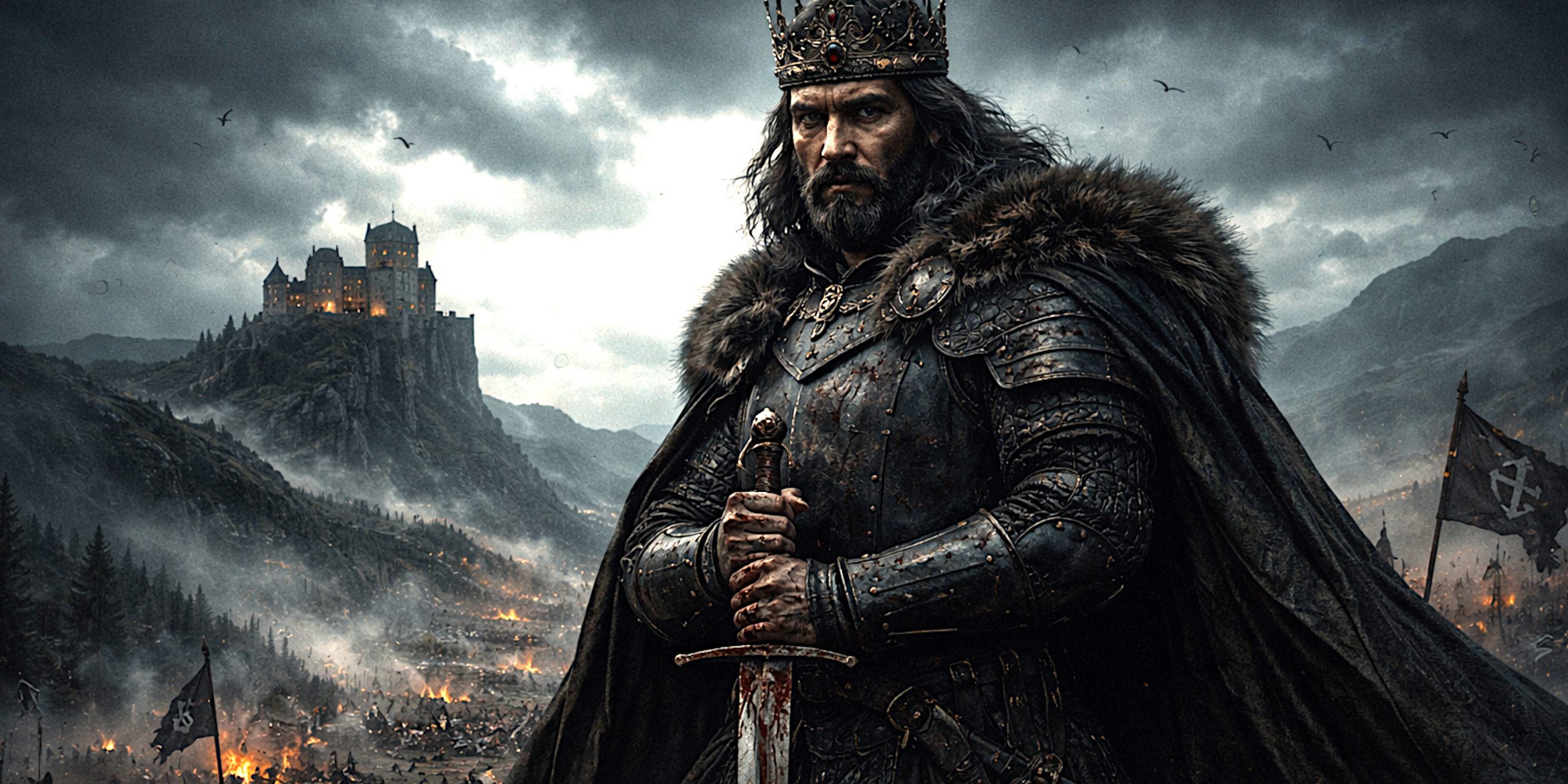
The core weapon was the spear, used both for thrusting in close formations and for throwing. Swords were status weapons, often pattern welded blades inherited or imported, likely of Scandinavian origin. These were not uniform army issue pieces but personal weapons with real symbolic weight. A king’s sword mattered.
Defensive equipment was limited but effective. Wealthier warriors, including Macbeth and his household troops, likely wore chainmail hauberks and conical helmets with nasal guards. Shields were round, wooden, and bossed, used actively rather than passively. Armour was expensive and repairable, which explains its patchy distribution.
This was not the age of massed plate or drilled infantry. Battles were decided by leadership, cohesion, and the ability to hold ground when lines met.
Battles and Military Acumen
Macbeth proved himself first as a regional war leader in Moray. His victory over Duncan suggests not just bravery but planning. Defeating a reigning king in open conflict required allies, preparation, and local support.
Later conflicts were more complex. Duncan’s son Malcolm Canmore found refuge at the English court, and by the 1050s England, under Edward the Confessor, had a growing interest in Scottish succession. In 1054, Siward, Earl of Northumbria, invaded Scotland in support of Malcolm. Macbeth was defeated but not destroyed. He retained the kingship for three more years, which speaks volumes about his resilience and the loyalty he commanded.
His final defeat came in 1057 at Lumphanan, where Malcolm killed him in battle. Even then, the transition was not immediate. Macbeth’s stepson Lulach succeeded briefly, showing that Macbeth’s line still held enough authority to matter.
From a military perspective, Macbeth was no reckless butcher. He fought when needed, withdrew when required, and held power through competence rather than fear. That alone sets him apart from the caricature.
Death and Reputation
Macbeth’s death in battle was an accepted end for a warrior king. What followed was the slow reshaping of his image. Later Scottish chroniclers, writing under the descendants of Malcolm III, had little incentive to praise a rival dynasty. Shakespeare inherited that hostile tradition and amplified it for drama.
As historians, we should resist the temptation to replace one myth with another. Macbeth was not a benevolent reformer king out of modern sensibility, but neither was he a blood soaked madman. He was a product of his time, and by the standards of that time, a successful ruler.
Artefacts and Where to See Them
No personal artefacts can be definitively linked to Macbeth, a common frustration when dealing with early medieval figures. However, material culture from his world survives.
The National Museum of Scotland in Edinburgh holds eleventh century weapons, jewellery, and carved stones that reflect the elite culture Macbeth inhabited. These objects, though anonymous, are closer to the historical Macbeth than any stage dagger.
Dunsinane Hill in Perthshire, long associated with his stronghold, has been the subject of archaeological study. Excavations have revealed fortified occupation predating Shakespeare’s imagined castle, supporting the idea of a high status centre used by regional rulers. It may not have been Macbeth’s residence, but it belonged to his political landscape.
In Moray, place names and burial sites point to a dense network of early medieval power centres. Archaeology here continues to refine our understanding of how northern Scotland was governed and defended during Macbeth’s lifetime.
Latest Archaeology and Historical Reassessment
Recent scholarship has focused less on individual villains and more on systems of power. Archaeological work in Moray and Perthshire highlights continuity rather than chaos, suggesting that Scotland in Macbeth’s era was more organised than once assumed.
Reassessment of annalistic sources has also softened earlier judgements. Irish chroniclers, often more detached from Scottish dynastic politics, provide a useful counterbalance and portray Macbeth as a legitimate and capable king.
As someone who has spent years watching medieval figures flattened by later storytelling, I find Macbeth’s case oddly reassuring. The record reminds us that history is rarely tidy, and that competence often leaves fewer traces than catastrophe.
A Historian’s Closing Thought
Macbeth does not need rescuing by modern sentiment, nor does he deserve perpetual condemnation for crimes shaped by fiction. Strip away the witches and blood stained soliloquies, and what remains is a ruler who understood power, fought for it, and held it longer than most of his peers. In eleventh century Scotland, that was achievement enough.
Watch the real Macbeth: