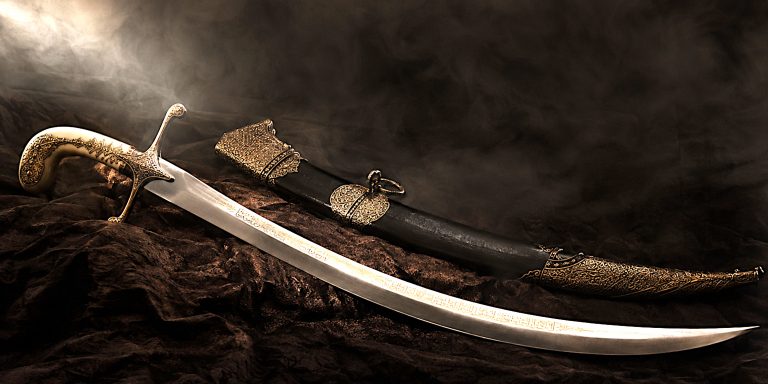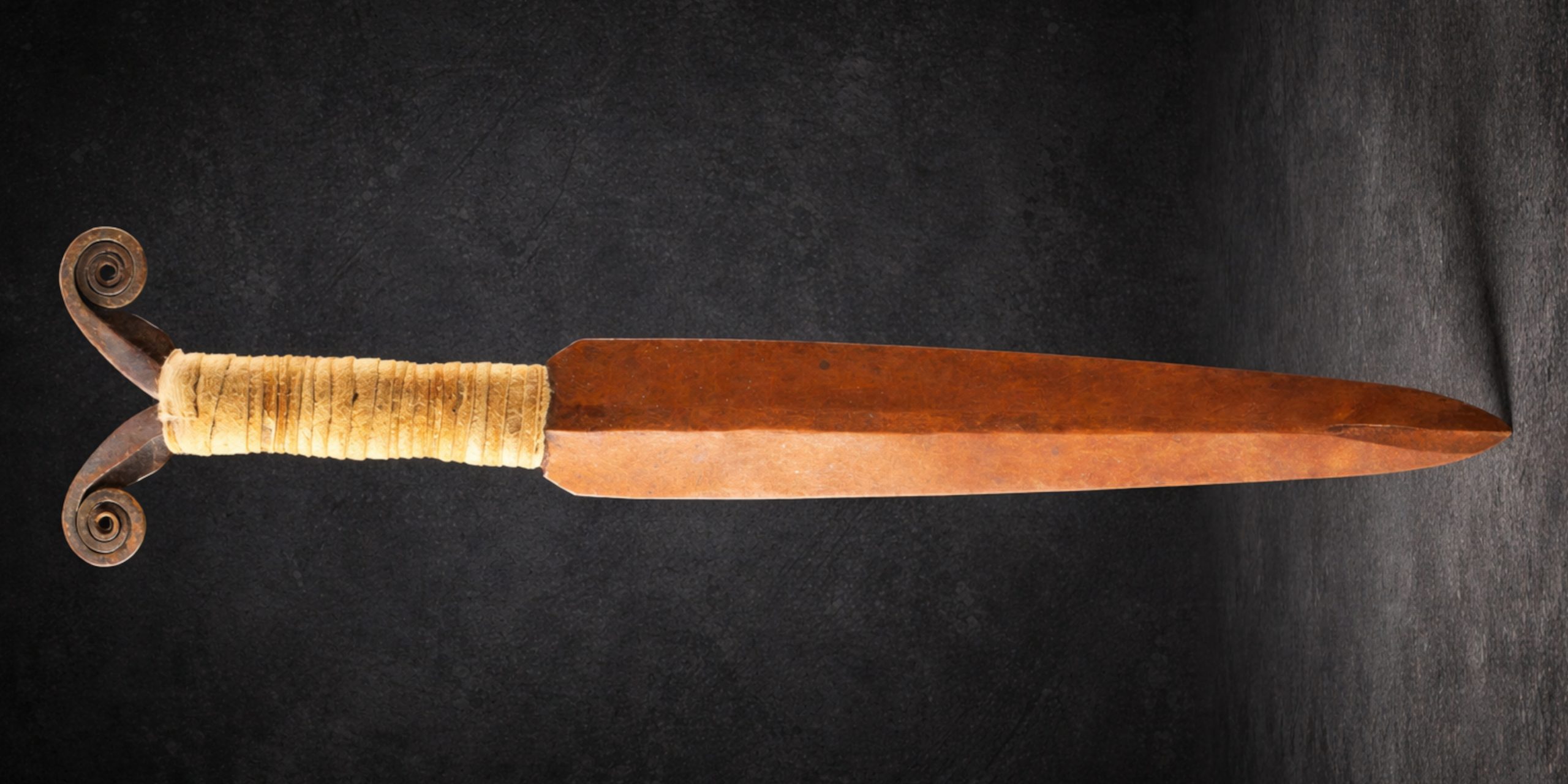
The so called Tlingit copper sword is better understood as a long bladed copper dagger or knife rather than a true sword in the European sense. Among the Tlingit peoples of the Pacific Northwest Coast, native copper carried immense social and spiritual weight. Blades made from it were statements of status, wealth, and ancestral authority first, practical weapons second. Their presence in ceremony, gift exchange, and elite display mattered as much as any cutting edge.
Specifications
Typical examples vary widely due to hand manufacture and regional style.
General characteristics
- Form: Long dagger or knife, occasionally described as sword like due to length
- Blade material: Native copper, often cold hammered
- Construction: Single piece or copper blade hafted into a wooden handle
- Edge: Soft cutting edge, capable of slicing but not optimised for heavy combat
- Decoration: Incised lines, repoussé work, clan motifs in some ceremonial pieces
Approximate dimensions
| Feature | Range |
|---|---|
| Overall length | 35 to 60 cm |
| Blade width | 4 to 7 cm |
| Thickness | 3 to 6 mm |
| Weight | 500 to 1200 g |
History and Evolution
Copper use among the Tlingit predates sustained European contact. Native copper sources in Alaska and the Yukon were traded widely and worked with stone tools long before iron arrived. Early blades were utilitarian knives, but by the eighteenth century copper objects had become deeply tied to rank and lineage.
With Russian and later American contact, iron and steel replaced copper for everyday tools and fighting weapons. Copper blades shifted firmly into ceremonial and prestige roles. Longer forms emerged for display, sometimes described by collectors as swords despite their traditional classification as daggers.
Advantages and Disadvantages
Advantages
- High symbolic and social value within Tlingit culture
- Corrosion resistant compared to iron in coastal environments
- Easily worked by cold hammering and annealing
- Visually striking with warm colour and patina
Disadvantages
- Softer than iron or steel, edges deform quickly
- Limited effectiveness against armour or bone
- Heavy for its cutting ability
- Unsuitable for prolonged combat use
Comparison With Similar Weapons
Copper blades appear across several Northwest Coast cultures, though meanings differ.
| Weapon | Culture | Key Difference |
|---|---|---|
| Copper dagger | Tlingit | Strong clan and prestige symbolism |
| Copper knife | Haida | Often smaller, more refined engraving |
| Copper blade | Tsimshian | More frequent ceremonial use |
| Iron trade dagger | Northwest Coast | Superior cutting performance, lower status value |
Compared to iron trade daggers, copper blades sacrificed performance for meaning. That trade off was intentional.
Legacy
The Tlingit copper blade stands as a reminder that weapons are not always designed around battlefield efficiency. These objects communicated wealth, lineage, and authority in societies where public display and gift exchange shaped power. Today they are studied as both weapons and artworks, inseparable from Tlingit social structure.
Where to See Tlingit Copper Blades
Authentic examples are held in major museum collections.
- Alaska State Museum, Juneau
- Smithsonian National Museum of the American Indian, Washington DC
- American Museum of Natural History, New York
- Royal BC Museum, Victoria
Many pieces are displayed alongside ceremonial regalia rather than arms and armour, reflecting their cultural role.
Collector’s Guide and Auction Prices
Original Tlingit copper blades are rare and tightly regulated.
What collectors should know
- Provenance is essential and often determines legality
- Many pieces are protected cultural property
- Condition issues such as cracks and edge deformation are common
- Reproductions are widespread and often poorly labelled
Recent market ranges
| Type | Typical Price Range |
|---|---|
| Small copper knife | £3,000 to £7,000 |
| Long ceremonial blade | £8,000 to £18,000 |
| Museum quality example | £20,000 plus |
Prices vary sharply based on documentation, age, and tribal attribution. Pieces with clear nineteenth century provenance command the highest interest.