Scottish schiltron infantry sit at the heart of medieval Scotland’s military reputation. They were not glamorous cavalry or chivalric heroes, but disciplined foot soldiers who learned how to make horses stop, panic, and die. For a brief but important window, the schiltron turned the imbalance between English cavalry and Scottish manpower into something close to fairness. As a historian, I find them quietly revolutionary. No banners of romance, just sharp sticks, bad weather, and stubborn men who refused to move.
What Is a Schiltron?
The schiltron was a dense infantry formation built around long spears. The word itself comes from Old Scots, meaning a shield troop or tight formation. Early schiltrons were largely static, planted like hedgehogs in the ground. Later versions became mobile, capable of advancing and wheeling while keeping their defensive shell intact.
At its core, the schiltron was about discipline rather than individual skill. Men trained to hold position even when faced with charging knights. That alone was unusual in an age when infantry often broke at the sight of armoured horses.
Tactical Role on the Battlefield
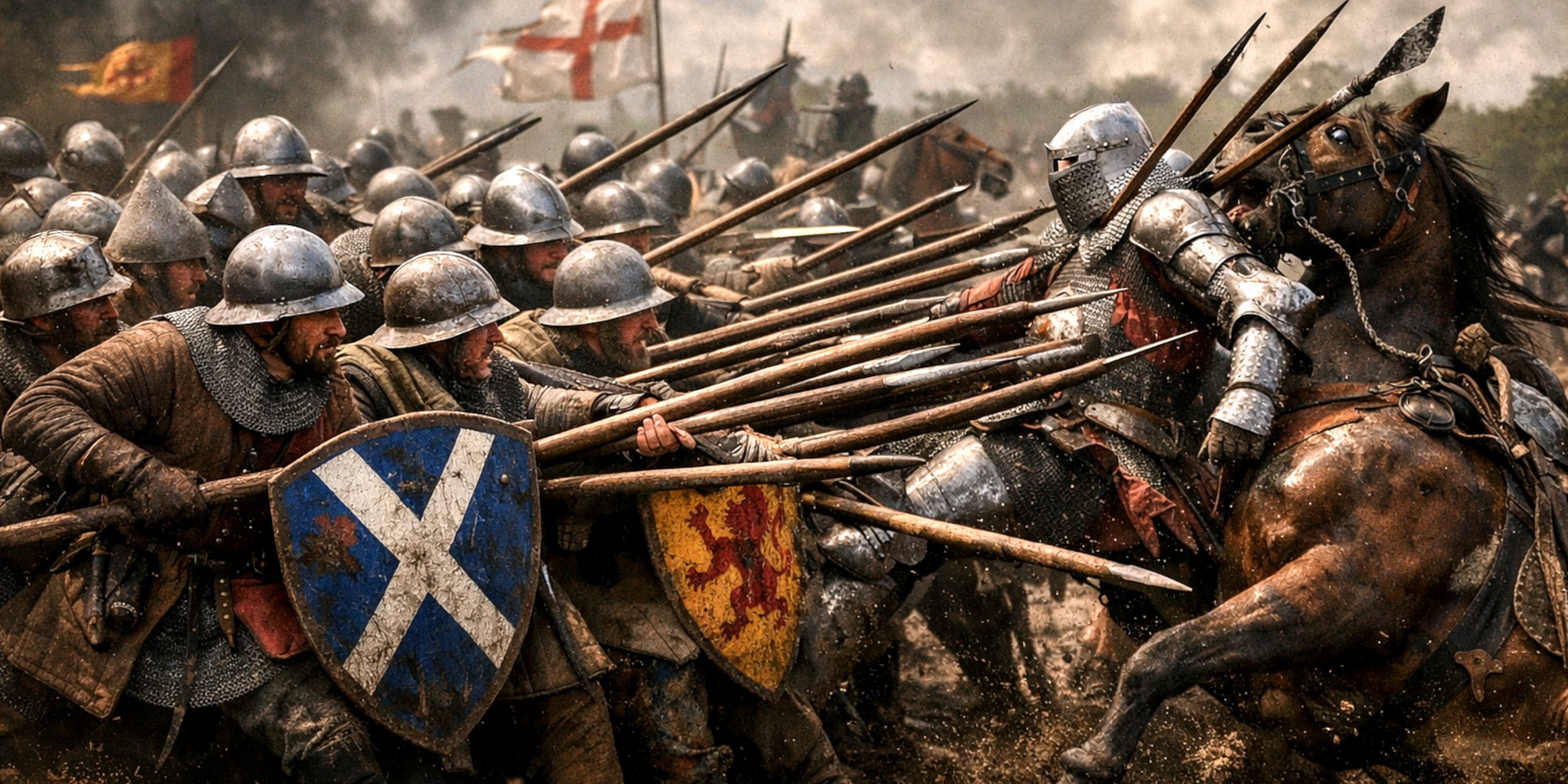
Schiltrons were designed to neutralise cavalry. Spears angled outward created a forest of points that horses would not willingly enter. English commanders learned this the hard way.
At Falkirk in 1298, William Wallace used static schiltrons effectively at first. They held firm against cavalry but lacked protection against sustained missile fire. English longbowmen eventually shredded the formations. Lesson learned, painfully.
By Bannockburn in 1314, Robert the Bruce refined the concept. His schiltrons were trained to move, advance, and exploit terrain. The result was catastrophic for English cavalry. Watching mounted knights bog down in mud while being prodded to death by farmers with spears must have been an unsettling moment for medieval notions of warfare.
Arms and Armour of Schiltron Infantry
Schiltron equipment reflected Scotland’s economy and geography. Practical, locally made, and brutally effective.
Primary weapons
- Long spear, typically 12 to 15 feet, ash shaft with iron head
- Lochaber axe in some regions, particularly later periods
- Short stabbing spears for close defence if the formation broke
Swords
- Single edged arming swords, often locally forged
- Falchions appear in limited numbers, especially among better equipped men
- Short seaxes or long knives carried as secondary weapons
Defensive equipment
- Wooden shields, round or kite shaped, though not universal
- Padded aketons or gambesons
- Mail shirts for wealthier infantry
- Simple iron helmets, including cervellières and early kettle hats
The lack of uniformity mattered less than cohesion. A schiltron did not need every man armoured like a knight. It needed everyone to stand still and trust the man next to them.
Training and Discipline
Contrary to popular myth, schiltron infantry were not an untrained mob. Surviving accounts suggest organised drilling, especially under Bruce. Holding formation under pressure required practice and leadership.
It also required morale. These men knew they would not outrun cavalry. The only option was forward or death. Dry humour creeps in here because the alternative was to cry.
Archaeology and Physical Evidence
Direct archaeological evidence for schiltrons is sparse, as one might expect from wooden shafts and iron points reused after battle. Still, the ground tells its own story.
- Bannockburn’s terrain shows clear choke points and marshy ground consistent with contemporary descriptions
- Spearheads and arrowheads recovered in the Stirling area support accounts of dense infantry and missile engagement
- Graves from the Wars of Independence often show trauma consistent with close formation fighting, including thrust wounds rather than slashing blows
Battlefields like Falkirk and Bannockburn continue to be reassessed through landscape archaeology, confirming that terrain choice was not accidental. Bruce was no romantic warrior king blundering into battle. He was a planner.
Contemporary Quotes
English chroniclers were often reluctant to praise Scottish infantry, which makes their admissions all the more telling.
An English account of Bannockburn notes that the Scots advanced “like a thick wood of spears, from which no horse might escape.”
John Barbour, writing in The Brus, describes the schiltrons as moving “all in a fair array, so close and strong that nought might pierce them.”
Neither source sounds impressed, which is exactly the point.
Strengths and Weaknesses
Schiltrons excelled against cavalry and in confined or broken terrain. They struggled in open ground when unsupported by missile troops. Against longbow fire, even the bravest formation had limits.
Their success depended on leadership, discipline, and timing. Used well, they reshaped medieval warfare in Britain. Used poorly, they became static targets.
Legacy and Historical Significance
The schiltron marked a shift in how infantry were perceived. They proved that foot soldiers, properly organised, could dominate the battlefield. This idea would echo across Europe in later centuries, from Flemish pikemen to Swiss halberdiers.
Scotland’s schiltron was not just a tactic. It was a statement. Landed knights were not invincible. Sometimes all it took was a long spear, a muddy field, and a refusal to budge.
Watch the documentary: